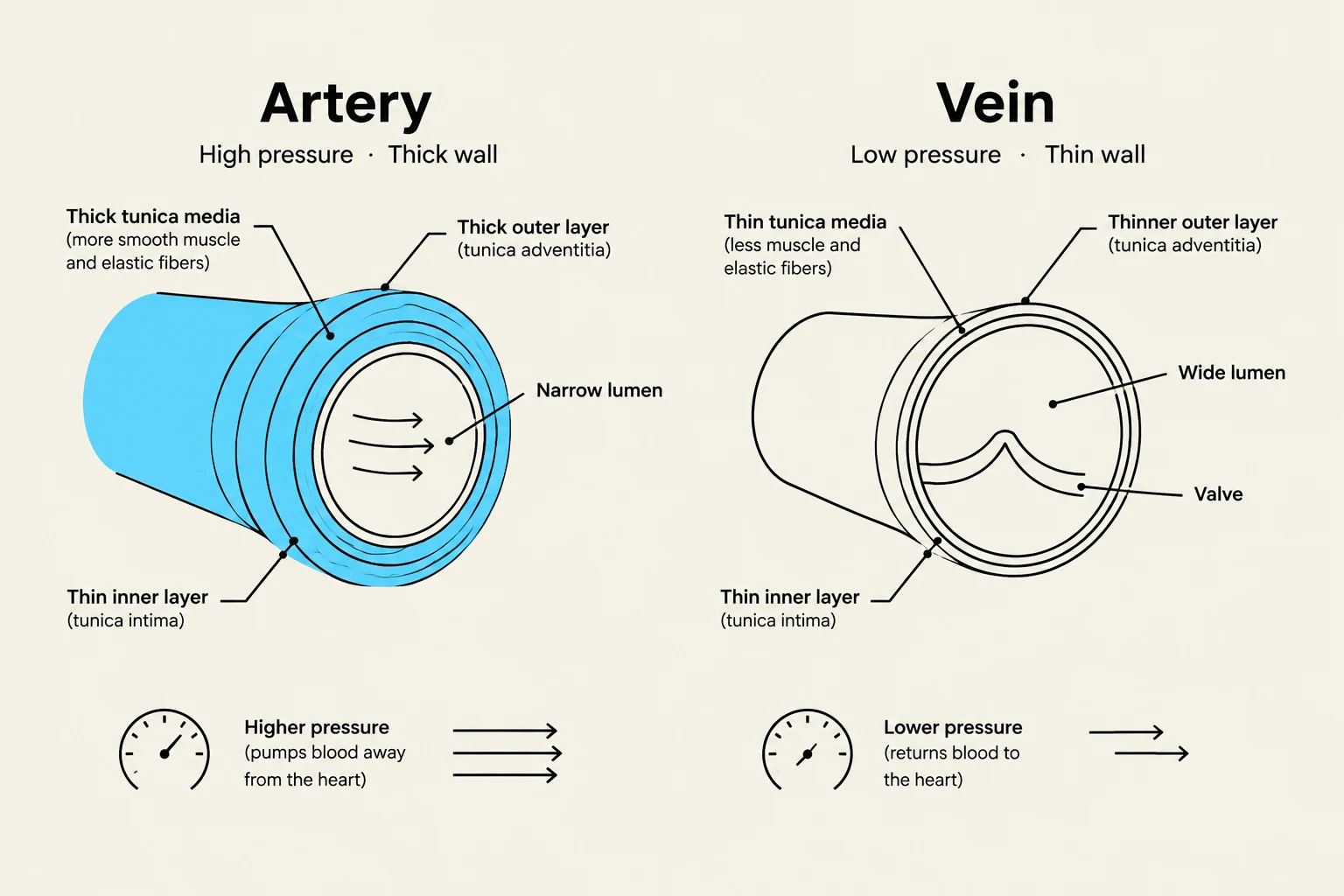
Hemodynamics and Poiseuille's Law
To understand how blood moves, we must look at fluid dynamics. The relationship between flow, pressure, and resistance is mathematically described by Poiseuille's law. The flow (F) is directly proportional to the pressure difference (ΔP) and inversely proportional to the resistance (R):
F=RΔP
Vascular resistance is a critical factor in determining how much blood reaches a specific tissue. Resistance is heavily influenced by the diameter of the vessel, particularly within the arterioles, which act as the primary "gatekeepers" of blood flow.
Capillary Exchange: Starling Forces
At the capillary level, the movement of fluid is not merely passive; it is governed by a delicate balance of two opposing pressures known as Starling forces:
- Capillary Hydrostatic Pressure (CHP): The physical pressure exerted by the blood against the vessel wall, which tends to push fluid out of the capillary into the interstitial space.
- Colloid-Osmotic Pressure (COP): Also known as oncotic pressure, this is exerted by plasma proteins (like albumin) that stay inside the vessel, creating an osmotic pull that draws fluid into the capillary.
The net movement of fluid is determined by the difference between these pressures. If the lymphatic system fails to clear the unabsorbed interstitial fluid, clinical edema (swelling) occurs.
Blood Pressure Regulation
Mean Arterial Pressure (MAP) is the critical indicator of adequate tissue perfusion. It represents the average pressure in a patient's arteries during one cardiac cycle and can be calculated using the following formula:
MAP=Diastolic Pressure+3Pulse Pressure
The body employs three primary mechanisms to regulate this pressure:
- The Heart: Adjusts cardiac output by modifying heart rate and stroke volume.
- The Kidneys: Manage long-term blood volume through the renin system, which influences sodium and water reabsorption.
- The Blood Vessels: Control resistance through vasoconstriction (narrowing) and vasodilation (widening).
Short-term vs. Long-term Regulation
Short-term regulation is primarily mediated by the baroreflex. When you stand up quickly, gravity causes venous pooling in the lower limbs, which reduces venous return and cardiac output. This can lead to orthostatic hypotension (a sudden drop in blood pressure). In response, baroreceptors detect the drop and trigger an increase in sympathetic tone, causing vasoconstriction and increased heart rate to restore MAP.
In contrast, long-term regulation is more hormonal and involves the kidneys. For example, the renin-angiotensin system can increase blood volume and systemic resistance over hours or days.
Local Autoregulation
Tissues also possess the ability to control their own perfusion through local autoregulation. This is achieved through the balance of chemical signals:
- Metabolic Vasodilators: When a tissue is hypoxic (low O2) or has high metabolic activity, it releases substances like Nitric Oxide ($NO$), CO2, $H^+$, and adenosine. These relax the smooth muscle in the vessel walls, causing vasodilation to increase blood supply. The enzyme endothelial nitric oxide synthase (eNOS) plays a key role in producing $NO$ to facilitate this relaxation.
- Vasoconstrictors: Substances like endothelin-1 (ET-1) act to constrict vessels, reducing flow.
Hemostasis and Thrombosis
The cardiovascular system must maintain a perfect balance between hemostasis (preventing blood loss) and preventing thrombosis (unwanted blood clotting).
Hemostasis occurs in stages:
- Vasoconstriction: Reducing blood flow to the site of injury.
- Platelet Plug Formation: Platelets adhere to exposed collagen and aggregate to form a temporary seal.
- Coagulation (Secondary Hemostasis): A cascade of factors leads to the conversion of fibrinogen into an insoluble fibrin mesh, which stabilizes the clot.
The healthy endothelium (the inner lining of blood vessels) is actively anti-thrombotic. It releases substances like Nitric Oxide and Prostacyclin to prevent platelets from sticking unnecessarily. If this balance is disrupted, a thrombus (blood clot) can form within the circulation, potentially obstructing blood flow.
Exam Tip: The Baroreflex
Remember that the baroreflex is a negative feedback loop. If blood pressure drops (e.g., due to orthostatic hypotension), the reflex increases sympathetic activity to raise the pressure back to the set point.