


Breathing, scientifically known as ventilation, is the essential process of moving air into and out of the bronchial tree and the microscopic alveoli. This movement is not merely a passive flow of air but a highly regulated mechanical process that allows the body to acquire oxygen for energy production and expel carbon dioxide, a metabolic waste product. This continuous process is organized into a respiratory cycle, which consists of one inspiration (inhalation) and one expiration (exhalation).
The Physics of Ventilation: Boyle's Law
To understand how air moves, we must look at the relationship between pressure and volume. The driving force behind breathing is the pressure gradient between the atmosphere and the lungs. At sea level, the atmospheric pressure is standardized at .
The mechanism of ventilation is governed by Boyle's Law, which states that the pressure and volume of a gas are inversely proportional. In a closed system, if the volume of a container increases, the pressure of the gas inside decreases, and vice versa.
This principle is applied to the thoracic cavity to create the pressure changes necessary to move air.
The Mechanics of Inspiration
Inspiration is the phase of the respiratory cycle where air enters the lungs. For air to rush into the airways, the intra-alveolar pressure (the pressure inside the lung's air sacs) must drop below the atmospheric pressure.
Normal, Resting Inspiration
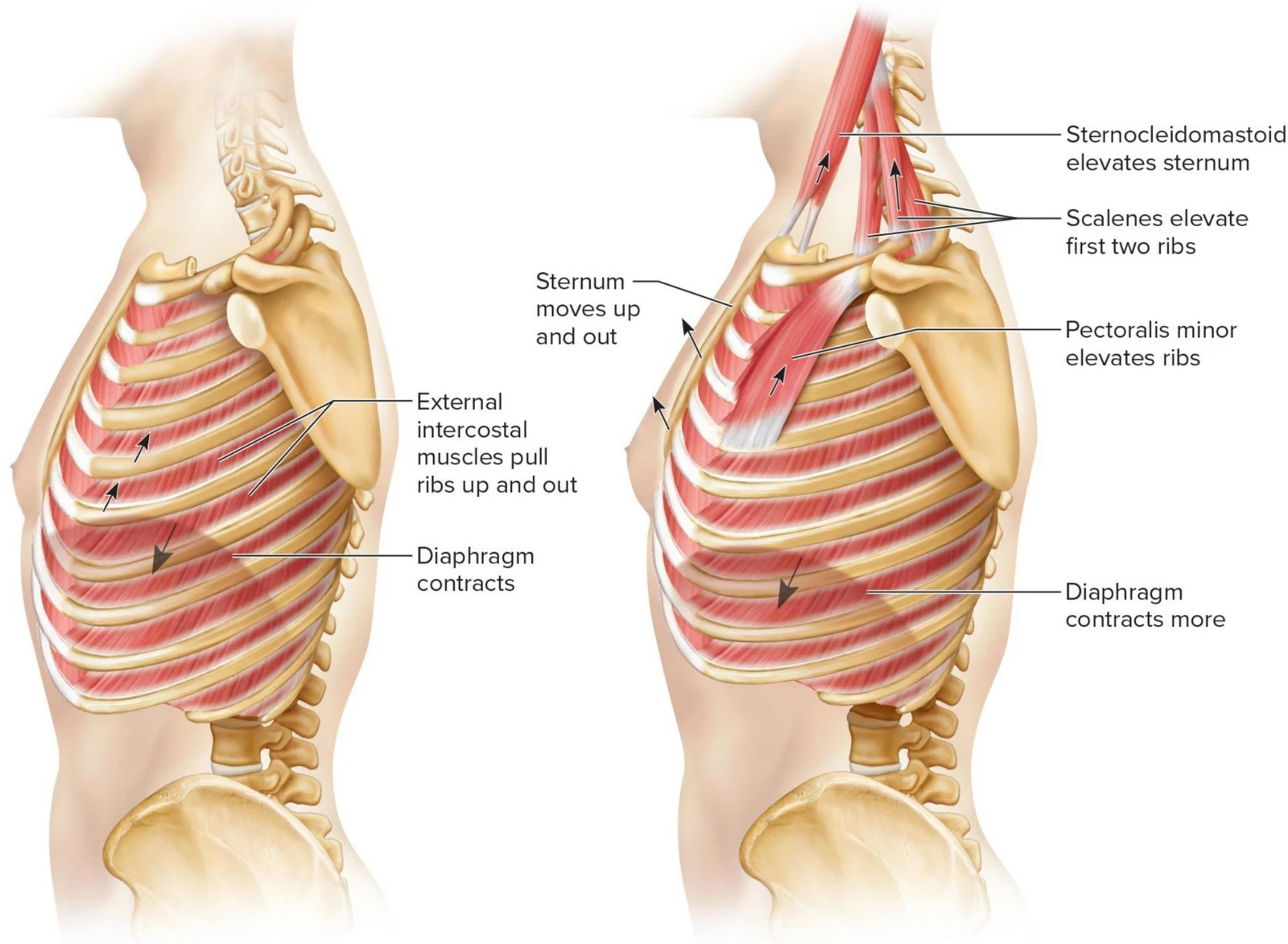
During normal, quiet breathing, the process is driven by the contraction of specific muscles:
- The Diaphragm: Stimulated by the phrenic nerves, the diaphragm contracts and moves downward, increasing the vertical dimension of the thoracic cavity.
- External Intercostal Muscles: These muscles contract to lift the ribs up and out, expanding the thoracic cavity laterally and anteriorly.

Keep reading for free.
Create an account to finish this reading and make it part of your study routine.
Continue reading freeAlready have an account? Log in
Updated