An overview of the human brain's organization into hindbrain, midbrain, and forebrain, detailing their respective roles in vital functions, sensory processing, and complex cognition, including the cerebral cortex, lobes, and limbic system.
The human brain is a complex organ that serves as the command center for the entire body. It is organized into three primary structural divisions: the hindbrain, the midbrain, and the forebrain. These regions work in concert to manage everything from basic life-sustaining functions, like breathing, to high-level cognitive processes, such as memory, emotion, and reasoning.
The Hindbrain: Managing Vital Life Functions
Located at the very top of the spinal cord, the hindbrain is responsible for some of the most fundamental survival mechanisms. It consists of three key structures:
The Medulla: This structure controls vital autonomic functions that keep us alive, such as heart rate and breathing.
The Pons: Often referred to as a "bridge," the pons serves as the primary connection between the cerebellum and the rest of the brain.
The Cerebellum: Traditionally known for coordinating movement and balance, recent research has also identified its roles in sensory integration and cognitive functions.
Exam Tip: If a question asks about the consequences of cerebellar damage, remember that it can impair more than just physical balance; it can also affect spatial reasoning and the ability to discriminate between different sounds.
The Midbrain: Sensory Relay and Coordination
The midbrain acts as a middle layer between the hindbrain and the forebrain. While smaller than the other divisions, it plays a critical role in processing sensory input and coordinating motor responses. Its primary functions include:
Eye Movement: Coordinating precise and rapid eye movements.
Auditory Processing: Relaying auditory information from the ears up to the forebrain for higher-level interpretation.
Pain Regulation: Playing a role in regulating how we experience pain.
The Forebrain: The Seat of Complex Cognition
The forebrain is the most expansive part of the brain, surrounding both the midbrain and the hindbrain. It is the center for complex thought, sensory perception, and emotional life. The anatomy of the forebrain is divided into the cerebral cortex and various subcortical structures.
The Cerebral Cortex and the Four Lobes
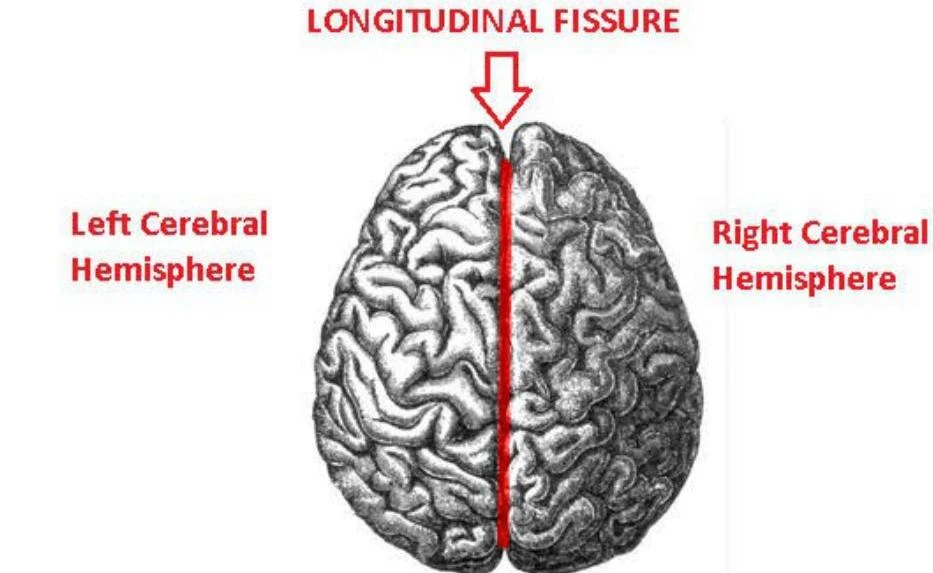
The cerebral cortex is a thin sheet of tissue that covers the outer surface of the forebrain. It is divided into two roughly symmetrical halves, known as the left and right cerebral hemispheres, which are separated by a deep groove called the longitudinal fissure.
Diagram illustrating the longitudinal fissure separating the left and right cerebral hemispheres of the brain.
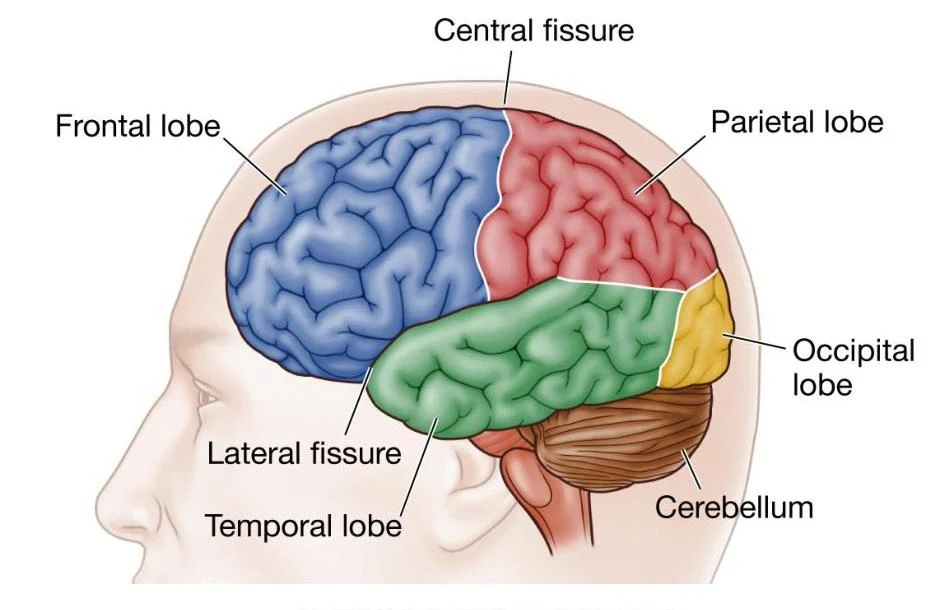
The cortex is further organized into four distinct lobes, each specialized for different types of processing: the frontal, parietal, temporal, and occipital lobes.
Diagram of the human brain showing different lobes and the cerebellum.
Subcortical Structures and the Limbic System
Deep within the forebrain lie the subcortical structures, which are essential for regulating biological needs and emotional states.
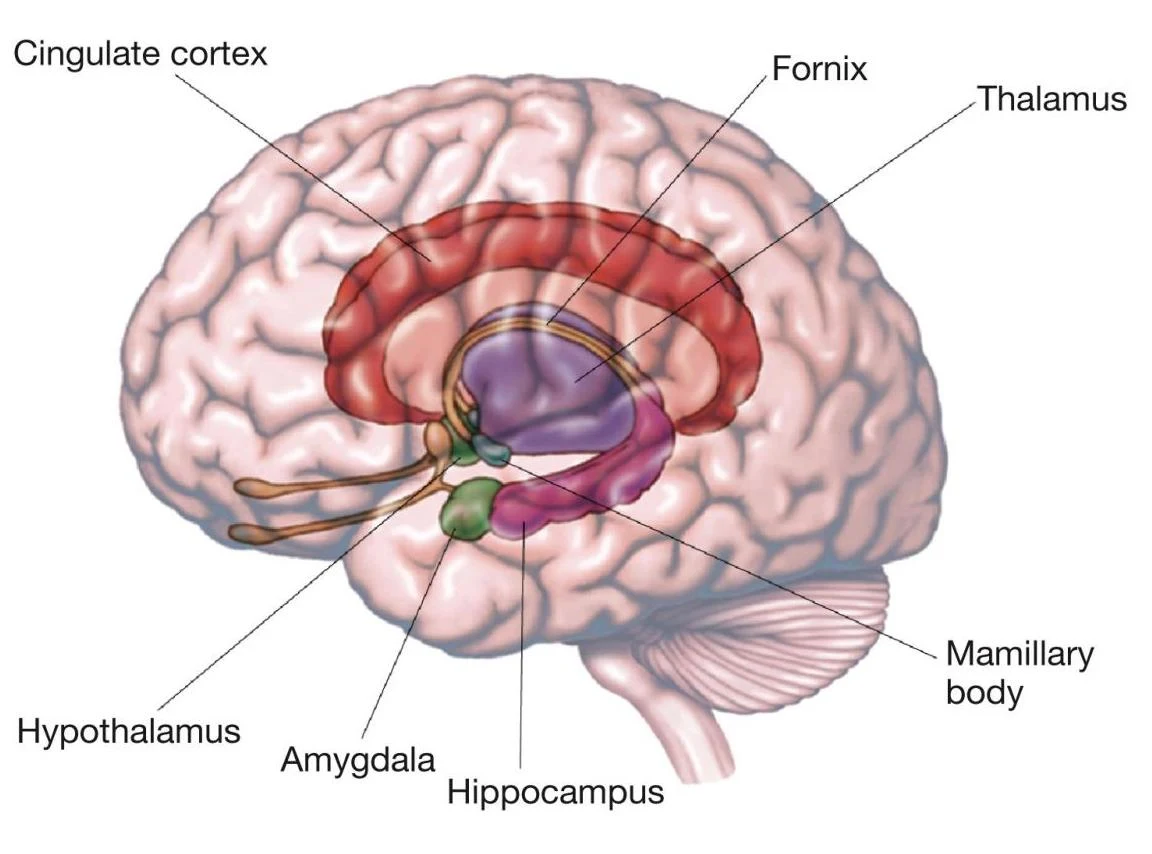
One of the most important subcortical components is the limbic system, which is crucial for learning, memory, and emotional processing. Key parts of this system include:
The Amygdala: Acts as an "emotional evaluator," helping to process emotions and support feelings of familiarity.
The Hippocampus: Plays a central role in learning and the formation of memories.
Other vital subcortical structures include the thalamus, which acts as a relay station for nearly all sensory information traveling to the cortex, and the hypothalamus, which regulates biological drives such as hunger, thirst, and sexual activity.
Diagram of the human brain highlighting key structures such as the cingulate cortex, fornix, thalamus, hypothalamus, amygdala, hippocampus, and mamillary body.
Brain Lateralization and Contralateral Responsibility
While many brain structures appear bilaterally (meaning they exist in both the left and right hemispheres), the brain exhibits a phenomenon known as lateralization. This means that the two hemispheres often specialize in different types of tasks.
Contralateral Control
The hemispheres maintain contralateral responsibilities, meaning the left hemisphere is responsible for controlling the right side of the body, and the right hemisphere controls the left side.
Hemispheric Specialization
Research involving "split-brain" patients—individuals whose connection between the hemispheres has been severed—has provided deep insights into these specializations:
The Left Hemisphere: Generally associated with language capacities.
The Right Hemisphere: Crucial for tasks involving spatial judgment.
The two hemispheres communicate through thick bundles of fibers called commissures, the largest and most important of which is the corpus callosum.
Worked Example: The Split-Brain Visual Test
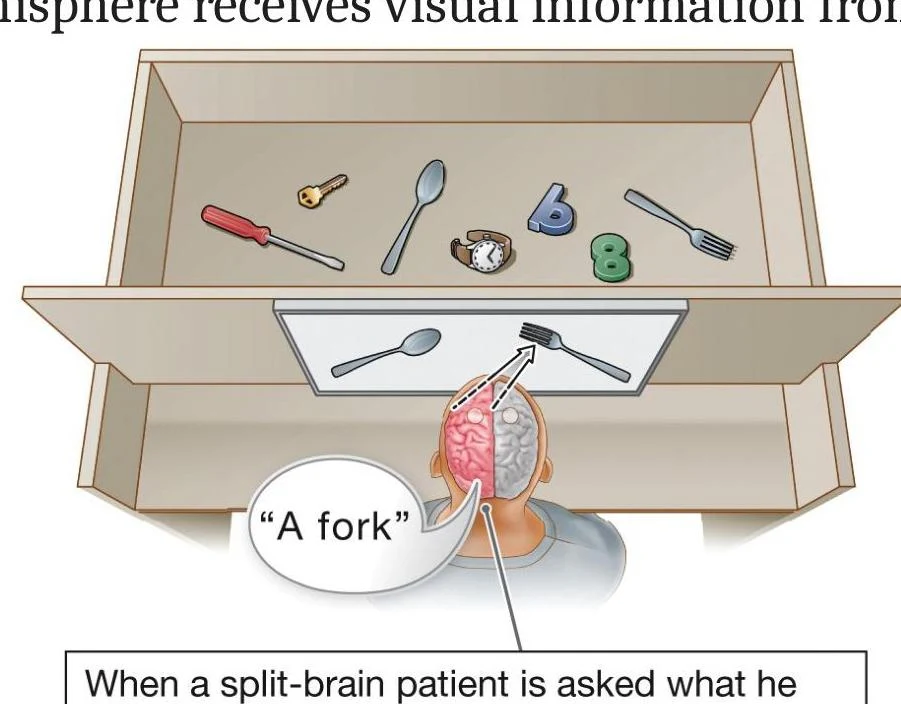
Imagine a split-brain patient is shown a picture of a fork in their right visual field. Because the right visual field is processed by the left hemisphere, and the left hemisphere controls speech, the patient can verbally say, "I see a fork". However, if asked to pick up the object with their left hand (which is controlled by the right hemisphere), they might pick up a spoon instead, because the right hemisphere "saw" the spoon in the left visual field but cannot communicate that information verbally to the left hemisphere.
Diagram illustrating how visual information is processed in a split-brain patient, showing the left hemisphere receiving input from the right visual field and verbalizing "A fork" when presented with an object in that field.
Illustration depicting how the right hemisphere of the brain processes visual information, specifically showing the perception of a spoon.
Keep reading for free.
Create an account to finish this reading and make it part of your study routine.