Host Defenses and Blood Components: An Educational Overview
Explore the fundamental components of blood, including plasma and formed elements, and understand the process of hematopoiesis. Learn about the classification and functions of leukocytes (granulocytes and agranulocytes), the mononuclear phagocyte system, and the crucial role of cytokines in mediating immune responses.
Understanding the immune system requires a clear grasp of the medium through which it travels: the blood. Blood is not merely a transport fluid; it is a complex suspension of specialized cells and proteins that serve as the primary vehicle for host defense. This article explores the composition of blood, the origins of immune cells, the specialized roles of various leukocytes, and the chemical messengers that coordinate the body's response to invasion.
Hematopoiesis and Blood Composition
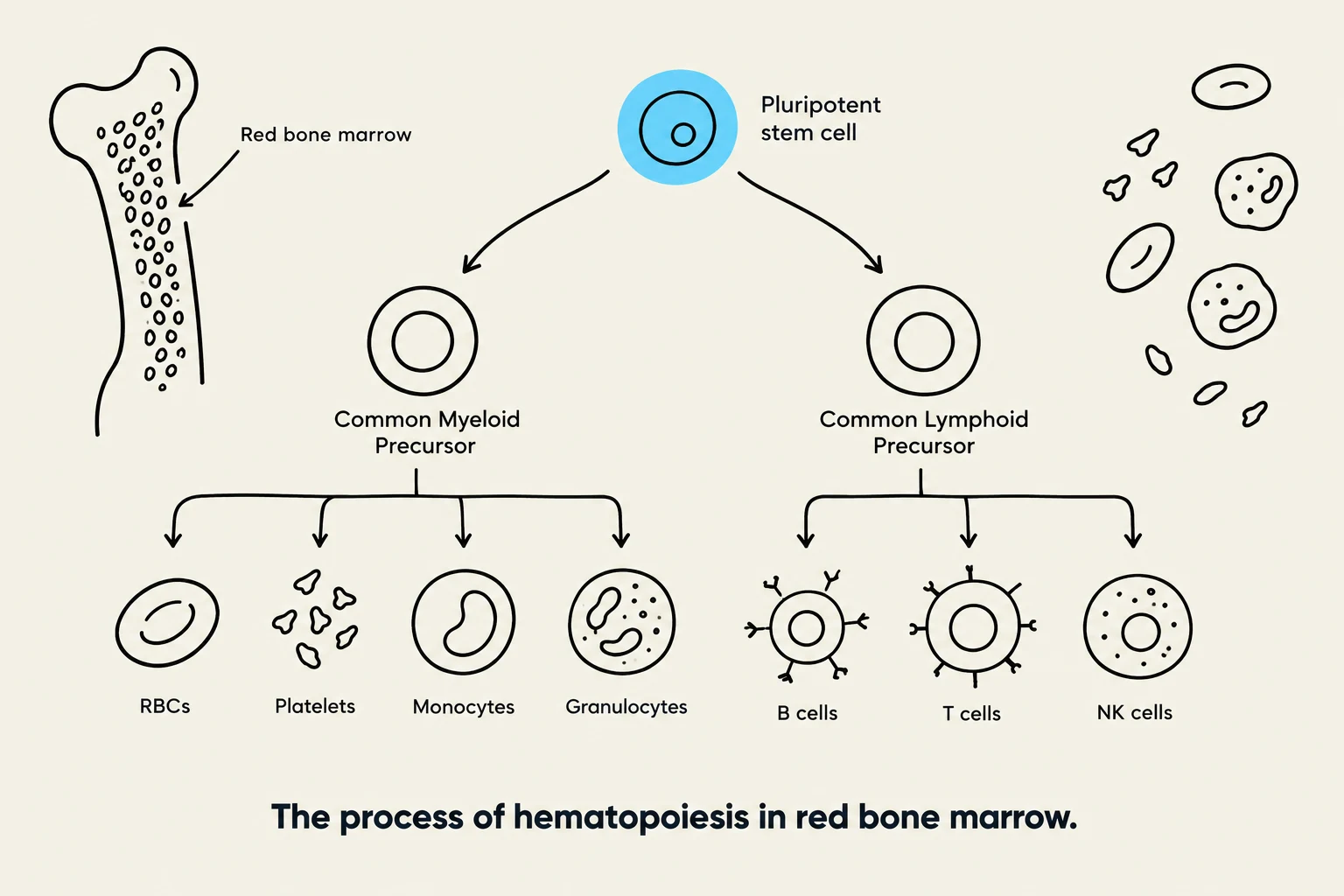
The process of hematopoiesis in red bone marrow.
Blood is composed of two main parts: plasma, a clear, yellowish fluid, and formed elements. While plasma carries nutrients, hormones, and clotting factors, the formed elements include red blood cells (RBCs), platelets, and white blood cells (WBCs/leukocytes).
The production of these cells is a highly regulated process known as hematopoiesis. This process occurs in the red bone marrow, where pluripotent stem cells serve as the ancestors of all blood lineages. These stem cells differentiate into two primary pathways:
Common Myeloid Precursor: Gives rise to platelets, RBCs, monocytes, and granulocytes (neutrophils, eosinophils, basophils, and mast cells).
Common Lymphoid Precursor: Gives rise to lymphocytes (B cells, T cells, and NK cells) and other innate lymphoid cells.
Exam Tip: The "B" and "T" Rule
To remember where lymphocytes mature, remember: B cells mature in the Bone marrow, while T cells mature in the Thymus.
Leukocyte Classification: Granulocytes vs. Agranulocytes
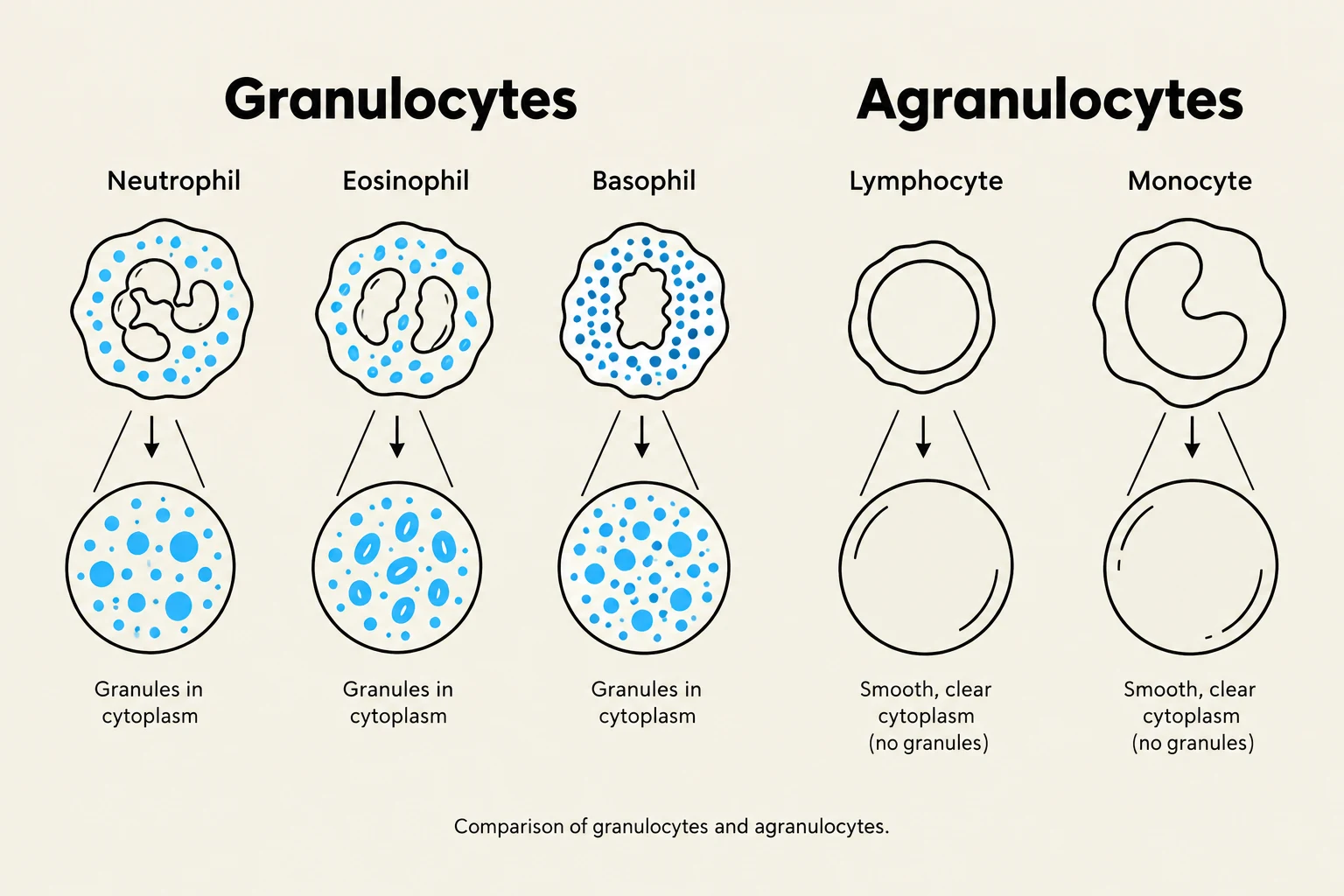
Comparison of granulocytes and agranulocytes.
White blood cells, or leukocytes, are the primary actors in the immune response. They are categorized into two groups based on the presence of visible granules in their cytoplasm.
Granulocytes
Granulocytes are characterized by their specialized granules containing enzymes and inflammatory mediators.
Neutrophils: The most abundant WBC (55–90% of total WBCs). They are professional phagocytes that ingest microbes using digestive enzymes. An elevated neutrophil count, known as neutrophilia, is a classic clinical sign of bacterial infection.
Eosinophils: Making up 1–3% of WBCs, these cells specialize in attacking parasitic worms and are heavily involved in allergic responses.
Basophils: These are the least common granulocytes (0.5%) and release histamine and prostaglandins to mediate inflammation and allergy.
Mast Cells: While functionally similar to basophils, mast cells do not circulate in the blood; instead, they reside in the tissues.
Agranulocytes
Agranulocytes lack prominent granules and include cells essential for both innate and adaptive immunity.
Lymphocytes: These are the cornerstones of specific (acquired) immunity. They are divided into three main types:
B cells: Responsible for humoral immunity by producing antibodies.
T cells: Responsible for cell-mediated immunity, modulating immune functions and directly killing foreign cells.
Natural Killer (NK) cells: Part of the innate immunity system, they target and kill cells infected by viruses or those that have become cancerous.
Monocytes: The largest of the WBCs, characterized by a kidney-shaped nucleus. They circulate in the blood before migrating into tissues to undergo a "glow-up" into more specialized cells.
The Mononuclear Phagocyte System (MPS) and Histiocytes
Diagram illustrating the differentiation of monocytes into tissue-resident macrophages, showing their movement from a blood vessel through the endothelium into connective tissue.
When monocytes leave the bloodstream and enter the connective tissues, they differentiate into two specialized roles: macrophages or dendritic cells. Macrophages are larger, live longer, and possess more lysosomes than neutrophils; they are also vital for processing antigens to present to B and T cells. Dendritic cells primarily function to trap pathogens.
The collective network of these phagocytic cells within the connective tissue is known as the Mononuclear Phagocyte System (MPS). Within this system, certain macrophages become permanent residents in specific tissues, known as histiocytes.
Histiocyte Type
Location
Mnemonic/Role
Kupffer cells
Liver
"Keeps the liver clean"
Alveolar macrophages
Lungs
"Air"
Langerhans cells
Skin
"Layer of skin"
Microglia
Brain
"Mind"
Cytokines: The Language of Immunity
Cellular communication is mediated by cytokines, which are small proteins produced by various cells (including WBCs, fibroblasts, and endothelial cells) to regulate, stimulate, or suppress immune responses.
Functional Categories of Cytokines
Pro-inflammatory Cytokines: These "hype up" the immune response. For example, Interleukin-1 (IL-1) is a major pro-inflammatory cytokine that encourages immune activity and induces fever.
Anti-inflammatory Cytokines: These act as the "chill pill" to prevent excessive tissue damage. Interleukin-10 (IL-10) is a primary example that suppresses immune responses.
Growth Factors: These drive the production of new cells. Interleukin-7 (IL-7) is essential for the development of B and T lymphocytes, while Erythropoietin stimulates the production of red blood cells (erythrocytes).
Vasoactive Substances: These alter the diameter and permeability of blood vessels to facilitate immune cell movement. Histamine (released by mast cells and basophils) acts as a vasodilator, while serotonin also influences vessel permeability.
Quick Summary for Review
IL-1: Pro-inflammatory (Fever)
IL-10: Anti-inflammatory (Suppression)
IL-7: Lymphocyte growth
Erythropoietin: RBC production
Keep reading for free.
Create an account to finish this reading and make it part of your study routine.