While the nervous system provides rapid, millisecond-to-millisecond control over our actions, the endocrine system provides a slower, more systemic, and long-lasting influence on our bodies. Hormones are chemical messengers secreted by cells that travel through the bloodstream to act on specific targets in distant parts of the body. Together, the neural and hormonal systems form a complex, reciprocal loop where experience influences hormones, hormones influence behavior, and behavior, in turn, influences future hormonal states.
The Endocrine System vs. Exocrine Glands
To understand how hormones work, we must first distinguish between the two primary ways glands secrete fluids. Exocrine glands use ducts to release substances like sweat, saliva, or tears onto body surfaces or into cavities. In contrast, endocrine glands are ductless; they secrete hormones directly into the bloodstream to reach their targets.
Major endocrine structures include the thyroid (regulating metabolism), the pancreas (regulating glucose), the adrenal glands (managing stress and arousal), and the gonads (testes and ovaries, which regulate reproduction).
The Master Integrator: The Hypothalamus
The hypothalamus is considered the "master integrator" of the body. It bridges the gap between the nervous system and the endocrine system by utilizing neuroendocrine cells—specialized neurons that convert electrical signals into hormonal signals.
The hypothalamus operates via two distinct modes:
Neural/Homeostatic Control: Rapid, targeted responses for functions like hunger, thirst, temperature, and sleep-wake cycles.
Neuroendocrine Control: Slower, systemic control over growth, reproduction, and stress through endocrine cascades.
Modes of Chemical Communication
Chemicals do not only travel through the blood. Depending on the distance and the target, communication can take several forms:
Endocrine: Hormones are released into the bloodstream to reach distant tissues.
Neurocrine (synaptic): Chemicals diffuse across a synapse between neurons.
Autocrine: The released chemical acts on the same cell that secreted it.
Paracrine: The chemical diffuses to affect nearby target cells.
Pheromones: Chemical signals released into the environment to communicate between individuals of the same species.
Allomones: Chemicals released by one species to affect the behavior of a different species.
Classification by Chemical Structure
The way a hormone behaves depends heavily on its chemical structure. There are three main categories:
1. Peptide Hormones
These are chains of amino acids. Because they are relatively large and often polar, they cannot pass through the fatty cell membrane. Instead, they bind to extracellular receptors on the cell surface. This binding triggers second messenger systems—such as cAMP, cGMP, or IP₃—which carry the signal into the cell to change its function rapidly.
2. Amine Hormones
These are derived from a single amino acid, typically tyrosine or tryptophan. Examples include thyroxine (from the thyroid) and melatonin (from the pineal gland).
3. Steroid Hormones
Derived from cholesterol, these hormones are highly lipophilic (fat-soluble). This allows them to pass directly through the cell membrane to interact with receptors inside the cell. They act through two distinct mechanisms:
Genomic Mechanisms: The hormone-receptor complex binds to DNA, acting as a transcription factor to control gene expression. This process is slow but produces long-lasting effects.
Nongenomic Mechanisms: Some steroids, like estradiol and testosterone, can trigger rapid effects via membrane-associated receptors, independent of immediate gene transcription.
Exam Tip: If a question asks about the speed of action, remember: Peptide/Amine hormones acting via second messengers are generally fast, while genomic steroid actions are slow and long-lasting.
The Pituitary Gland: The Master Gland
The pituitary gland (or hypophysis) is attached to the hypothalamus by the pituitary stalk (infundibulum). It is divided into two distinct lobes that function differently:
The Posterior Pituitary (Neurohypophysis)
This lobe is an extension of the hypothalamus. It does not synthesize its own hormones; instead, it stores and releases peptide hormones (like oxytocin and vasopressin) that were produced in the hypothalamus and transported down axons.
Oxytocin: Involved in uterine contraction, milk letdown, and social behaviors like pair-bonding.
Vasopressin (ADH): Regulates water balance and blood pressure.
The Anterior Pituitary (Adenohypophysis)
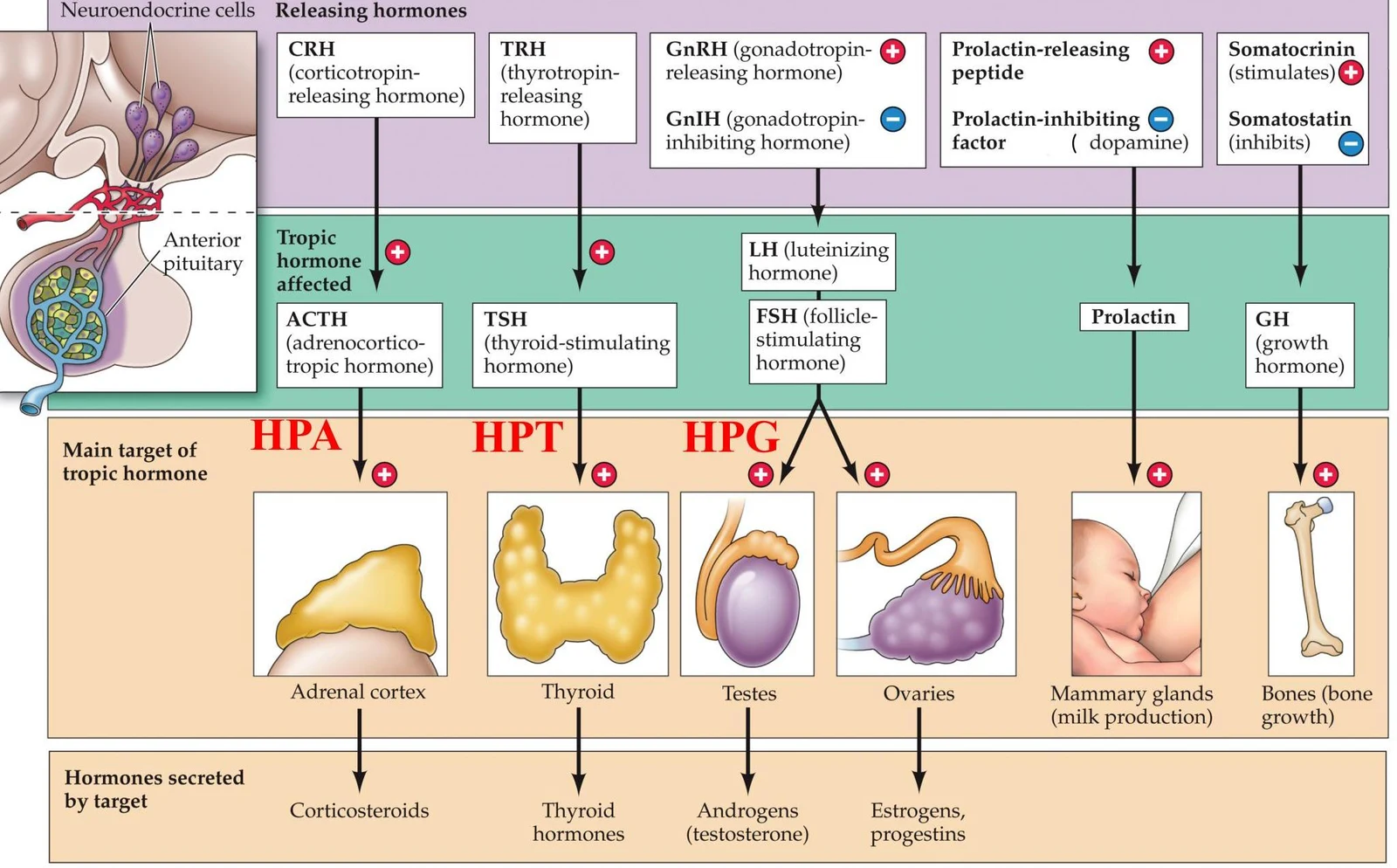
This lobe is regulated by the hypothalamus through the hypophyseal portal system, a network of blood vessels. The hypothalamus secretes releasing hormones that travel to the anterior pituitary, stimulating it to release tropic hormones—hormones that target other endocrine glands.
Key anterior pituitary hormones include:
FSH & LH: Regulate the gonads.
ACTH: Stimulates the adrenal cortex.
TSH: Stimulates the thyroid.
Prolactin (PRL): Stimulates milk production.
Growth Hormone (GH): Promotes growth and metabolism.
This diagram illustrates the human endocrine system, detailing the interplay between neuroendocrine cells, releasing hormones, tropic hormones, and their target organs. It shows how hormones like CRH, TRH, and GnRH stimulate the pituitary gland to release ACTH, TSH, LH, and FSH, which in turn act on the adrenal cortex, thyroid, testes, and ovaries, respectively. The diagram also includes the roles of prolactin and growth hormone in mammary glands and bone growth.
Feedback Loops and Regulation
Hormone levels are maintained through negative feedback. When a hormone reaches a certain level or achieves its biological effect, the system sends a signal to inhibit further secretion.
There are several levels of feedback:
Autocrine Feedback: The hormone inhibits the very cell that released it.
Target Cell Feedback: The biological effect on the target cell is detected, which then inhibits the original endocrine gland.
Brain/Hypothalamic Feedback: The brain detects the hormone's effects in the blood and exerts negative feedback on the hypothalamus.
Neurosteroids and Local Brain Chemistry
A fascinating aspect of neuroendocrinology is the production of neurosteroids—steroids synthesized directly within the nervous system. For example, the brain contains the enzyme aromatase, which can locally convert testosterone into estradiol. This allows the brain to alter its own neural circuits locally, independent of what is happening in the rest of the body.
To study where these hormones act, researchers use autoradiography. This involves injecting radioactively labeled hormones (like testosterone) into an animal, allowing them to accumulate in cells with specific receptors, and then using an autoradiogram to visualize the distribution of those molecules in brain tissue.
Summary of Principles
When studying hormones, keep these core principles in mind:
Hormones act gradually and often in bursts (pulsatile).
They change the probability or intensity of a behavior rather than acting as a simple "on/off" switch.
A hormone can only affect a cell if that cell possesses the specific receptor protein for it.
The relationship between hormones and behavior is reciprocal.
Keep reading for free.
Create an account to finish this reading and make it part of your study routine.