Hormone Replacement and Contraceptive Drugs: Pharmacology and Nursing Considerations
This guide details the pharmacology of hormone replacement and contraceptive drugs, including their mechanisms of action, various forms of administration, adverse effects, contraindications, drug interactions, and essential nursing considerations for patient care.
Hormonal pharmacology plays a critical role in reproductive health, encompassing both the management of menopausal symptoms and the prevention of pregnancy. These medications primarily utilize synthetic versions of the female sex steroid hormones—estrogens and progestins—to manipulate the natural menstrual cycle. Understanding the nuances of their mechanisms, delivery methods, and significant safety profiles is essential for providing safe and effective patient care.
Mechanisms of Action
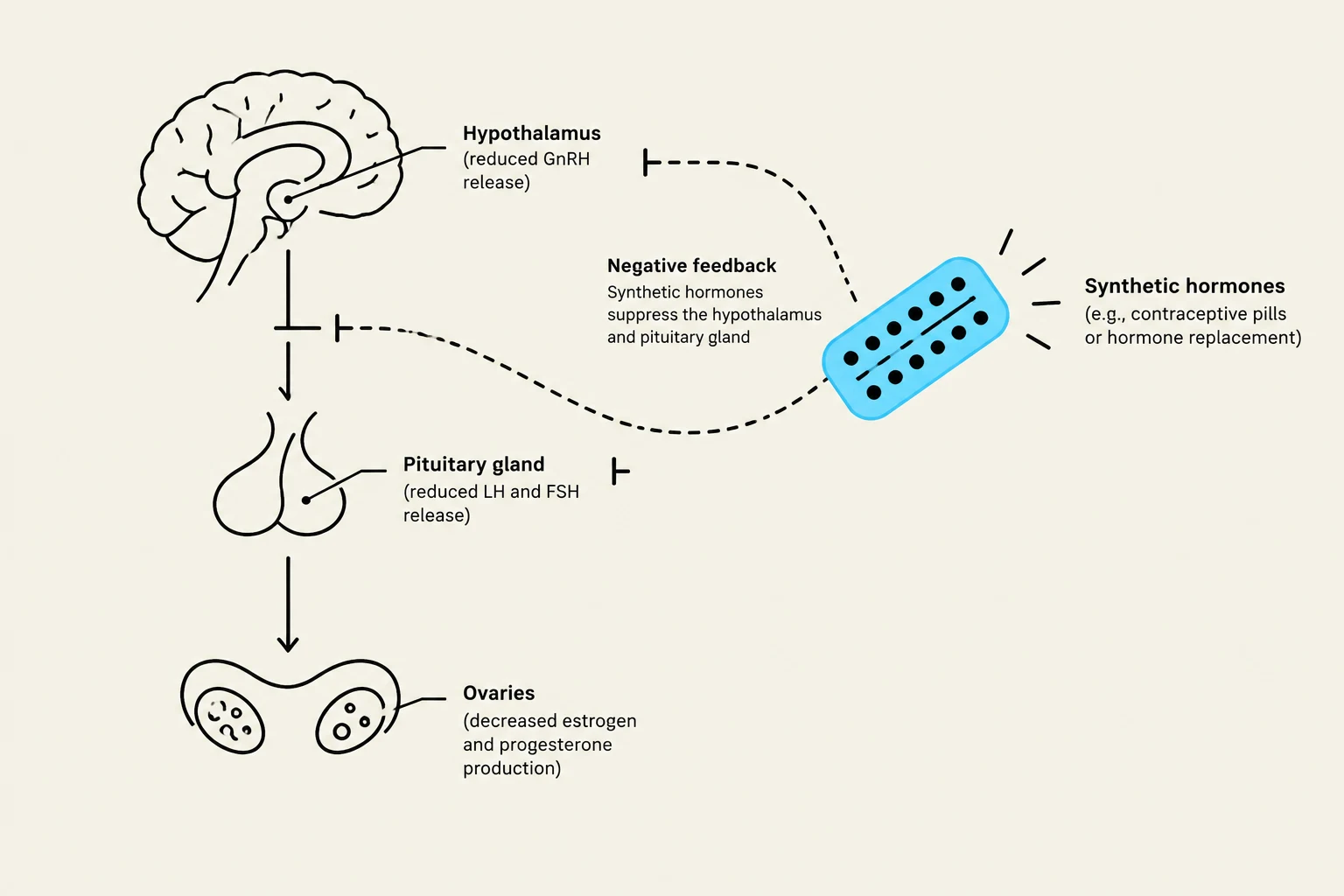
To understand how these drugs work, one must first understand the natural feedback loop involving the hypothalamus, the pituitary gland, and the ovaries. In a natural cycle, the pituitary gland releases Follicle-Stimulating Hormone (FSH) and Luteinizing Hormone (LH).
Contraceptive drugs work by disrupting this cycle to prevent pregnancy through several pathways:
Suppression of Ovulation: Progestins suppress the secretion of gonadotropin-releasing hormone (GnRH) from the hypothalamus and inhibit the release of FSH and LH from the pituitary gland. Without the surge of LH, ovulation does not occur.
Cervical Mucus Alteration: Progestins increase the viscosity of cervical mucus, creating a physical barrier that prevents sperm penetration.
Endometrial Changes: These drugs can induce endometrial atrophy or alter the lining to make it less receptive to the implantation of a fertilized egg.
This diagram illustrates the negative feedback mechanism of synthetic hormones, such as those found in contraceptive pills or hormone replacement therapy, on the hypothalamic-pituitary-ovarian axis. Synthetic hormones suppress the release of GnRH from the hypothalamus and LH and FSH from the pituitary gland, leading to decreased estrogen and progesterone production by the ovaries.
Contraceptive Forms and Administration
Contraceptives are available in various forms to accommodate different patient lifestyles, preferences, and medical needs.
Oral Contraceptives
Oral pills are the most common form and are categorized by their hormonal composition and dosing schedules:
Monophasic: Contains a fixed, consistent ratio of estrogen and progestin throughout the entire cycle.
Biphasic: Features a fixed estrogen dose with a low progestin dose for the first 10 days, followed by a higher progestin dose for the remainder of the cycle.
Triphasic: Uses three different estrogen-progestin dose ratios to closely mimic the natural hormonal fluctuations of a female cycle.
Long-Acting and Other Methods
For patients seeking higher efficacy or less daily maintenance, several other options exist:
Injectable (Medroxyprogesterone): A progestin-only method (e.g., Depo-Provera) administered via intramuscular (IM) injection every 3 months.
Transdermal Patch: A fixed estrogen-progestin combination applied to the skin once a week for three weeks, followed by one week without the patch.
Intravaginal Ring: A ring (e.g., NuvaRing) inserted into the vagina for three weeks, then removed for one week.
Implantable Rods: Placed under the skin of the upper arm (e.g., Nexplanon) and replaced every 3 years.
Intrauterine Devices (IUD): Devices placed in the uterus that can last between 3 to 10 years.
Exam Tip: When comparing oral contraceptives, remember that the triphasic form is designed to most closely duplicate the natural hormonal levels of the female cycle.
Emergency and Pregnancy Termination Medications
In specific clinical scenarios, different hormonal interventions are required.
Emergency Oral Contraception: Often referred to as the "morning-after pill" (e.g., Plan B), these are progestin-only medications used within 72 hours of unprotected intercourse to delay ovulation or prevent fertilization.
Pregnancy Termination: Medications such as mifepristone work by binding to progesterone receptors, thereby preventing the action of progesterone which is necessary to maintain a pregnancy. Methotrexate is also utilized specifically for managing ectopic pregnancies.
Adverse Effects and Contraindications
While effective, these medications carry significant risks that require vigilant monitoring.
Adverse Effects
Both estrogens and progestins share several side effects, including nausea, vomiting, headache, breast tenderness, fluid retention, and changes in weight or appetite.
Serious Risks:
Thromboembolic Events: The most serious risk involves the formation of blood clots, including deep vein thrombosis (DVT), pulmonary embolism (PE), stroke, and myocardial infarction (MI).
Bone Density: Specifically for the injectable medroxyprogesterone, prolonged use (especially in women under 25) can lead to significant loss of bone mineral density.
Cancer Risks: Black box warnings indicate increased risks for endometrial, breast, and cardiovascular-related cancers, as well as dementia.
Contraindications
Hormonal therapy should generally be avoided in patients with:
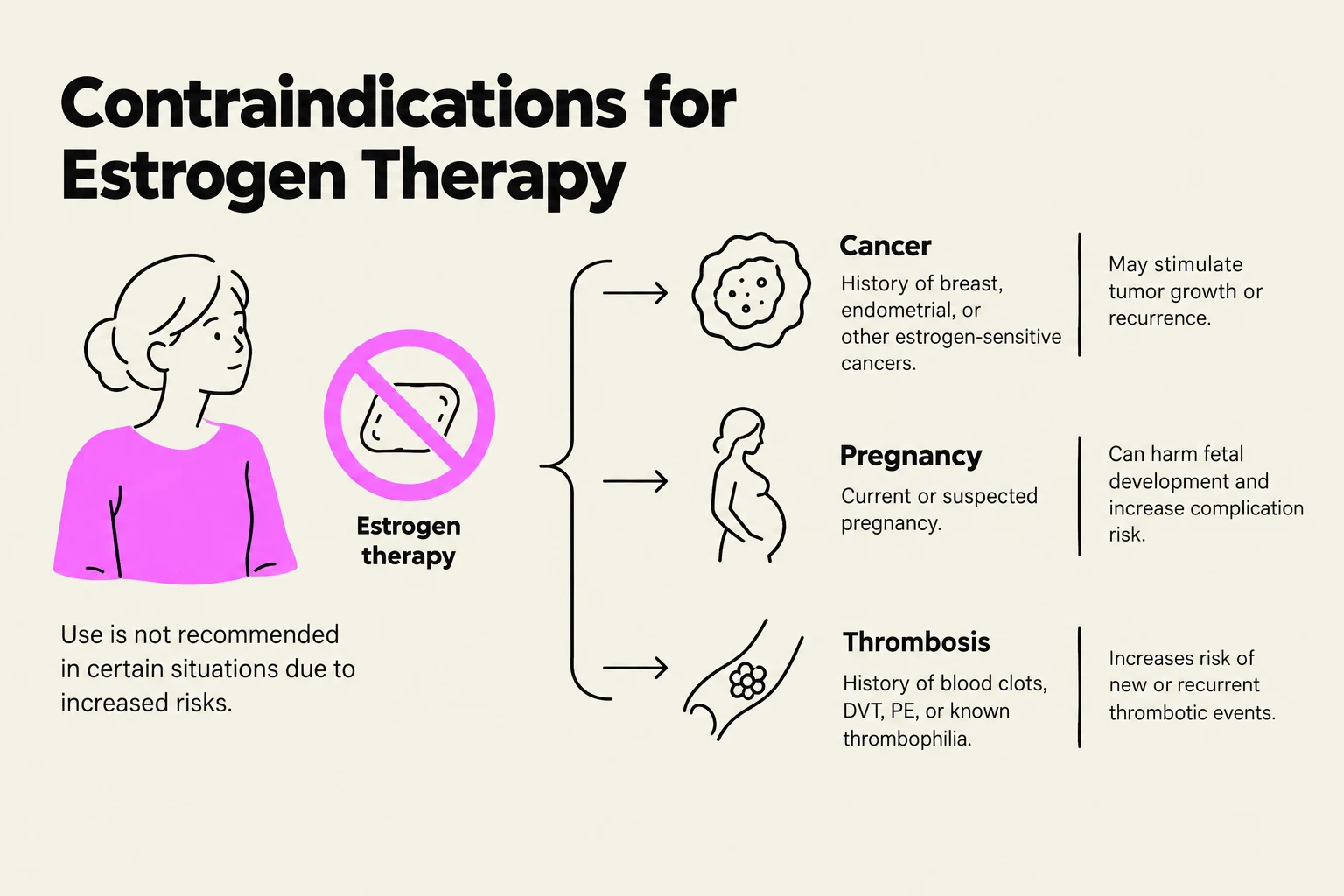
Any estrogen-dependent cancer.
A history of or high risk for thromboembolic disorders.
Undiagnosed abnormal vaginal bleeding.
Pregnancy or lactation.
This diagram outlines contraindications for estrogen therapy, including cancer, pregnancy, and thrombosis, along with their associated risks.
Drug Interactions
Hormonal efficacy can be significantly altered by other medications.
Decreased Effectiveness: Certain drugs can reduce the effectiveness of oral contraceptives, potentially leading to unintended pregnancy:
Antibiotics: Particularly penicillins and cephalosporins.
Other agents: Barbiturates, isoniazid, rifampin, anticonvulsants, and St. John's wort.
Reduced Effectiveness of Other Drugs: Conversely, oral contraceptives may decrease the effectiveness of other medications, such as beta-blockers, warfarin, theophylline, and antidiabetic drugs.
Nursing Considerations and Patient Education
Nursing care involves assessment, administration, and extensive patient education.
Clinical Assessment and Administration
Assessment: Monitor for signs of thromboembolism (redness/swelling of legs, shortness of breath, chest pain) and changes in breast tissue.
Administration: Oral doses should be taken with meals to minimize GI upset. IM injections should be given deep into large muscle masses with site rotation.
Surgical Prep: Patients should discontinue hormonal therapy prior to surgeries that result in immobilization to reduce clot risk.
Patient Education
Consistency: Emphasize taking medication at the same time every day.
Missed Doses: If a dose is missed, the patient must be taught to use a backup method of birth control (like a barrier method) to prevent pregnancy.
Lifestyle: Strongly advise patients to avoid smoking, as it significantly increases the risk of thrombophlebitis.
Sun Safety: Estrogen can increase photosensitivity; however, patients should be cautioned that applying sunscreen directly over transdermal patches or creams may reduce the absorption of the medication.
Clinical Scenario: A 68-year-old patient receiving estrogen therapy for palliative breast cancer treatment who smokes one pack of cigarettes a day is at an extremely high risk for thrombosis. Smoking should be strictly addressed as a major contraindication to safe therapy.
Keep reading for free.
Create an account to finish this reading and make it part of your study routine.