Explore the complex ways hormones interact, including antagonism, additive effects, synergism, and permissiveness, to maintain physiological homeostasis. Learn about hormonal regulation, secretion signals, and feedback loops.
The endocrine system is a sophisticated communication network that utilizes chemical messengers, known as hormones, to maintain physiological homeostasis. Rather than acting in isolation, hormones frequently interact with one another to fine-tune bodily functions. These interactions can be cooperative, opposing, or even conditional, allowing the body to respond precisely to changing internal and external environments.
Mechanisms of Hormonal Interaction
Hormones influence target tissues through four primary types of interactions: antagonism, additive effects, synergism, and permissiveness.
Antagonism
Antagonism occurs when two hormones have opposing physiological effects on the same target tissue or metabolic process. This "tug-of-war" is essential for maintaining stability within narrow physiological ranges.
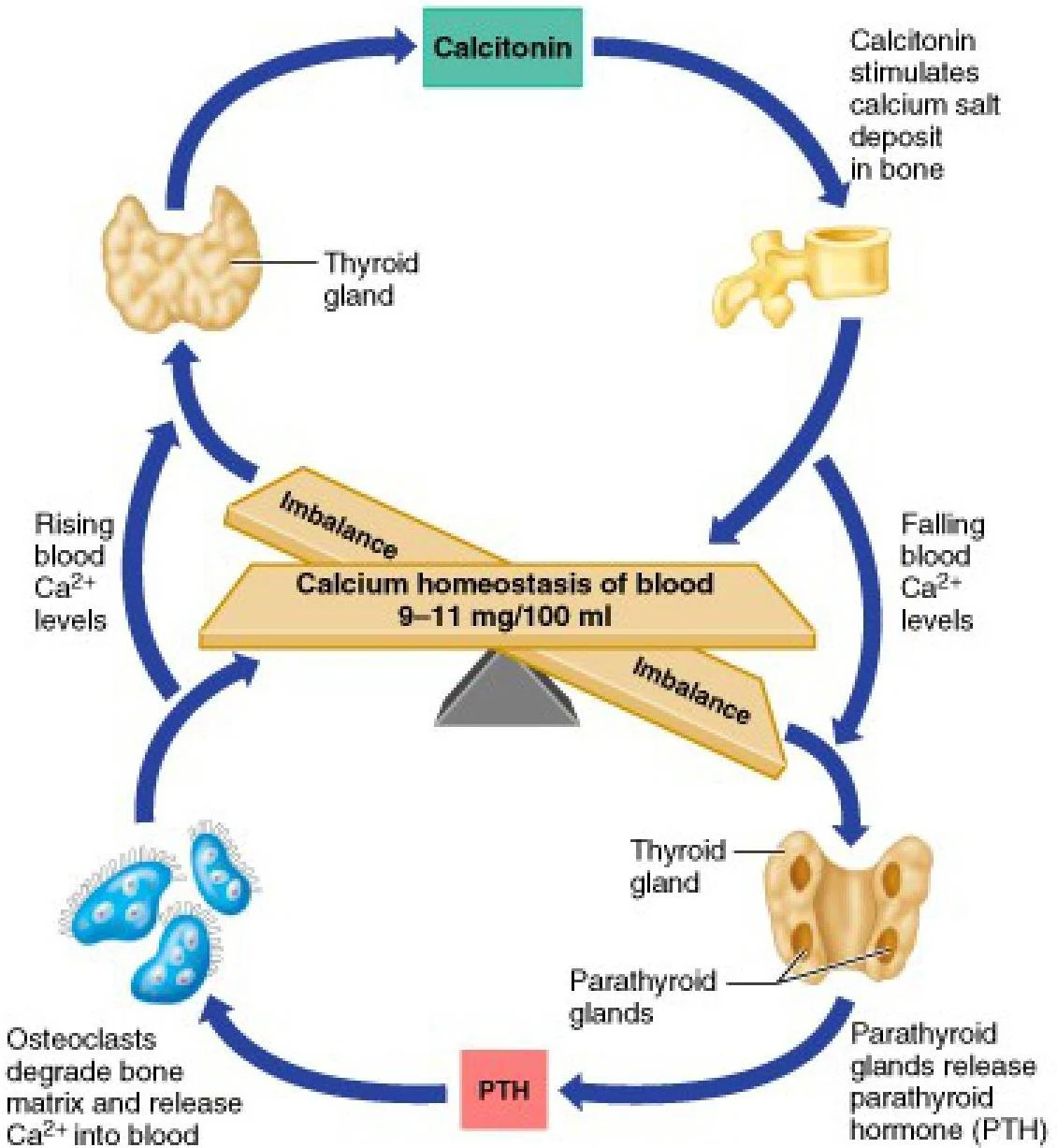
A classic example is the regulation of blood calcium levels. Calcitonin and parathyroid hormone (PTH) act as antagonists to ensure calcium levels do not swing too high or too low. Similarly, blood glucose levels are regulated by the opposing actions of insulin (which lowers blood sugar) and glucagon (which raises it) through the coordination of the pancreas and liver.
Diagram illustrating the homeostasis of blood calcium levels, regulated by calcitonin and parathyroid hormone (PTH) secreted by the thyroid and parathyroid glands, respectively.
Additive Effect
In an additive effect, the combined impact of multiple hormones is equal to the mathematical sum of their individual effects. Unlike other interactions, these hormones do not necessarily enhance or amplify each other's specific mechanisms; they simply contribute their individual "strengths" toward a single goal.
For instance, growth hormone, testosterone, and thyroid hormone all promote physical growth. While they work together to achieve the net result of increased body mass, they do so through their own distinct pathways without significantly boosting the potency of the others.
Synergism
Synergism represents a cooperative relationship where the combined effect of two or more hormones is significantly greater than the sum of their individual parts. This "1 + 1 = 3" effect allows the body to mount massive physiological responses very quickly.
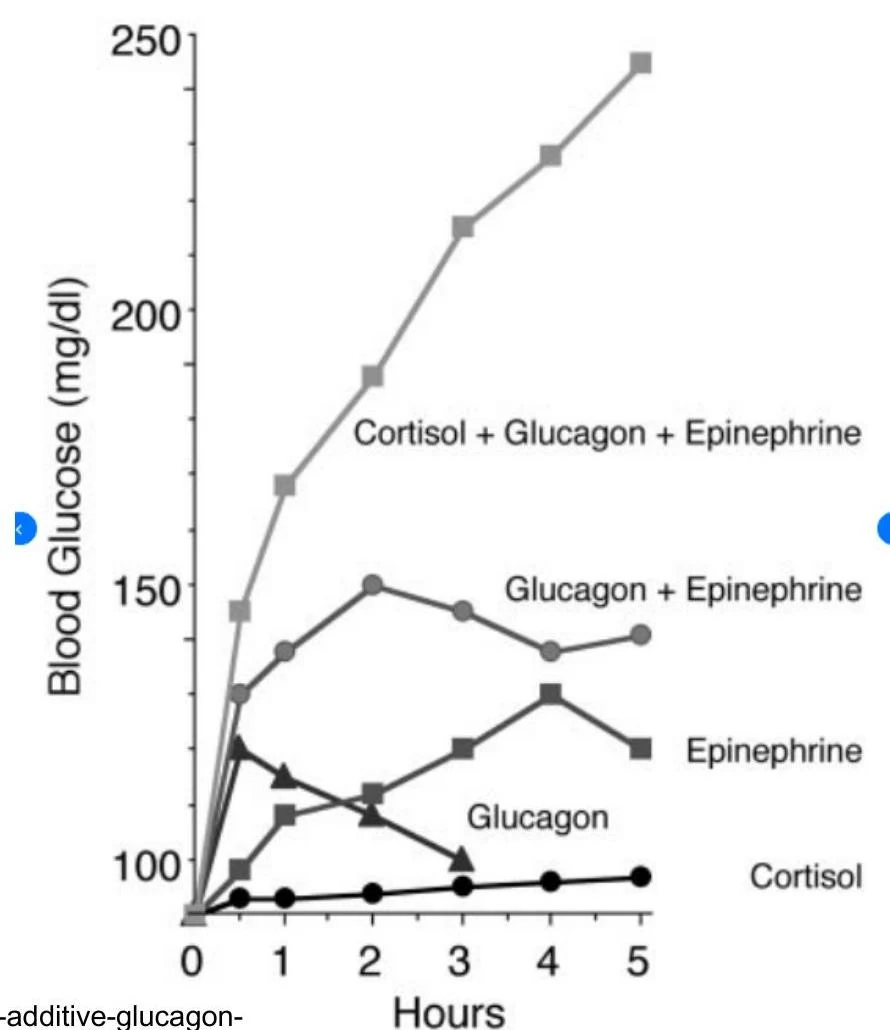
A vital example of synergism is the body's response to stress. When the body requires a rapid increase in energy, glucagon, cortisol, and epinephrine work together to raise blood glucose levels. This combined action results in stress-induced hyperglycemia, providing the brain and muscles with the fuel needed to handle a crisis.
This graph illustrates the effect of different hormones on blood glucose levels over time. It shows how Cortisol, Glucagon, Epinephrine, and combinations thereof impact blood glucose concentration in mg/dl over a 5-hour period.
Permissiveness
Permissiveness is a conditional interaction where one hormone is required to be present in adequate amounts to allow a second hormone to exert its full effect. In these cases, the first hormone often acts by "preparing" the target cell—for example, by inducing the expression of specific receptors.
Two key biological examples include:
Thyroid hormones: These must be present to cause the expression of β adrenergic receptors in the bronchiolar smooth muscle, allowing the body to respond to epinephrine.
Estrogen: This hormone is necessary to cause the expression of progesterone receptors in the uterus.
Exam Tip: If a question asks about a hormone that "sets the stage" or "primes" a cell for another hormone, the answer is likely permissiveness.
Hormonal Regulation and Secretion
The secretion of hormones is not constant; it is dynamically regulated by various internal and external signals to maintain homeostasis.
Signals for Secretion
Endocrine glands respond to several types of stimuli to alter hormone release:
Neural Stimulation: Direct signals from the nervous system (e.g., sympathetic neurons stimulating the adrenal medulla to release epinephrine).
Humoral Control: Changes in the concentration of metabolites or ions in the blood, such as rising blood glucose levels triggering insulin release or high blood potassium triggering aldosterone.
Tropic Hormones: Hormones released from one endocrine gland that specifically target another endocrine gland to regulate its secretion. A common pathway involves the hypothalamus releasing releasing hormones that stimulate the anterior pituitary, which in turn releases tropic hormones like ACTH to stimulate the adrenal cortex.
Muscle Contractions: Physical contractions in the muscles surrounding certain glands can also assist in hormone release.
Feedback Loops
Most endocrine regulation relies on negative feedback loops. In these loops, the physiological response (such as an increase in cortisol) eventually signals the original stimulus (the hypothalamus or pituitary) to decrease further secretion, thereby preventing overproduction.
Clinical Correlations: When Regulation Fails
When the balance of hormone secretion or tissue responsiveness is disrupted, pathological conditions arise.
Hypersecretion and Hyposecretion
Hypersecretion (Too much): This can be primary (the gland itself is overproducing, often due to a tumor) or secondary (the problem lies in the hypothalamus or pituitary gland producing too many tropic hormones). For example, a pituitary tumor can lead to gigantism via excess growth hormone, or excess cortisol can lead to Cushing syndrome, characterized by physical symptoms like a "buffalo hump" and abdominal weight gain.
Hyposecretion (Too little): A critical example is insulin-dependent diabetes mellitus, which is caused by the hyposecretion of insulin from the beta cells of the pancreas.
Abnormal Tissue Responsiveness
Sometimes, hormone levels are normal, but the body's cells fail to respond correctly.
Laron's dwarfism: Caused by a mutation in the growth hormone (GH) receptor, meaning the body cannot respond to the hormone even if it is present.
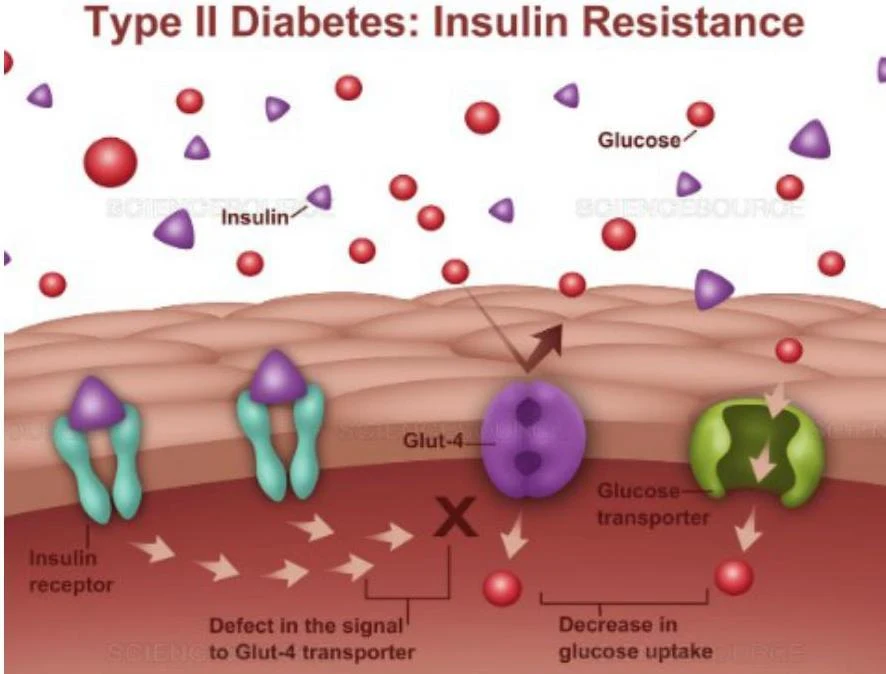
Type II Diabetes Mellitus: Characterized by a defect in the signal transduction pathway of insulin, leading to insulin resistance where glucose cannot be effectively taken up by cells.
Illustration showing insulin resistance in Type II Diabetes, where a defect in the signal to the Glut-4 transporter leads to decreased glucose uptake.
Keep reading for free.
Create an account to finish this reading and make it part of your study routine.