Hooke's Law, Work, and Energy Conservation in Classical Mechanics
Explore Hooke's Law, the spring constant, and the relationship between force, displacement, work, and energy. This content covers the Work-Energy Theorem, spring potential energy, conservation of mechanical energy, and the impact of non-conservative forces like friction.
In the study of classical mechanics, we often transition from analyzing individual forces using Newton's Laws to understanding the broader concepts of work and energy. While forces describe the "push and pull" of objects, energy provides a powerful way to track how those forces change an object's state of motion or position. One of the most fundamental examples of this relationship is found in the behavior of elastic materials, such as springs, which follow a predictable mathematical relationship known as Hooke's Law.
Hooke's Law and the Spring Constant
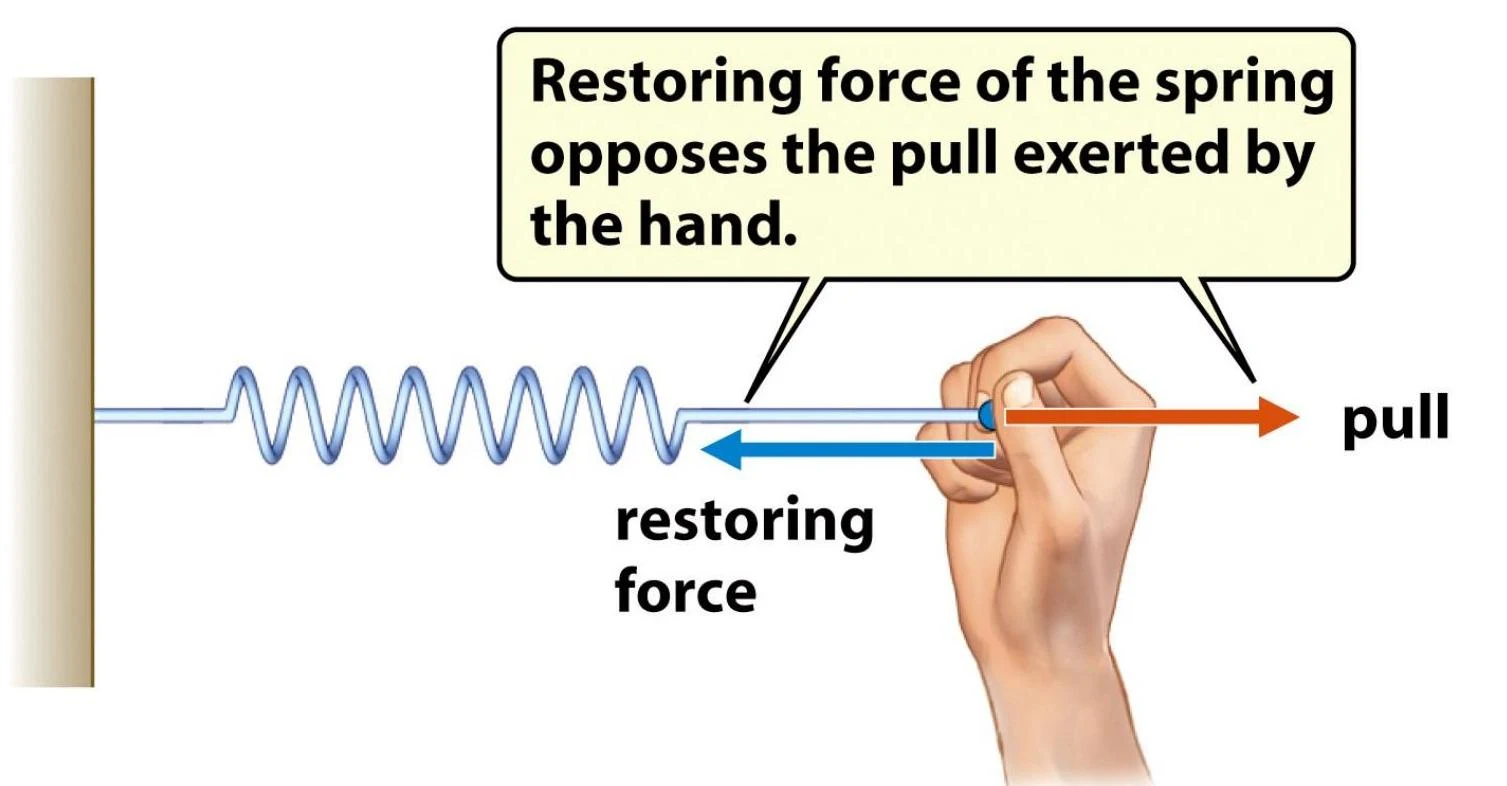
When you stretch or compress a spring, it exerts a force that attempts to return it to its original, equilibrium position. This is known as a restoring force. Robert Hooke developed an empirical relationship to describe this phenomenon, stating that the force exerted by a spring is directly proportional to the displacement from its equilibrium position.
The mathematical expression for Hooke's Law is:
Fspring=−kx
A diagram illustrating the concept of a restoring force in a spring, showing that it opposes the external pull applied to it.
In this equation:
Fspring is the restoring force.
k is the spring constant, a measure of the spring's stiffness, measured in Newtons per meter (N/m).
x is the displacement from the equilibrium position (x>0 for stretching and x<0 for compression).
The negative sign is crucial: it indicates that the direction of the spring force is always opposite to the direction of the displacement. This principle isn't just for mechanical springs; even molecular bonds in substances like oxygen (O2) or ethylene behave like tiny springs, a concept utilized in technologies like the atomic force microscope.
This illustration shows the relationship between force and displacement for springs with different spring constants (k), illustrating Hooke's Law and the elastic region of a material before yielding and fracturing.
Work and the Work-Energy Theorem
To understand how a spring can move an object, we must look at work. Work is defined as the product of force and displacement, but because both are vectors, we use the dot product to account for the angle between them:
W=Fnet⋅d
If a force varies along a path (as a spring force does), we calculate work by integrating the force over the displacement:
W=∫xixfF(x)⋅dx
The Work-Energy Theorem connects this work to the object's motion. It states that the net work done on an object is equal to its change in kinetic energy (K), which is the energy of motion:
W=ΔK=Kf−KiW=21mvf2−21mvi2
Exam Tip: The sign of the work tells you exactly what is happening to the object's speed. If W>0, the object is speeding up (ΔK>0). If W<0, the object is slowing down (ΔK<0).
Spring Potential Energy
When work is done against a conservative force like a spring, that energy isn't lost; it is stored as potential energy (U). For a spring, this is called spring potential energy.
A spring at rest (x=0) has no potential to move an object. However, once it is stretched or compressed, it stores energy based on the spring constant and the square of the displacement:
Uspring=21kx2
The relationship between work and potential energy is defined by:
ΔU=−W
This means that the work done by the spring is the negative of the change in its potential energy.
Conservation of Energy
In a system where only conservative forces (like gravity or spring forces) are acting, the total mechanical energy remains constant:
K+U=constantKi+Ui=Kf+Uf
This principle allows us to solve complex problems by comparing the starting and ending states without needing to know every detail of the path taken.
Gravitational Potential Energy
Just as a spring stores energy when displaced, an object stores gravitational potential energy when lifted against gravity:
Ugravity=mgh
Worked Example: The Navy Jet Landing
Imagine a Navy jet of mass M lands on an aircraft carrier and snags a cable that acts like a spring with constant k. The jet is stopped by the spring over a distance d. To find the initial speed v of the jet, we equate the initial kinetic energy to the final spring potential energy:
Initial State: The jet has kinetic energy Ki=21mv2 and no spring energy.
Final State: The jet is stopped (Kf=0) and the spring is stretched to Uf=21kd2.
Conservation:21mv2=21kd2v=mkd
Non-Conservative Forces
In the real world, energy is often "lost" to the environment. Non-conservative forces, such as friction, do work that transforms mechanical energy into other forms, like heat. When friction is present, K+U is no longer constant; instead, the total energy decreases.
This diagram illustrates the physics of a car rolling down an incline, comparing two solutions for calculating its final velocity, one neglecting friction and the other accounting for it.
Keep reading for free.
Create an account to finish this reading and make it part of your study routine.