Homeownership vs. Renting: An Economic and Social Analysis
Explore the historical evolution of housing from necessity to commodity, analyzing the economic, psychological, and policy factors influencing the decision between homeownership and renting. Discusses government policies, market dynamics, and the concept of social housing.
When a young couple plans to get married, one of the most significant questions they face is whether to buy a home or continue renting. This decision is rarely just about a single transaction; it is a complex intersection of economic calculation, psychological desire, and the prevailing social and political landscape. To understand why some societies favor owning while others embrace renting, we must look back at how housing evolved from a self-provided necessity to a global market commodity.
From Agrarian Roots to Urban Markets
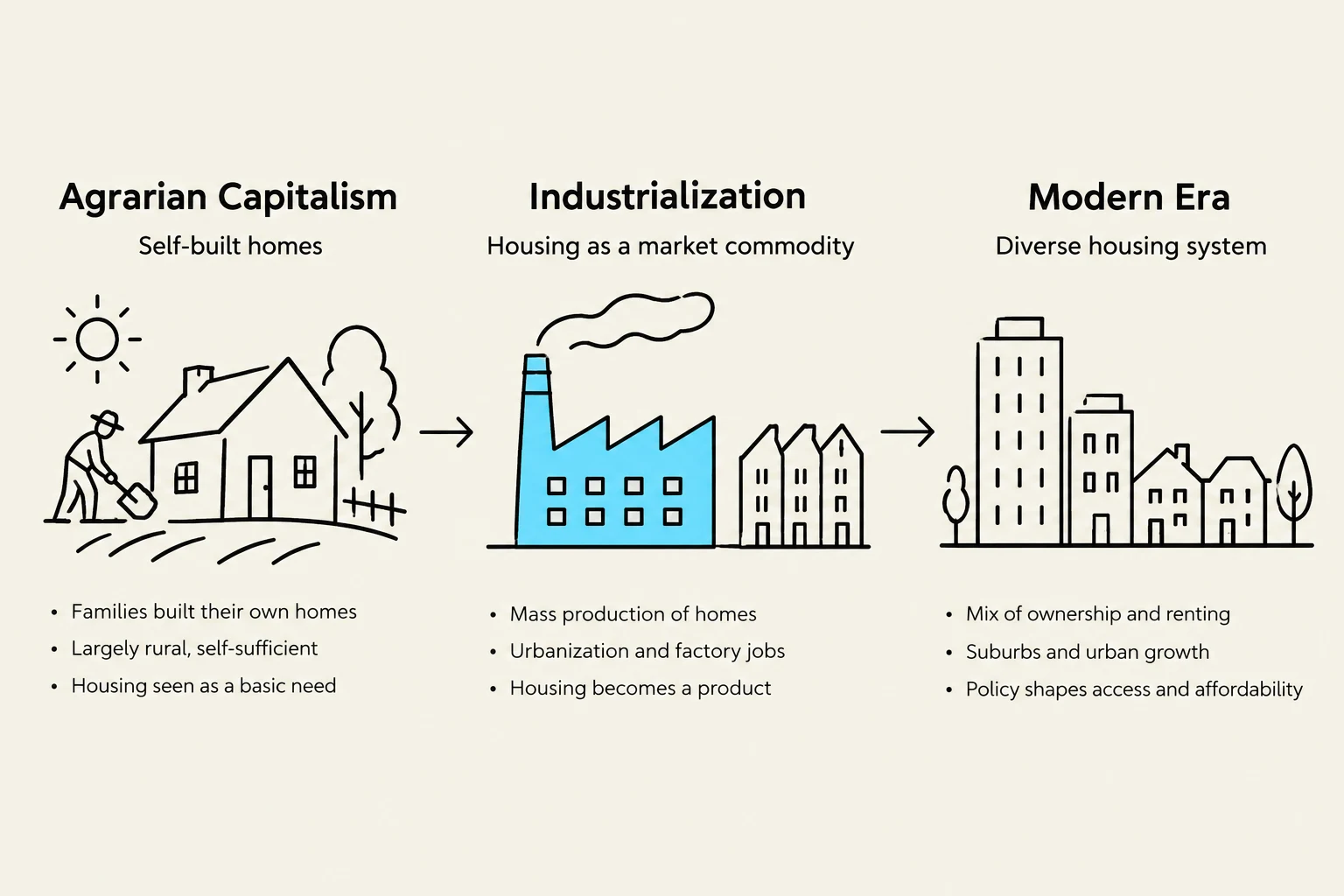
In the pre-industrial era, characterized by agrarian capitalism, economic life revolved around small towns and the countryside. During this time, a large proportion of the population built their own homes, leading to a form of "self-promoted homeownership". Housing was often provided directly by employers, and the concept of a competitive rental market was minimal.
The shift toward modern housing patterns was driven by industrialization and urbanization. As populations moved to cities for factory work, housing transformed into a market commodity governed by the laws of demand and supply. In many countries, this transition led to a surge in the private rental sector, as people with small amounts of capital acted as landlords to seek investment returns, while new urban workers—often earning low or irregular wages—found it impossible to secure housing loans.
However, the dominance of the private rental sector has declined in many regions due to several factors:
Rising Real Incomes: As wealth increases, more individuals can afford to transition from renting to owning.
Investment Potential: Real increases in house prices make property an attractive asset.
Inflation and Mortgages: Inflation can actually encourage borrowing; as inflation rises, the real value of mortgage payments may decrease over time as salaries rise, giving borrowers the confidence to take on debt.
Government Intervention: Many states have moved away from supporting private landlords through rent control (which can make investing in rentals unattractive) and instead provide large-scale public rental housing or subsidies for homeownership.
This illustration depicts the evolution of housing systems through three eras: Agrarian Capitalism, Industrialization, and the Modern Era, highlighting key characteristics of each period.
The Multifaceted Nature of Homeownership
Why do people strive to own? The reasons are rarely purely economic; they span investment, psychology, and policy.
Homeownership as Investment and Life-Cycle Tool
For many, a home is a vehicle to protect savings from inflation and accumulate wealth. If a country does not impose capital gains tax, homeownership can become one of the few significant ways to save tax-free. Furthermore, owning a home allows a family to "smooth" housing costs over their life cycle: one might buy a home when income is high and the family is growing, and upon retirement, the elderly can live "for free" in a home they already own.
The Psychology of Ownership
There is a debate regarding whether the desire to own is "innate" or a response to the "bundle of goods" available. While some argue people have an instinctive drive to own, others point to wealthy nations like Germany and Switzerland, which have low homeownership rates because renting offers high security of tenure. Beyond economics, homeownership provides:
Security of Tenure: A sense of permanence.
Self-Identity: The ability to decorate and invest in a space creates a sense of belonging.
Prestige: In many cultures, owning a home is a sign of success.
Policy Drivers and Economic Impacts
Governments often actively promote homeownership through policies such as mortgage interest relief, capital gains relief, and various grant or loan schemes. From a state perspective, a "property-owning democracy" can be advantageous: owners are often seen as responsible voters with a stake in the system, and the sector generates significant revenue through stamp duties and stimulates economic activity in construction, law, and real estate.
However, high homeownership rates carry risks. They can lead to extreme volatility in both the housing market and the wider economy, as seen in the Asian Financial Crisis or the Global Sub-prime Crisis. In such cases, the government may ultimately be forced to bail out institutions or support low-income individuals who purchased unaffordable housing.
Exam Tip: When discussing the advantages of homeownership to the government, remember to balance "social stability" (the property-owning democracy) against "economic risk" (market volatility and the cost of bailing out the system).
Case Study: The Hong Kong Context
Hong Kong presents a unique landscape where the stability of one sector contrasts sharply with the instability of another. According to 2022 Census data, the housing distribution shows a significant presence of both public and private sectors:
Public Rental Housing (PRH) Tenants: 30.3%
Private Tenants: 14.5%
Private Homeowners: 36.1%
Subsidized Homeownership: 15.4%
Instability in Private Rental Housing
For the poor, the private rental sector in Hong Kong can be a source of extreme instability. Tenants often face forced evictions due to redevelopment or landlord decisions, sometimes with little to no legal protection. One case study highlighted a tenant who faced the sudden loss of electricity and water after a landlord sold the property, leaving the family with no immediate recourse.
Stability in Public Rental Housing (PRH)
In contrast, PRH offers significant stability. Rents are kept at affordable levels, with maximum increases capped at 10% under the Housing Ordinance, and rental reviews occur every two years based on household income.
To ensure these resources are used fairly, the government implements "Well-off Tenants Policies" (WTP). Recent updates (as of 2025) include:
Biennial Declarations: Households living in PRH for over ten years must declare their status.
Income/Asset Thresholds: Households exceeding certain income or asset limits must vacate.
Tiered Rents: For households with incomes between 2 and 5 times the prevailing PRH income limits, rents are adjusted upward (e.g., 2.5 to 4.5 times the net rent).
Strict Enforcement: Tenancy can be terminated for "abuse," such as subletting, non-occupation, or making false declarations. To combat this, the "Report Public Housing Abuse Award" was launched in 2025, offering rewards of up to HK$3,000 for intelligence on tenancy abuse.
This graphic illustrates the trade-offs between private rental housing and homeownership, highlighting differences in stability, costs, security, and customization.
The Synergy of the Homeownership Decision
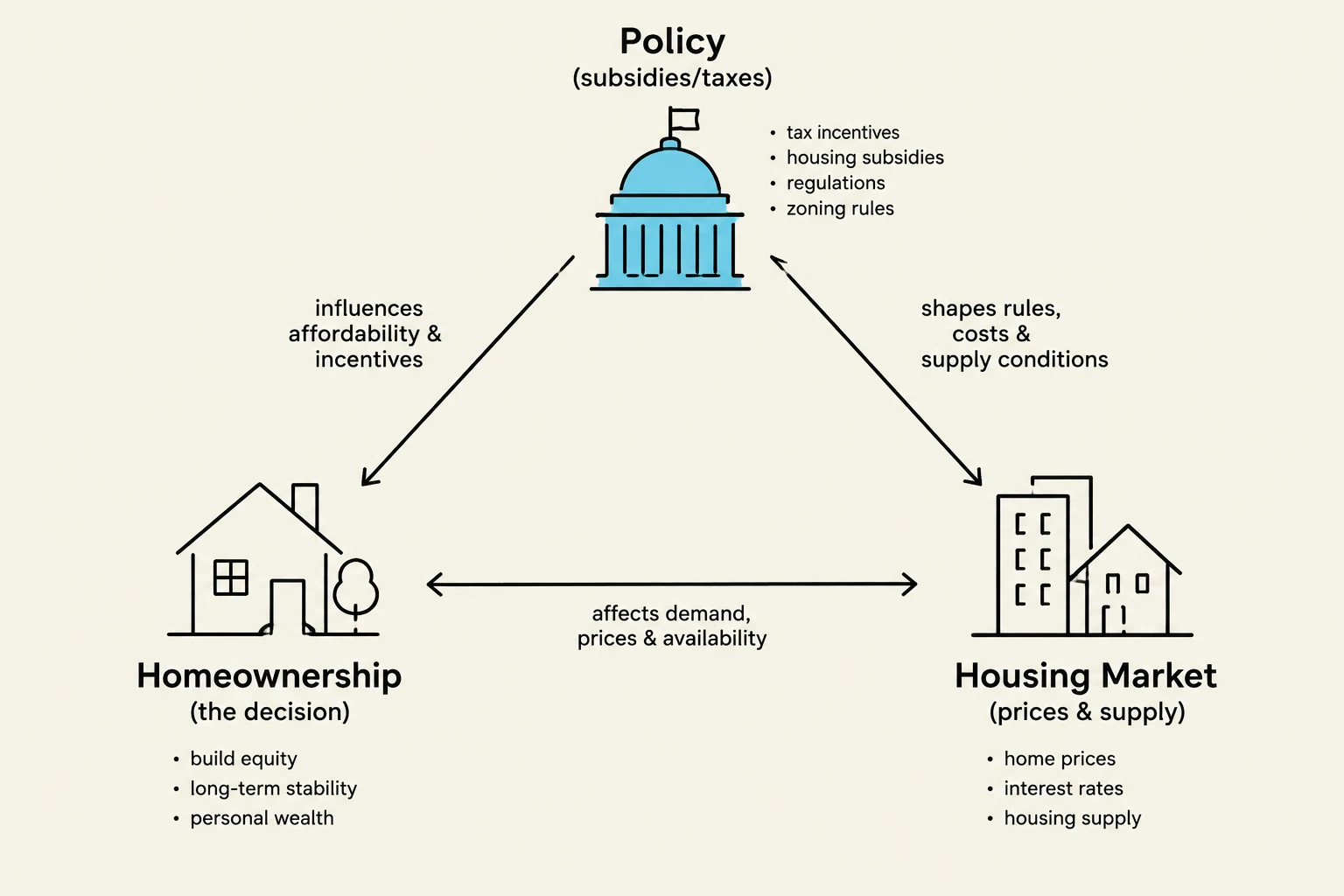
Ultimately, the decision to buy or rent is not made in a vacuum. It is the result of a synergy between three pillars:
Economic Calculations: Comparing the escalation of house prices against stable rent prices and calculating the "user cost" of owning.
Policy Frameworks: The availability of tax concessions, subsidies, and the strength of tenant protections.
Social Values: Cultural tendencies, such as the norm of buying a home before marriage, which influence individual choices.
This decision-making process is also heavily influenced by the availability of Social Housing. Social housing is defined by the principle that rent is not set for profit, but rather according to the needs of the population. This can take the form of:
Public Housing: Provided directly by the state.
Third Sector Housing: Provided by voluntary, non-profit organizations.
In societies where renting is a viable, stable, and protected option, homeownership rates tend to be lower. For example, Germany's lower homeownership rate (44%) is linked to a robust rental market with protected tenure, whereas the United States (63%) views homeownership as a central component of the "American Dream".
This diagram illustrates the interconnectedness of policy, homeownership decisions, and the housing market, showing how government policies influence affordability and incentives, which in turn affect homeownership decisions and the housing market's demand, prices, and availability. The housing market, with its prices and supply, also shapes the rules, costs, and supply conditions influenced by policy.
Summary Formula for Students:
To understand the "User Cost" of housing, consider that the decision to buy is often a comparison of:
Cost of Owning=Mortgage Interest+Maintenance+Property Taxes−Expected Capital Gains
vs.
Cost of Renting=Monthly Rent+Rent Escalation Risk
Keep reading for free.
Create an account to finish this reading and make it part of your study routine.