This content explains the concept of homeostasis and its critical role in regulating body fluids and electrolytes. It details the different fluid compartments (intracellular and extracellular), the mechanisms of fluid movement (passive and active transport, Starling's Law), and the hormonal regulation of fluid balance
The human body is a complex biological system that requires a highly stable internal environment to function correctly. This state of balance is known as homeostasis. One of the most critical aspects of homeostasis is the regulation of body fluids and electrolytes. Because water and dissolved substances (solutes) are distributed throughout various compartments, the body must constantly monitor and adjust their total volume, distribution, concentration, and pH to ensure survival.
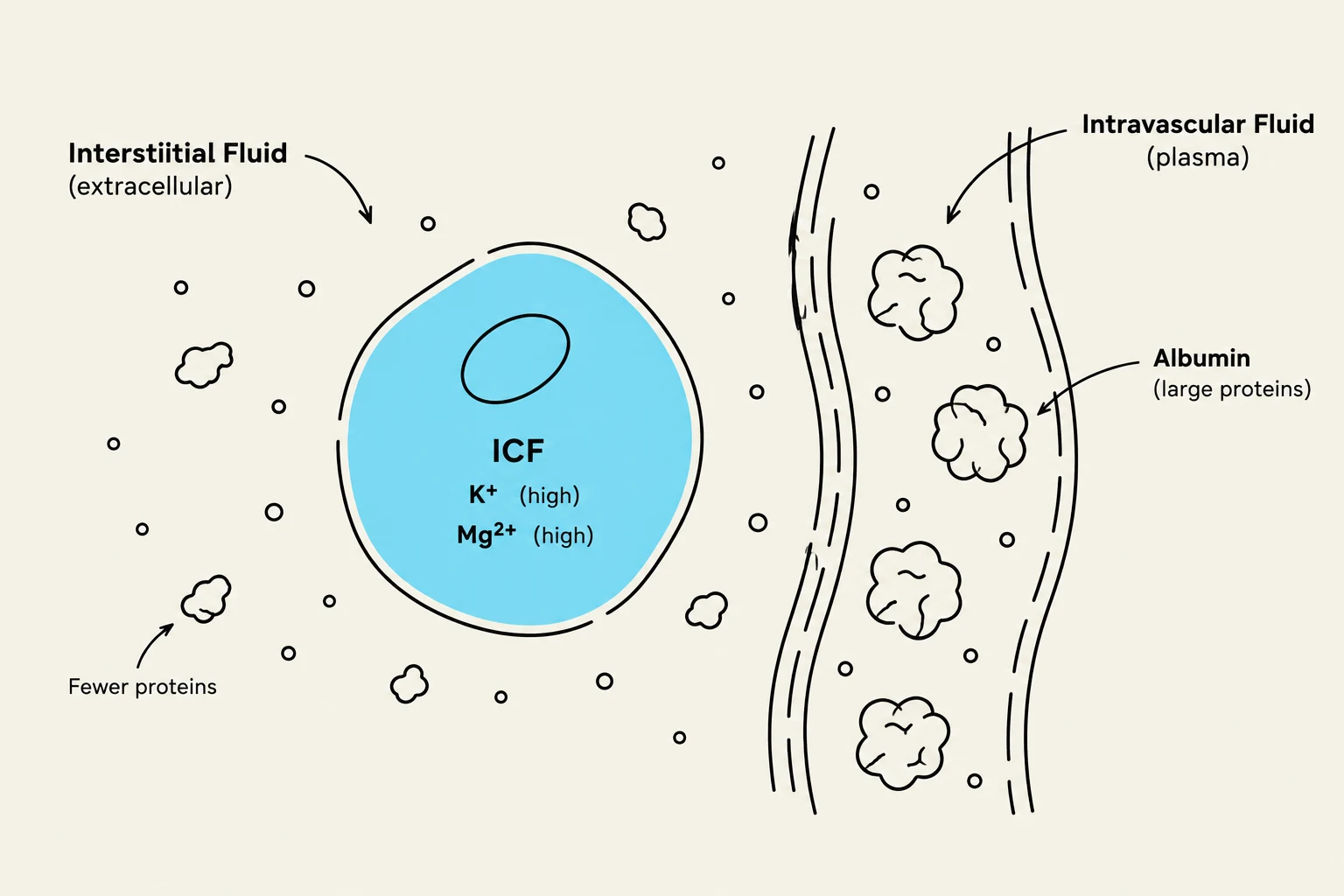
This diagram illustrates the difference in protein concentration and ion composition between intracellular fluid (ICF), interstitial fluid, and intravascular fluid (plasma). ICF is characterized by high concentrations of potassium (K+) and magnesium (Mg2+), while interstitial fluid has fewer proteins compared to plasma, which contains albumin (large proteins).
In a healthy adult, total body water typically accounts for approximately $60%$ of total body weight. However, this ratio is not fixed; it varies by sex, with females generally having a higher percentage of liquids (approximately $55%$) compared to males (approximately $45%$).
Fluid Compartments
Body fluids are not just floating loosely; they are organized into specific compartments that allow for specialized physiological functions.
Intracellular Fluid (ICF)
The Intracellular Fluid is the fluid located within the cells, specifically the cytoplasm. The chemical composition of the ICF is distinct from the fluid outside the cells. It is characterized by high concentrations of potassium ($K^+$), magnesium, and phosphates.
Extracellular Fluid (ECF)
The Extracellular Fluid refers to all fluid located outside of the cells. The ECF is further subdivided into two main types:
Interstitial Fluid: This is the fluid that surrounds the cells within specialized spaces.
Intravascular Fluid (Blood Plasma): This is the liquid component of the blood found within the circulatory system.
While the composition of interstitial fluid and blood plasma is quite similar, they differ in one vital way: plasma proteins. Plasma contains high concentrations of proteins, primarily albumin, which are too large to pass through natural membranes but are essential for maintaining osmotic pressure.
Movement of Fluids and Starling’s Law
Fluid exchange between these compartments occurs in only two primary locations: through cell membranes (between ICF and interstitial fluid) and through capillary walls (between interstitial fluid and plasma).
Transport Mechanisms
Substances move across these membranes via several processes:
Passive Transport: Requires no metabolic energy and moves substances along their concentration gradients via diffusion.
Simple Diffusion: Movement from an area of high concentration to low concentration.
Osmosis: The specific movement of water through a selectively permeable membrane from an area of higher water concentration to lower water concentration.
Facilitated Diffusion: Movement down a concentration gradient that requires a carrier protein.
Active Transport: Requires metabolic energy (ATP) to move solutes against their concentration gradient using carrier molecules, such as the Sodium-Potassium (Na+−K+) pump.
Starling’s Law of the Capillary
To maintain balance between the blood and the interstitial space, the body utilizes Starling’s Law. This law describes how fluid moves across capillary walls based on pressure gradients:
Filtration: At the arterial end of a capillary, fluid moves from the blood into the tissues due to hydrostatic pressure.
Reabsorption: At the venous end of the capillary, fluids return to the blood. This is driven by osmotic pressure created by plasma proteins like albumin.
Note: Any tissue fluid that is not returned directly to the blood via reabsorption is collected and drained via the lymphatic system.
Regulation of Fluid Balance
The body maintains a balance where fluid gain (from ingestion and metabolic water formation) equals fluid loss (urine, feces, sweat, and breath). This regulation is managed by complex hormonal and neural systems.
The Renin-Angiotensin-Aldosterone System (RAAS)
When blood volume or sodium (Na+) levels decrease, the kidneys release renin. This triggers a cascade:
Renin converts angiotensinogen into Angiotensin I.
Angiotensin-Converting Enzyme (ACE) converts Angiotensin I into Angiotensin II.
Angiotensin II stimulates the adrenal cortex to release aldosterone.
Aldosterone promotes the reabsorption of Na+ and H2O in the kidneys, which increases blood volume and sodium levels.
Antidiuretic Hormone (ADH)
When blood osmolarity (solute concentration) increases or blood volume decreases, the hypothalamus signals the posterior pituitary gland to release ADH. ADH acts on the kidneys to increase water reabsorption, which helps lower osmolarity and restore blood volume.
Atrial Natriuretic Peptide (ANP)
Conversely, if blood volume is too high, the heart wall releases ANP. This hormone promotes the renal excretion of sodium (natriuresis), which leads to increased urine output and a decrease in blood volume.
Electrolytes and Tonicity
The effect of tonicity on cell volume through osmosis.Electrolytes are substances that dissociate in solution to form charged particles called ions.
Balances anions between compartments, component of gastric juice
Bicarbonate (HCO3−)
ECF / Plasma
Major way CO2 is transported in the blood
Tonicity of Solutions
Tonicity describes how a solution affects the movement of water across a cell membrane via osmosis:
Isotonic: The solute concentration is equal inside and outside the cell; there is no net movement of water.
Hypertonic: The solution has a higher solute concentration than the cell, causing water to leave the cell.
Hypotonic: The solution has a lower solute concentration than the cell, causing water to enter the cell.
Exam Tip: Remember that "water follows salt." In the kidneys, the regulation of urinary NaCl loss is a primary way the body regulates overall fluid volume.
Keep reading for free.
Create an account to finish this reading and make it part of your study routine.