This content explains homeostasis, the process by which organisms maintain a stable internal environment. It details negative feedback loops, using blood glucose regulation as a case study, and compares the roles of the nervous and endocrine systems in physiological regulation.
Imagine you are walking outside on a freezing winter day. Your body immediately begins to shiver, and your blood vessels constrict to keep your core warm. Conversely, if you step into a sauna, you begin to sweat to cool down. These are not random occurrences; they are part of a sophisticated, constant effort by your body to maintain stability. This fundamental biological necessity is known as homeostasis.
The Concept of Homeostasis
Homeostasis is the physiological process by which an organism maintains a stable internal environment despite the constant fluctuations of external conditions. For an organism to survive, its internal variables—such as temperature, pH levels, energy availability, and chemical concentrations—must stay within a very narrow, functional range.
If these variables deviate too far from their "set point," the organism may face cellular damage or death. To prevent this, the body utilizes complex communication networks that sense changes and trigger corrective actions.
Negative Feedback Loops: The Body's Thermostat
The primary mechanism used to achieve homeostasis is the negative feedback loop. In biology, "negative" does not mean "bad"; rather, it refers to a response that is opposite to the initial stimulus. When a physiological variable moves away from its set point, a negative feedback loop detects this change and initiates a response that counteracts the direction of the change, bringing the variable back toward the normal range.
A negative feedback loop typically consists of three main components:
Sensor/Control Center: Detects the deviation from the set point.
Effector: An organ, tissue, or cell that carries out the response.
Response: The action that counteracts the stimulus, eventually terminating the loop once balance is restored.
Exam Tip: If a question asks you to identify a negative feedback loop, look for a cycle where the output of the system eventually shuts off or reduces the original stimulus. This is the hallmark of stability.
Case Study: Blood Glucose Regulation
One of the most critical examples of negative feedback in human physiology is the regulation of blood glucose (sugar) levels. Glucose is the primary fuel for our cells, but having too much or too little in the bloodstream can be dangerous.
When Glucose Levels Rise
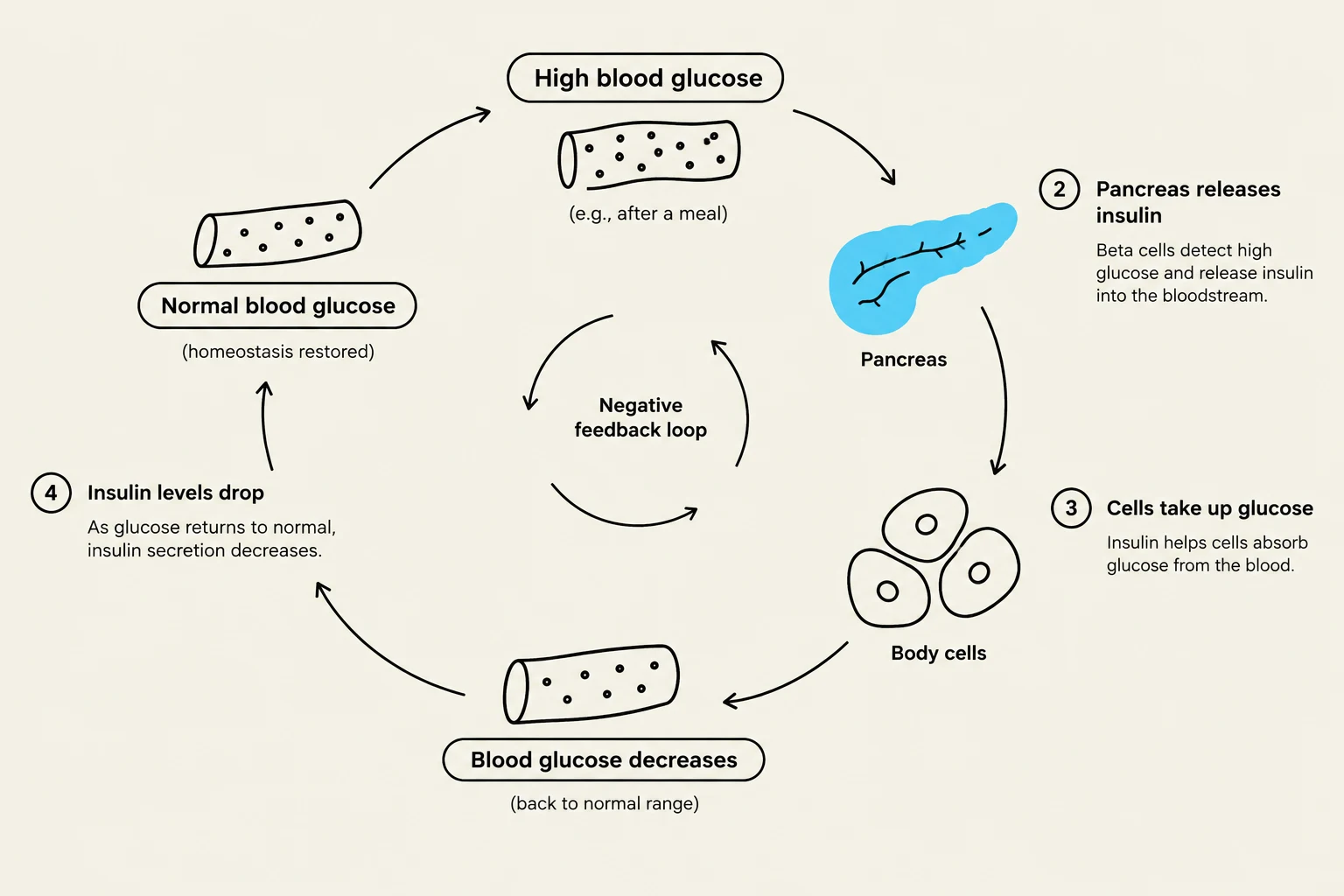
After you consume a meal rich in carbohydrates, your blood glucose levels increase. This triggers the following sequence:
Stimulus: High blood glucose levels.
Sensor/Control Center: The pancreas detects the rise in glucose.
Effector/Hormone: The pancreas releases the hormone insulin into the bloodstream.
Target Tissues: Insulin travels through the blood to reach target tissues, specifically the liver and muscle cells.
Response: These cells take up glucose from the blood. The liver converts the excess glucose into glycogen, a storage form of energy.
Result: Blood glucose levels decrease, returning to the normal range, which signals the pancreas to stop releasing insulin.
When Glucose Levels Drop
If you haven't eaten for several hours, your blood glucose levels may drop too low. To prevent a crisis, the body initiates a different response:
Stimulus: Low blood glucose levels.
Response: The body triggers glycogen breakdown (glycogenolysis). The liver breaks down its stored glycogen back into glucose and releases it into the bloodstream.
Result: Blood glucose levels rise back to the normal set point.
This diagram illustrates the negative feedback loop that regulates blood glucose levels through the action of insulin.
Systems of Communication: Nervous vs. Endocrine
To coordinate these complex responses, the body relies on two distinct but integrated communication systems: the nervous system and the endocrine system.
The Nervous System: The Rapid Responder
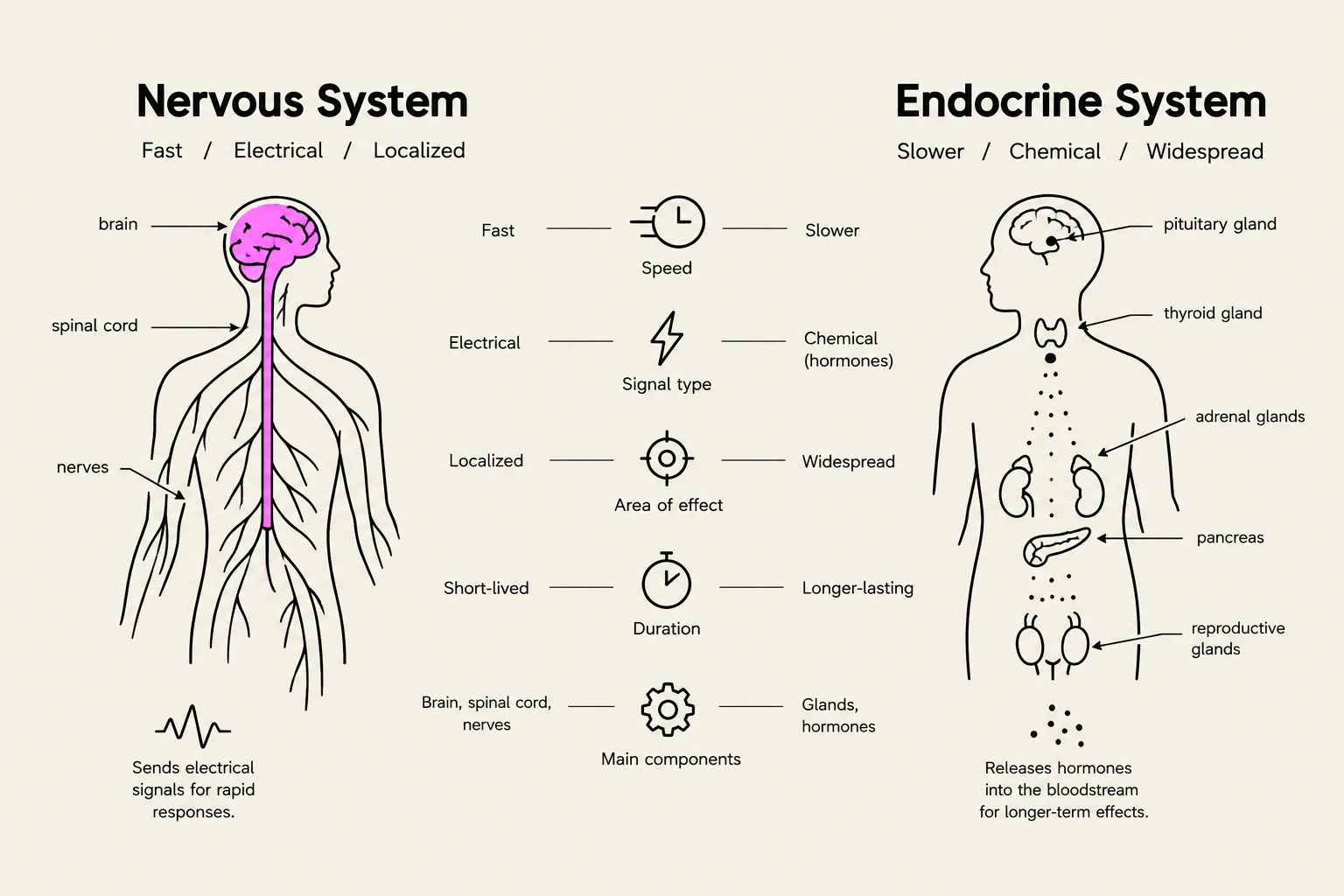
The nervous system is designed for speed and precision. It provides rapid, short-term, and highly localized responses to stimuli.
The fundamental units of this system are neurons. Communication occurs through a combination of electrical and chemical signals:
Electrical Signaling: An electrical impulse travels along the length of the neuron (the axon).
Chemical Signaling: When the impulse reaches the end of the neuron (the synapse), it triggers the release of chemical messengers called neurotransmitters. These chemicals cross the gap to communicate with the next cell, whether it is another neuron, a muscle cell, or an organ.
The Endocrine System: The Widespread Regulator
While the nervous system is like a high-speed fiber-optic cable, the endocrine system is more like a broadcast radio signal. It provides slower, longer-lasting, and more widespread regulation.
Instead of using electrical wires, the endocrine system utilizes hormones—chemical messengers secreted by endocrine glands directly into the bloodstream. Because hormones travel through the blood, they can reach almost every part of the body. However, they only affect target cells that possess specific receptors capable of binding to that particular hormone. For example, while insulin travels everywhere, only cells with insulin receptors will respond to it by taking up glucose.
Comparison of the nervous system and the endocrine system, highlighting their differences in speed, signal type, area of effect, duration, and main components.
Summary of Functional Differences
Feature
Nervous System
Endocrine System
Signal Type
Electrical (impulses) & Chemical (neurotransmitters)
Chemical (hormones)
Transmission Path
Along neurons to specific synapses
Through the bloodstream
Speed of Response
Very rapid (milliseconds)
Slower (seconds to hours)
Duration of Effect
Short-lived
Longer-lasting
Targeting
Highly localized (specific cells/muscles)
Widespread (any cell with the right receptor)
By working in tandem, these two systems ensure that the body can react instantly to immediate threats (via the nervous system) while also managing long-term metabolic needs and growth (via the endocrine system), ultimately maintaining the delicate balance of homeostasis.
Keep reading for free.
Create an account to finish this reading and make it part of your study routine.