An explanation of the biomechanics of the hip joint during bilateral and unilateral stance, focusing on forces, moments, and muscle actions crucial for stability and occupational performance.
The hip complex is a remarkable feat of biological engineering, designed to balance the conflicting demands of stability and mobility. As the central link between the upper body and the lower extremities, the hip serves as a primary site for absorbing descending forces from gravity and managing ascending ground reaction forces. For clinicians, particularly those in occupational therapy, understanding how these forces interact during standing and movement is essential for assessing a patient's ability to perform daily tasks, manage falls, and recover from joint replacements.
The Mechanics of Bilateral Stance
In a symmetrical bilateral stance, the body is distributed evenly across both hips. Typically, the hips are positioned in slight extension. Because the Line of Gravity (LoG) passes posterior to the hip's axis of rotation in this position, it creates an external hip extension moment. This force naturally tends to pull the pelvis into a posterior tilt. To prevent excessive energy expenditure, the body relies on passive structures, such as the tension in the capsulo-ligamentous tissues, to maintain posture.
When the stance is symmetrical, the weight of the Head, Arms, and Trunk (HAT) is transmitted through the sacroiliac joints equally to both femoral heads. In this state, each hip axis is an equal distance from the LoG, resulting in external hip adduction moments that are equal and opposite. Because these moments cancel each other out, the pelvis can maintain equilibrium in the frontal plane without requiring significant muscular assistance.
Diagram illustrating the line of gravity in bilateral stance and its relation to the hip axis, creating an external extensor moment.
Clinical Note: Asymmetry
If a patient presents with a lateral pelvic shift (e.g., shifting weight to the right), the symmetry is broken. To return to a neutral position from a rightward shift, the patient must actively contract the right hip abductors and the left hip adductors to re-establish equilibrium.
The Challenge of Unilateral Stance
The biomechanical complexity increases dramatically during unilateral (single-leg) stance. When one leg is lifted, the stance-side hip must suddenly support a much larger proportion of the body's weight. Specifically, the stance limb must support the weight of the HAT plus the weight of the non-weight-bearing limb. Mathematically, this can be expressed as:
Total Load=Weight of HAT+Weight of non-weight-bearing limb
Given that the HAT represents approximately 32 of body weight and the lifted limb represents 61, the stance hip supports:
32+61=64+61=65 of total body weight
This configuration creates a massive external hip adduction moment due to gravity. Without intervention, this force would cause the pelvis to drop on the opposite side (pelvic obliquity).
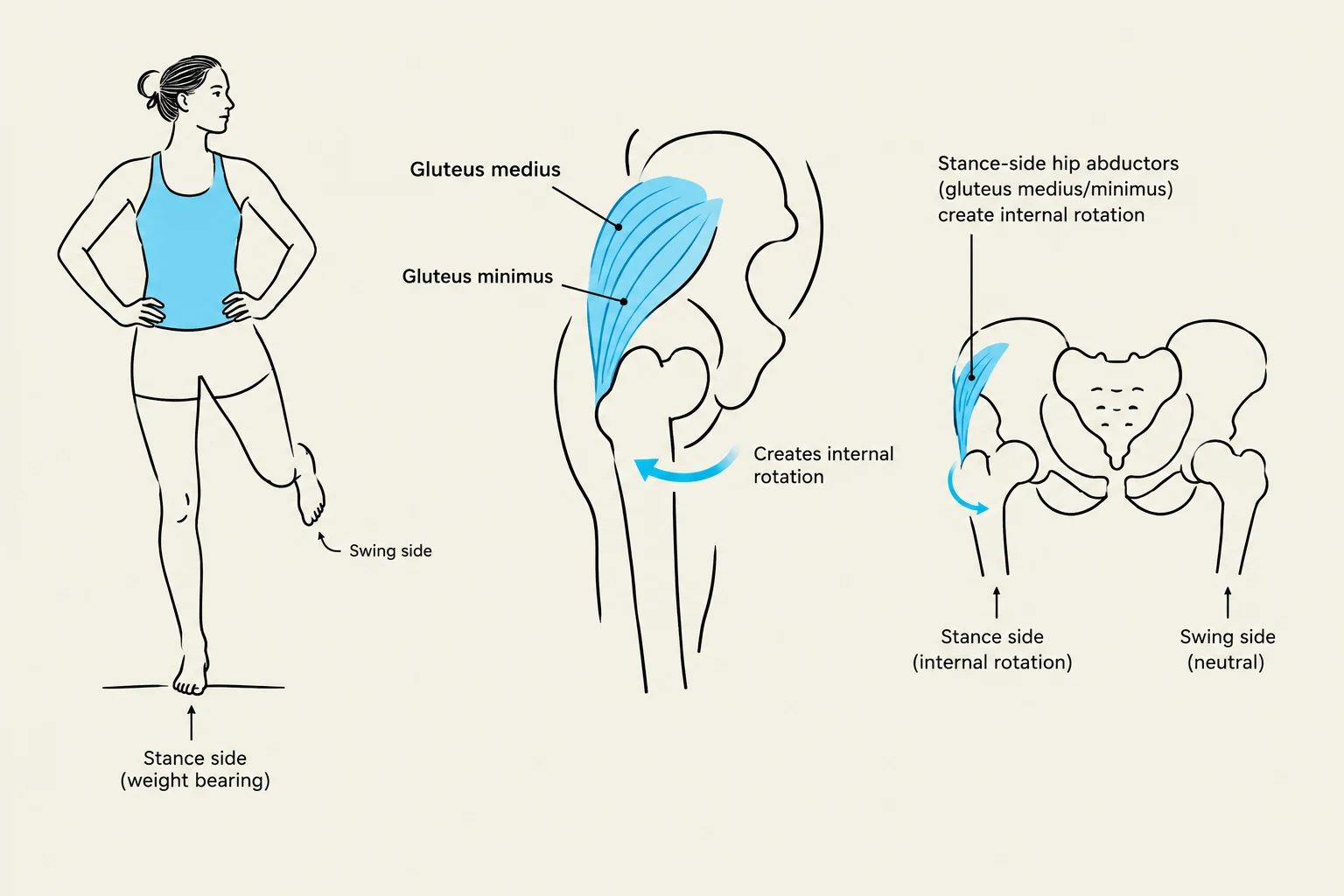
To maintain pelvic stability and prevent this drop, the stance-side hip abductors—primarily the gluteus medius and gluteus minimus—must contract forcefully. This muscular contraction produces an internal hip abduction moment that counteracts the external force.
Diagram illustrating the role of the gluteus medius and minimus muscles in hip abduction and internal rotation during gait.
Hip Joint Compression and Loading
The requirement to produce a powerful internal counter-torque, combined with the massive descending weight of the body, results in significant hip joint compression forces. These forces are not static; they fluctuate based on the activity being performed. In a standard stance, compression can range from 4 to 7 times the individual's body weight. During more demanding tasks, such as climbing or descending stairs, these forces can reach even higher levels.
The total load at the hip is a result of two interacting force systems:
Descending Forces: Gravity acting on the HAT and any objects being carried.
Ascending Forces: Ground Reaction Forces (GRF) traveling up through the lower extremity during standing, walking, or transfers.
Exam Tip: Trendelenburg Gait
If the hip abductors (gluteus medius/minimus) are weak, they cannot produce a sufficient internal abduction moment to counter the external adduction moment during unilateral stance. This results in the pelvis dropping on the side of the lifted leg, a clinical sign known as a Trendelenburg gait.
Clinical Implications for Occupational Performance
Understanding hip biomechanics is vital for evaluating a patient's functional independence. Because the hip is the "foundation" that prevents us from falling over, any deficit in stability or strength directly impacts occupational performance.
Mobility and Transfers: Patients with hip replacements or significant weakness must manage high compression forces during transfers and stair negotiation.
Falls Risk: Weakness in the hip abductors reduces single-limb stability, significantly increasing the risk of falls, which is a leading cause of disability in older adults.
Activities of Daily Living (ADLs): Issues with pelvic stability can affect everything from dressing and hygiene to driving and home maintenance.
By analyzing how a patient manages these internal and external moments, clinicians can better design interventions—such as strengthening the gluteal complex or modifying environmental tasks—to improve safety and participation in meaningful occupations.
Keep reading for free.
Create an account to finish this reading and make it part of your study routine.