


Imagine trying to fit 4.9 centimeters of incredibly thin thread into a space no larger than a microscopic speck. This is the fundamental challenge faced by every living cell. In a single human diploid cell, there are approximately 6400 Mb of DNA spread across 46 chromosomes. Without an incredibly sophisticated packaging system, the cell would be unable to accommodate its genome, nor could it manage the complex tasks of gene expression and cell division. To solve this, cells use a hierarchical system of packaging known as chromatin.
The Building Blocks: Histones and Nucleosomes
The first step in condensing DNA is to wrap it around specialized proteins called histones. When DNA is extracted from a nucleus, it is referred to as chromatin, which is a complex of DNA and proteins where the proteins are spaced at regular intervals.
The fundamental unit of this packaging is the nucleosome. Each nucleosome consists of an octamer—a core of eight histone proteins. This octamer is composed of two copies each of four specific histones: H2A, H2B, H3, and H4. The DNA wraps around this protein disk approximately twice. Under an electron microscope, this arrangement looks like "beads on a string," where the beads are the nucleosomes and the string is the linker DNA.
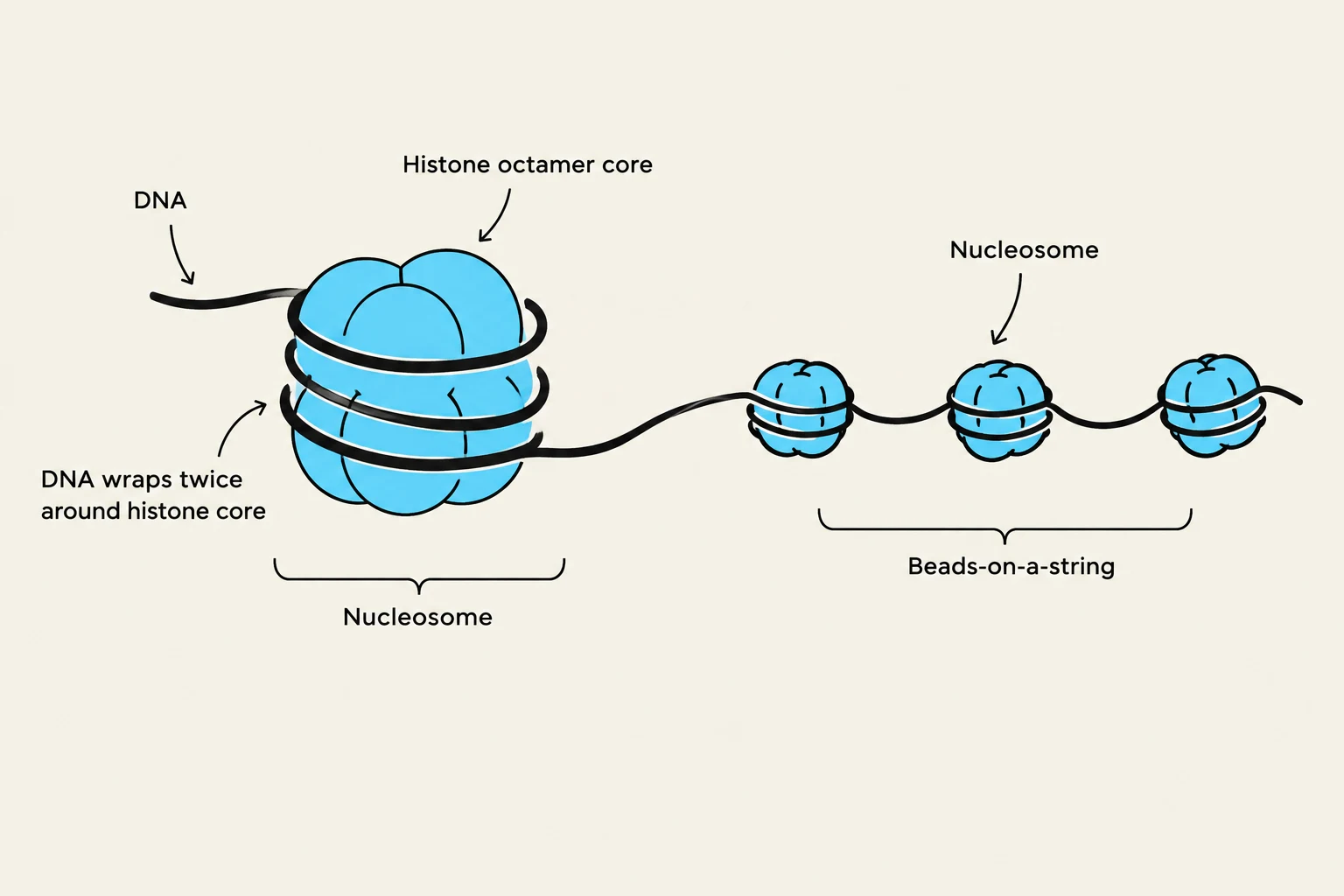
To further stabilize this structure, a fifth histone called histone H1 (the linker histone) attaches to the outside of the nucleosome. When you combine the nucleosome, the wrapped DNA, and the H1 linker histone, the resulting complex is called a chromatosome.
Keep reading for free.
Create an account to finish this reading and make it part of your study routine.
Continue reading freeAlready have an account? Log in
Updated