High-Yield Facts in Pediatrics: Vision, Vaccines, Lead, and Trauma
This resource provides essential information for medical students and clinicians on pediatric vision screening, childhood vaccination protocols, lead poisoning screening and management, and the recognition of abusive head trauma in infants.
Pediatrics is a vast field requiring a keen eye for developmental milestones, subtle physical findings, and critical red flags that distinguish benign variants from life-threatening emergencies. For medical students and clinicians, mastering high-yield topics—such as vision screening, immunization protocols, environmental toxins, and the recognition of nonaccidental trauma—is essential for effective patient management and preventative care.
Pediatric Vision Screening and Development
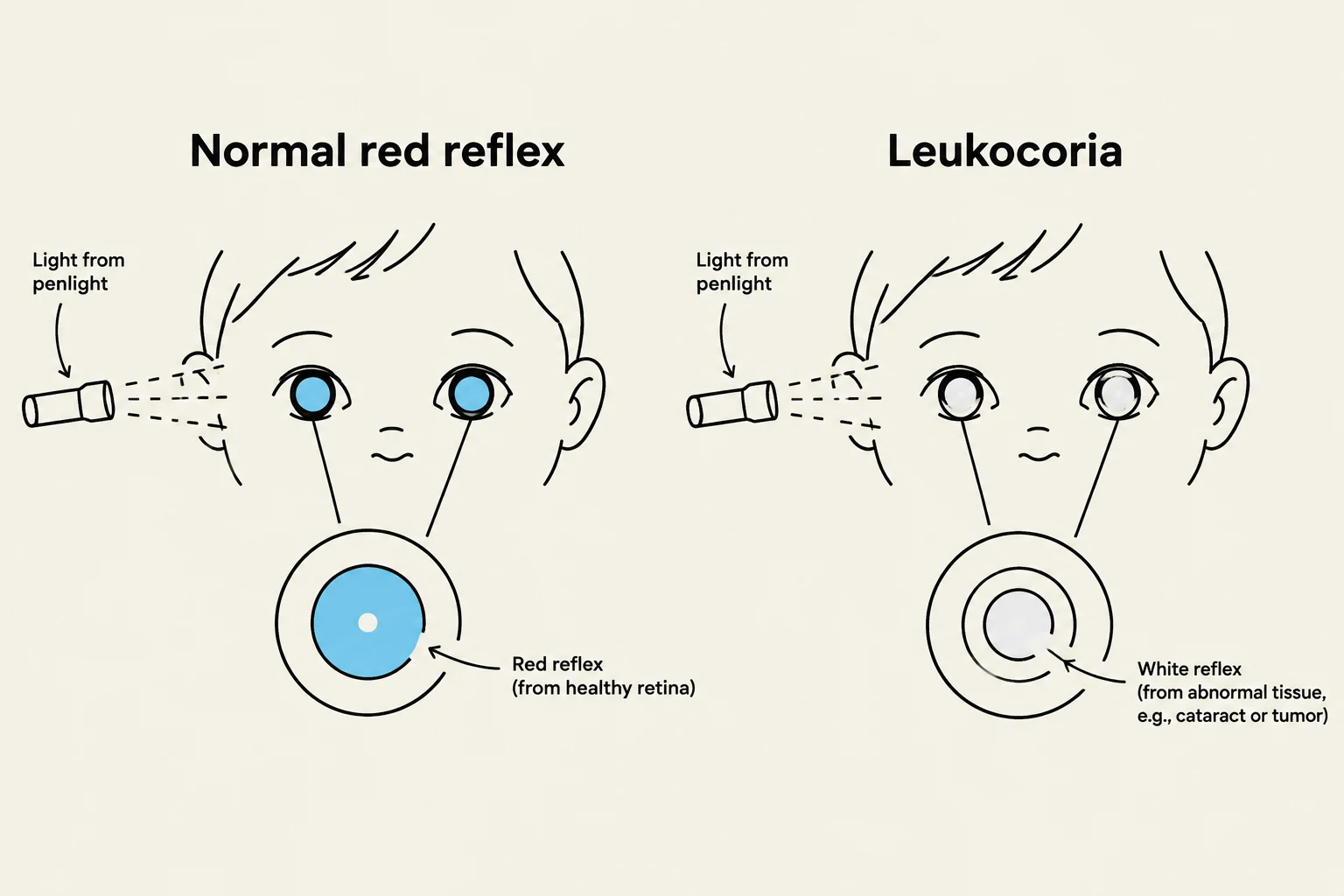
Vision assessment is a vital component of routine well-child visits, particularly for children under 5 years of age. One of the most critical findings to identify at birth is the red reflex. The absence of a red reflex, known as leukocoria, is a significant clinical red flag.
Leukocoria can indicate several serious conditions, including:
Retinoblastoma
Congenital cataracts
Retinopathy of prematurity
All cases of leukocoria require immediate ophthalmologic workup. Additionally, clinicians must screen for strabismus (ocular misalignment) and amblyopia (suppression of retinal images in a misaligned eye). While strabismus can be normal in infants up to 3 months of age, any misalignment observed beyond this age requires evaluation by a pediatric ophthalmologist. Treatment strategies to prevent permanent vision loss (amblyopia) may include corrective lenses, surgery, or occlusion (using an eye patch to strengthen the weaker eye).
Illustration comparing a normal red reflex in the eye with leukocoria, which presents as a white reflex and may indicate an abnormality.
Childhood Vaccinations: Contraindications and Precautions
Vaccination is a cornerstone of pediatric preventative medicine, guided by CDC recommendations. However, clinicians must distinguish between absolute contraindications and relative precautions to ensure patient safety.
Contraindications
Absolute contraindications include a severe, life-threatening allergy to a vaccine component or a prior dose of the vaccine. Specific considerations include:
Egg Allergies: Patients with life-threatening egg allergies may still receive MMR and influenza vaccines under medical supervision, but caution is required for the yellow fever vaccine.
Pertussis: A history of encephalopathy within 7 days of a prior pertussis vaccination is a contraindication.
Rotavirus: A personal history of intussusception or Severe Combined Immunodeficiency (SCID) are contraindications.
Immunocompromised Patients: Live vaccines (e.g., rotavirus, oral polio, varicella, MMR, intranasal influenza, and yellow fever) should be avoided in pregnant and immunocompromised patients. An exception exists for HIV patients with a CD4+ cell count >200 copies/mm3, who may receive MMR and varicella.
Precautions and Non-Contraindications
Precautions include current moderate-to-severe illness (with or without fever) or a history of receiving IVIG within the past year. Notably, prematurity is not a contraindication; all vaccines should be administered based on the child's chronologic age, regardless of gestational age. Similarly, mild illness, low-grade fever, and current antibiotic therapy do not preclude vaccination.
Exam Tip: If a question describes a child with a history of a seizure within 3 days of a pertussis vaccine or a shock-like state following vaccination, consider these as significant prior reactions that may serve as precautions for future doses.
Lead Poisoning: Screening and Management
Lead poisoning remains a significant environmental health concern, primarily caused by lead-contaminated household dust from old lead paint. Universal screening is not recommended; instead, routine screening should be performed at 12 and 24 months of age for children living in high-risk areas, such as homes built before the 1970s.
Diagnosis and Clinical Findings
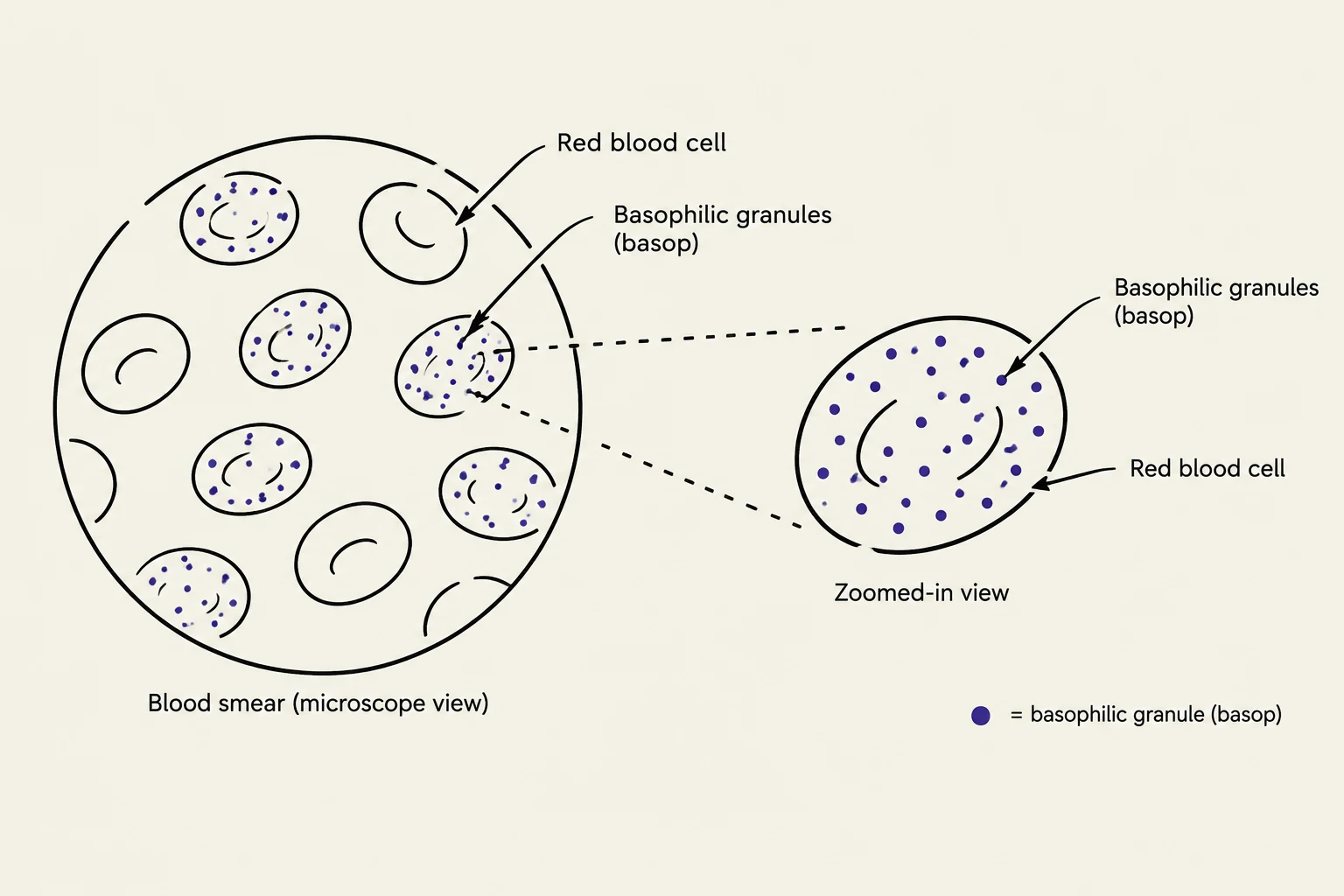
Initial screening is often performed via a fingerstick test; if results are elevated, a serum venous blood lead level must be obtained. Laboratory findings may include microcytic, hypochromic anemia and basophilic stippling on a peripheral blood smear.
Diagram illustrating a blood smear with a zoomed-in view of a red blood cell showing basophilic granules.
Management Protocols
Management is strictly dictated by the venous blood lead concentration (measured in μg/dL):
Blood Lead Level (μg/dL)
Recommended Action
<5
Family education and annual testing
5−14
Retest in 1–3 months; remove lead sources
15−44
Retest in 1–4 weeks; remove lead sources
45−69
Retest within 48 hours; further workup; start oral succimer
>70
Retest within 24 hours; hospitalization; succimer + CaNa2EDTA
High-Yield Fact: Recent evidence indicates that even low levels of lead exposure (as low as 10μg/dL) can result in impaired intelligence and neurodevelopmental outcomes in children.
Abusive Head Trauma in Infants
Abusive head trauma (formerly "shaken baby syndrome") is a critical diagnosis in pediatric emergency medicine. It is most common in infants aged 3 to 4 months.
Clinical Presentation
The presentation of abusive head trauma is often nonspecific in the early stages, which can lead to diagnostic delays. Symptoms include:
Lethargy and irritability
Poor feeding and vomiting
Later progression to seizures or apnea
Neurologic findings are frequently driven by subdural hematoma and cerebral edema. Clinicians should maintain a high index of suspicion, especially when the provided history is discordant with the physical findings (e.g., a parent claiming a 2-month-old "rolled off a couch," despite the child being developmentally unable to roll).
Differential Diagnosis and Mimics
It is essential to differentiate abuse from other conditions. For example, Congenital Dermal Melanocytosis (Mongolian spots)—which are flat, blue-gray, non-blanching patches often found on the sacrum—can be mistaken for bruises. However, true bruises are typically tender and show color variation, whereas dermal melanocytosis is nontender and fades spontaneously.
In cases of suspected physical abuse, specific injuries like posterior rib fractures, metaphyseal "bucket handle" fractures, and retinal hemorrhages are highly suspicious. If sexual abuse is suspected, clinicians should test for gonorrhea, syphilis, chlamydia, and HIV.
Clinical Pearl: In infants presenting with abusive head trauma, there is a $50%-70%$ chance of documented prior abuse.
Keep reading for free.
Create an account to finish this reading and make it part of your study routine.