This content explains the fundamental concepts of heat and work as modes of energy transfer in thermodynamics. It differentiates between heat (energy transfer due to temperature difference, involving random particle motion) and work (energy transfer through organized motion, often involving force and displacement). The
In the study of thermodynamics, energy is never truly "lost"; instead, it is constantly moving from one place to another or changing form. When we talk about a system (the object we are studying) and its surroundings (everything else), we focus on how energy crosses the boundary between them. The two primary ways this happens are through heat and work. While both result in a change in the system's internal energy, the mechanism of transfer is fundamentally different.
The Nature of Heat (q)
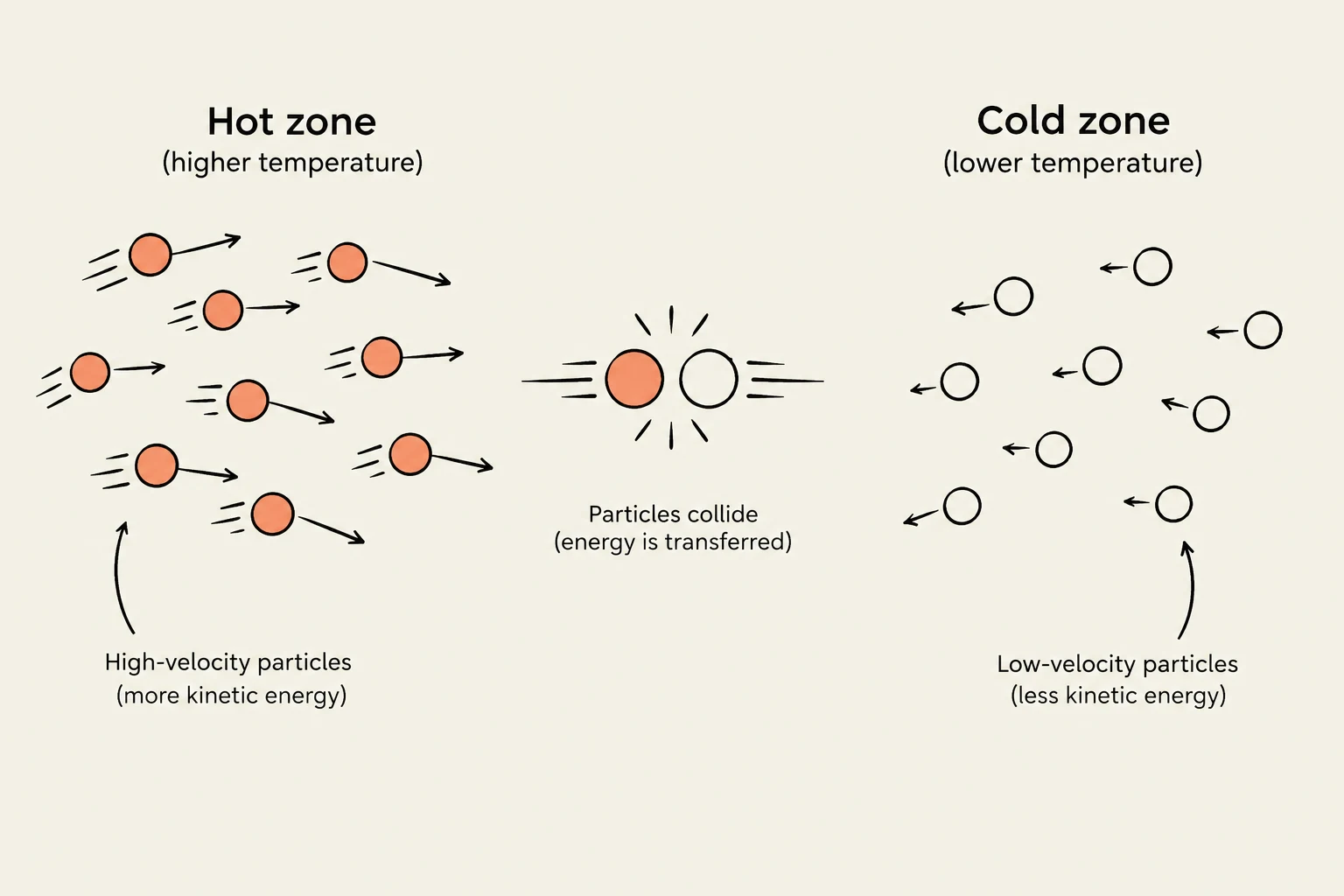
Heat is the transfer of energy driven by a temperature difference between a system and its surroundings. On a microscopic level, heat is the disorganized transfer of energy through the random motion of particles. When a hot object touches a cold one, the fast-moving particles in the hot object collide with the slower-moving particles in the cold object, transferring kinetic energy until thermal equilibrium is reached.
Because heat is tied to the random, chaotic motion of atoms and molecules, it is often described as "disordered" energy transfer. In thermochemistry, we use the symbol q to represent heat. If a system absorbs heat, q is positive; if the system releases heat to the surroundings, q is negative.
This diagram illustrates the concept of heat transfer through particle collisions. In a hot zone, particles have high velocity and kinetic energy. When these particles collide with particles in a cold zone, energy is transferred, causing the particles in the cold zone to gain kinetic energy and increase their velocity.
Exam Tip: Remember that heat is a path function. This means the amount of heat transferred depends on the specific process or "path" taken to get from state A to state B, not just the starting and ending points.
The Nature of Work (w)
Unlike the random motion associated with heat, work is the transfer of energy through organized motion. In physics and chemistry, work occurs when a force acts upon an object to cause a displacement. In a chemical context, this most commonly appears as "Pressure-Volume work" (P-V work), where a gas expands or contracts against an external pressure.
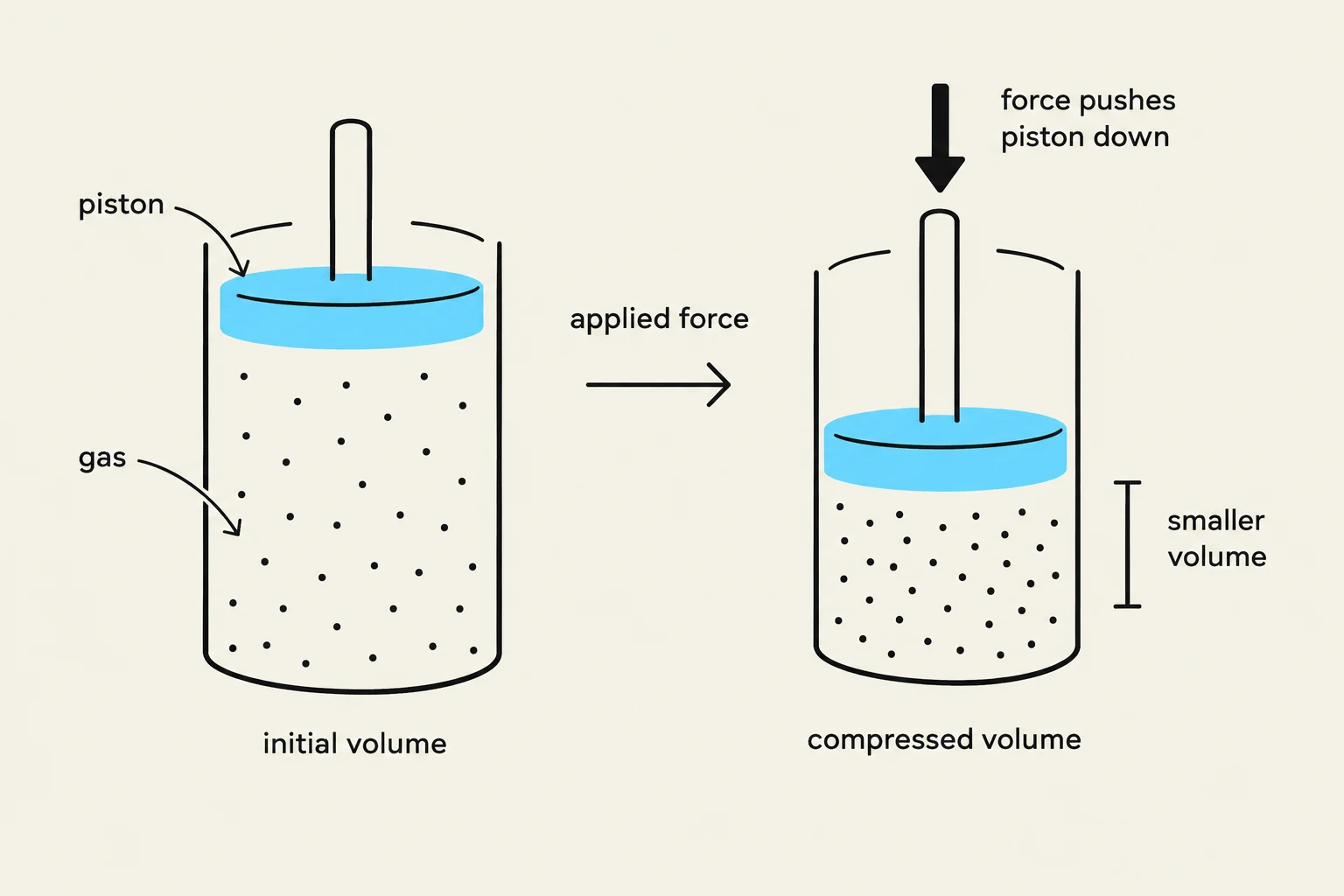
When a gas expands, it pushes against its surroundings, requiring energy to move the "piston" or the atmosphere. This energy comes from the system's internal reserves. Conversely, if the surroundings compress the gas, work is being done on the system, increasing its energy.
The mathematical expression for P-V work is:
w=−Pext⋅ΔV
Where:
w is the work done.
Pext is the external pressure.
ΔV is the change in volume (Vfinal−Vinitial).
This diagram illustrates the compression of a gas within a cylinder. An applied force pushes a piston down, reducing the volume occupied by the gas.
Comparing the Mechanisms
The fundamental distinction lies in how the energy is "packaged" during the transfer.
Feature
Heat (q)
Work (w)
Driving Force
Temperature difference (ΔT)
Force and displacement (F⋅d)
Microscopic View
Random particle collisions
Organized, directional motion
Order
Disordered/Chaotic
Ordered/Structured
While heat moves through the "jittery" vibrations and translations of molecules, work moves through a coordinated push or pull that affects the entire system's boundaries simultaneously.
The First Law of Thermodynamics
To understand how heat and work interact, we look to the First Law of Thermodynamics, which is essentially the law of conservation of energy applied to thermal systems. The law states that the change in the internal energy (ΔU) of a system is equal to the sum of the heat added to the system and the work done on the system.
The equation is expressed as:
ΔU=q+w
In this convention:
If q>0, heat is absorbed by the system (endothermic).
If q<0, heat is released by the system (exothermic).
If w>0, work is done on the system (e.g., compression).
If w<0, work is done by the system (e.g., expansion).
Worked Example: Gas Expansion
Let's apply these concepts to a practical scenario. Imagine a gas in a cylinder with a movable piston. The gas is at a constant external pressure of 1.50 atm. The gas expands from an initial volume of 2.00 L to a final volume of 5.00 L. How much work is done by the gas?
Step 1: Identify the variables.
Pext=1.50 atm
Vinitial=2.00 L
Vfinal=5.00 L
Step 2: Calculate ΔV.
ΔV=5.00 L−2.00 L=3.00 L
Step 3: Use the work formula.
www=−Pext⋅ΔV=−(1.50 atm)⋅(3.00 L)=−4.50 L⋅atm
Step 4: Convert to Joules (optional but common).
Since 1 L⋅atm=101.325 J:
ww=−4.50⋅101.325 J≈−455.96 J
Interpretation: The negative sign indicates that the system did work on the surroundings. The energy required to push the piston out came from the internal energy of the gas.
Keep reading for free.
Create an account to finish this reading and make it part of your study routine.