Health, Wellness, and the Human Dimensions of Care
This content defines health, wellness, and illness, exploring the multifaceted human dimensions that influence an individual's well-being. It also covers classifications of illness, risk factors, health disparities, levels of prevention, and effective health teaching strategies.
In the field of nursing and public health, understanding the distinction between being "healthy" and being "free from disease" is fundamental. Health is a multifaceted concept that integrates the physical, mental, and social aspects of a person's life. To provide effective care, clinicians must look beyond biological symptoms and consider the "whole person," recognizing that every individual responds to illness through a unique lens shaped by their environment, culture, and personal values.
Defining Health, Wellness, and Disease
The World Health Organization defines health as a state of complete physical, mental, and social well-being, rather than merely the absence of disease or infirmity. While the terms are often used interchangeably, there are critical distinctions between health, wellness, disease, and illness:
Wellness: An active state of being healthy by living a lifestyle that promotes good physical, mental, and emotional health.
Disease: A medical term referring to pathologic changes in the structure or function of the body or mind.
Illness: The individual's unique response to a disease; it is an abnormal process that results in a changed level of functioning.
Public health professionals measure the impact of health states on a population using two key metrics: morbidity, which refers to how frequently a disease occurs, and mortality, which refers to the number of deaths resulting from a disease.
The Human Dimensions: The Whole Person
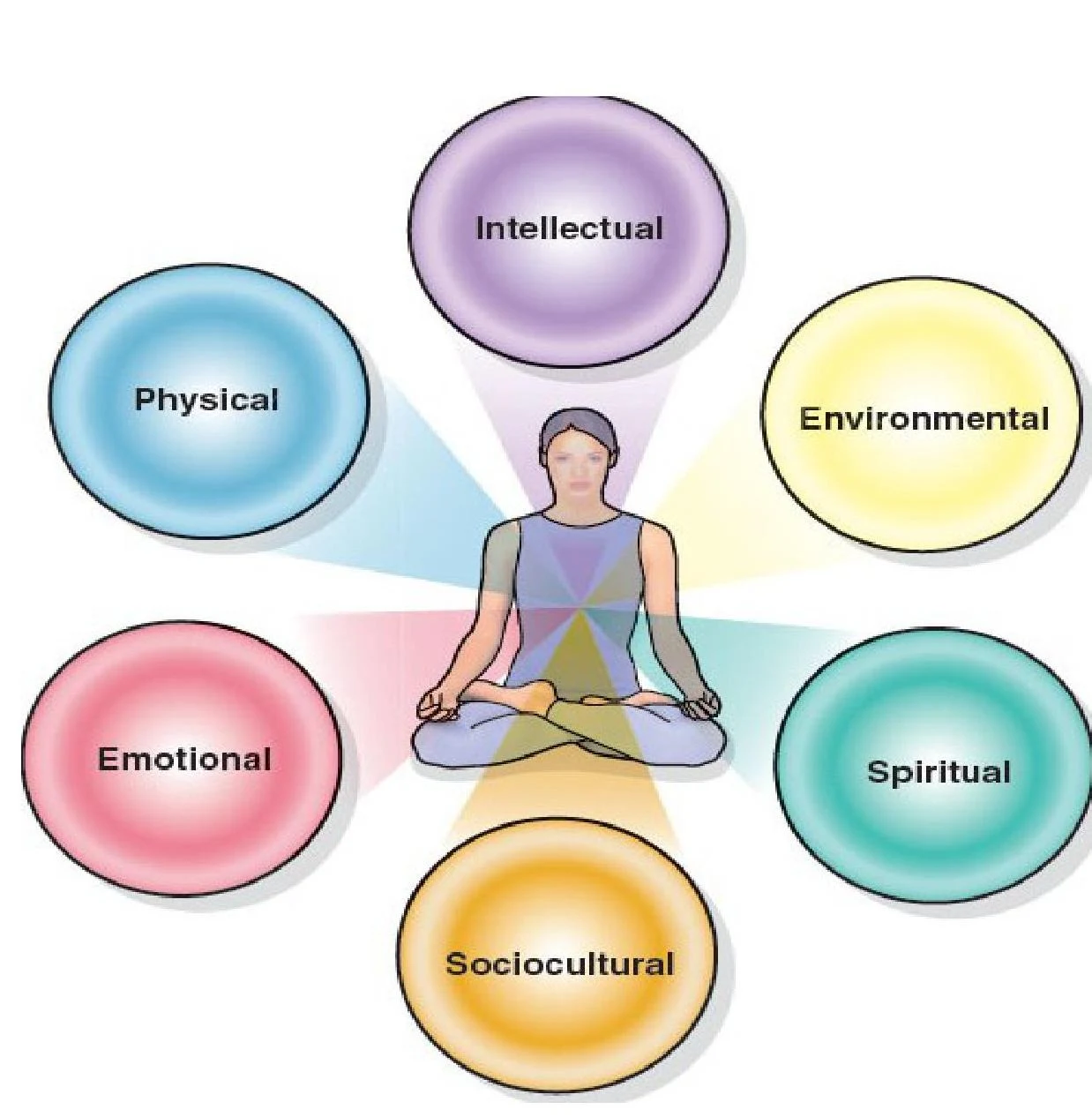
To provide holistic care, nurses must integrate the six interrelated human dimensions that compose the "whole person". These dimensions are not isolated; they influence one another constantly.
Diagram illustrating the six dimensions of wellness: physical, emotional, intellectual, sociocultural, environmental, and spiritual.
Physical: Includes genetic inheritance, age, developmental level, race, and gender.
Emotional: How the mind affects body function and how the body responds to various conditions.
Intellectual: Cognitive abilities, educational background, and past experiences.
Environmental: Factors such as housing, sanitation, climate, and the pollution of air, food, and water.
Sociocultural: Economic level, lifestyle, family, and culture.
Spiritual: An individual's spiritual beliefs and values.
A diagram illustrating the six dimensions of wellness: physical, emotional, intellectual, sociocultural, environmental, and spiritual, centered around a person in a meditative pose.
Classifications of Illness
Illness is generally categorized based on its onset and duration:
Acute Illness
Acute illnesses have a rapid onset of symptoms and last for a relatively short time. Examples include pneumonia, appendicitis, or the common cold. While some acute illnesses are life-threatening, medical treatment often aims to return the person to their normal state of function.
Chronic Illness
Chronic illnesses involve a slow onset and result in irreversible alterations to the normal state of anatomy and physiology. These conditions require long-term support, ongoing management, and often specialized rehabilitation.
Chronic conditions are characterized by fluctuations between two states:
Exacerbation: An increase in the severity of symptoms or a worsening of the condition.
Remission: A period where symptoms decrease or disappear. It is vital to note that even in remission, the disease is still present but controlled.
Risk Factors and Health Disparities
Health outcomes are influenced by various risk factors, which are divided into two categories:
Modifiable Risk Factors: Factors a person can change, such as health habits and lifestyle.
Non-modifiable Risk Factors: Factors that cannot be changed, such as age and genetic factors.
When looking at populations, we observe health disparities, which are differences in health outcomes among various groups. These disparities are largely driven by the social determinants of health, including income, education, access to healthcare, environment, housing, and culture. The goal of public health is to move toward health equity, ensuring everyone has a fair opportunity to attain their full health potential.
Levels of Prevention
Nurses utilize three distinct levels of prevention to promote health and manage disease:
Reduce disability and rehabilitate after diagnosis
Physical therapy for stroke patients, pulmonary rehab for COPD
Teaching and Learning: Facilitating Change
A key role of the nurse is health education. However, it is important to distinguish between education (the information provided by the nurse) and learning (the actual change in a patient's knowledge, attitude, or behavior).
Exam Tip: Remember the hierarchy of change. The easiest thing to change is knowledge, followed by attitudes, while the most difficult thing to change is behavior.
Domains of Learning
To ensure effective teaching, nurses must address the three domains of learning:
Cognitive Domain: Focuses on thinking, knowledge acquisition, and comprehension.
Affective Domain: Focuses on feelings, attitudes, and the development of values.
Psychomotor Domain: Focuses on physical actions and motor skills, requiring practice and sensory imagery.
The TEACH Mnemonic
To optimize patient education, clinicians can use the TEACH mnemonic:
Tune into the patient (Listen actively)
Edit information (Keep it patient-centered)
Act on every teaching moment (Every interaction is an opportunity)
Clarify often (Teach from the first encounter)
Honor the patient as a partner (Engage and motivate)
Evaluating Success
Because teaching does not always equal learning, nurses must evaluate outcomes. Common methods include:
Teach-back: Asking the patient to explain the information in their own words.
Return Demonstration: Asking the patient to perform a physical skill (essential for the psychomotor domain).
Observation and Q&A: Watching the patient apply a skill or answering questions to clarify misunderstandings.
When documenting, nurses should record the patient's response, the level of understanding demonstrated, any assistance required, and any barriers to learning encountered.
Keep reading for free.
Create an account to finish this reading and make it part of your study routine.