


Public health operates at the intersection of law, policy, and morality. While the primary goal of public health is to improve the well-being of populations, this mission often requires navigating complex legal frameworks and ethical dilemmas. Practitioners must constantly ask: How do we balance the rights of the individual against the needs of society? How should resources be distributed? And what are the legal boundaries of government intervention in health?
The Legal Landscape of Public Health
In the United States, the legal foundation for public health is unique. Interestingly, the U.S. Constitution does not explicitly mention "health". Instead, it functions as a "negative constitution," meaning it allows—but does not require—governments to act to protect public health or provide specific health services.
However, the federal government derives significant authority through the Interstate Commerce Clause (ICC). This clause allows federal agencies to set standards (such as those from the FDA or EPA) and provides the authority to use financial incentives to influence state-level programs like Medicaid. While the Constitution grants individual rights, many protections in healthcare are "inferred rights" that must be upheld by the courts.
Exam Tip: Remember that the U.S. Constitution is a "negative constitution" regarding health. It provides the permission for government action but does not mandate the provision of healthcare services.
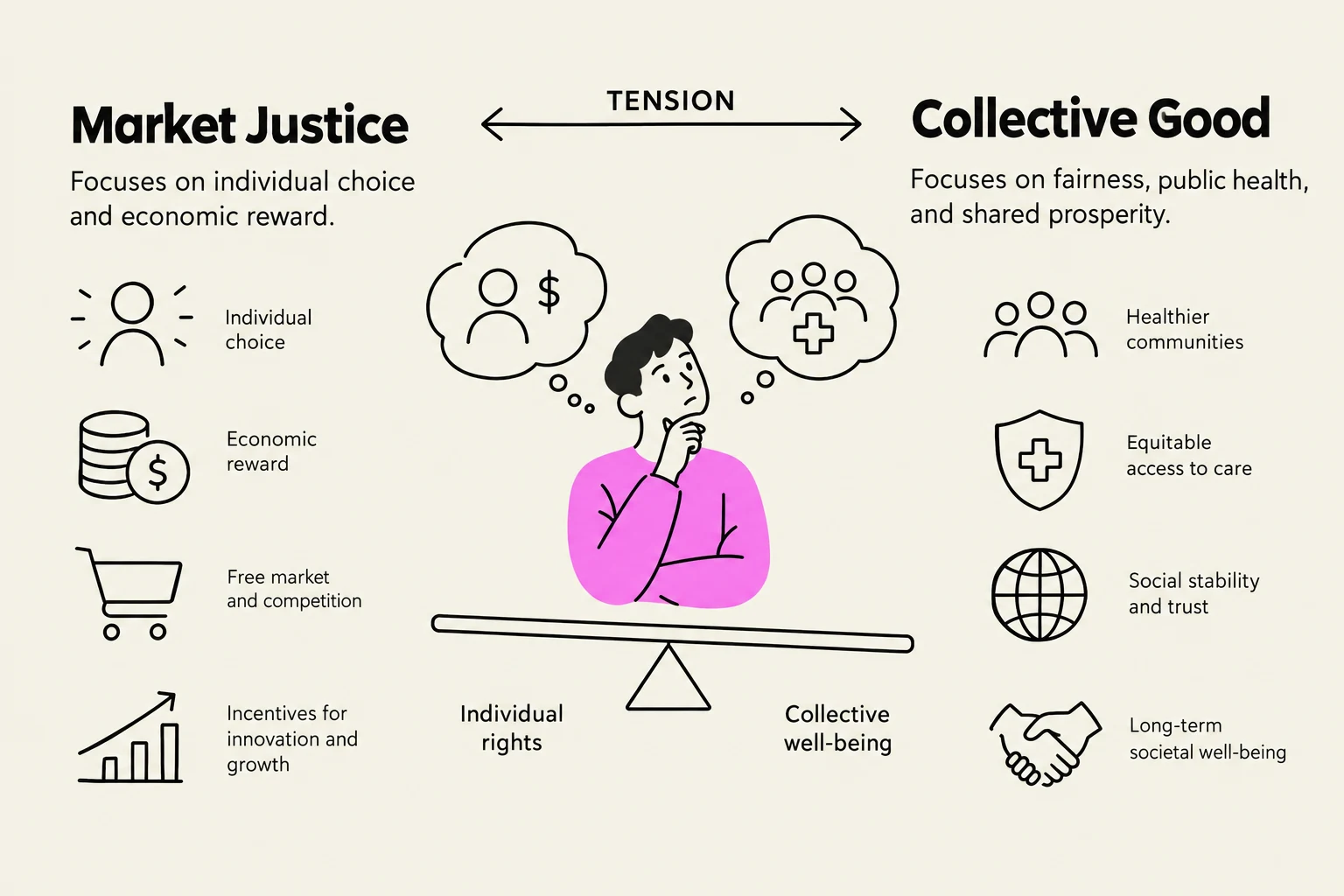
Philosophies of Health: Market vs. Social Justice
How a society approaches health policy often depends on its underlying philosophy regarding the role of government. There are two primary competing frameworks: Market Justice and Social Justice.
Market Justice views healthcare as an economic good. It emphasizes individual responsibility, freedom, and the efficiency of free markets. In this model, access to care is often seen as an economic reward for personal effort, and the distribution of services is determined by an individual's ability to pay.
Keep reading for free.
Create an account to finish this reading and make it part of your study routine.
Continue reading freeAlready have an account? Log in
Updated