


In a perfectly free market, the price of a good or service is determined by the natural intersection of supply and demand, known as the market equilibrium. However, governments often intervene in markets to achieve social or political objectives. One of the most common methods of intervention is through price controls. While a price ceiling sets a maximum allowable price, a price floor establishes a legal minimum on the price at which a good or service can be sold.
By implementing a price floor, the government ensures that prices do not fall below a specific, predetermined level, effectively prohibiting any transactions from occurring at a price lower than the mandated minimum.
Understanding the Price Floor
The actual impact of a price floor on a market is not determined by the policy itself, but rather by how that policy relates to the existing market equilibrium. Economists distinguish between two types of price floors: binding and non-binding.
The Non-binding Price Floor
A price floor is considered non-binding if it is set below the market equilibrium price. In this scenario, the natural market price is already higher than the legal minimum required by the government. Because the market is already operating at a price that satisfies the law, the policy has no actual effect on market behavior, the equilibrium price, or the quantity traded.
The Binding Price Floor
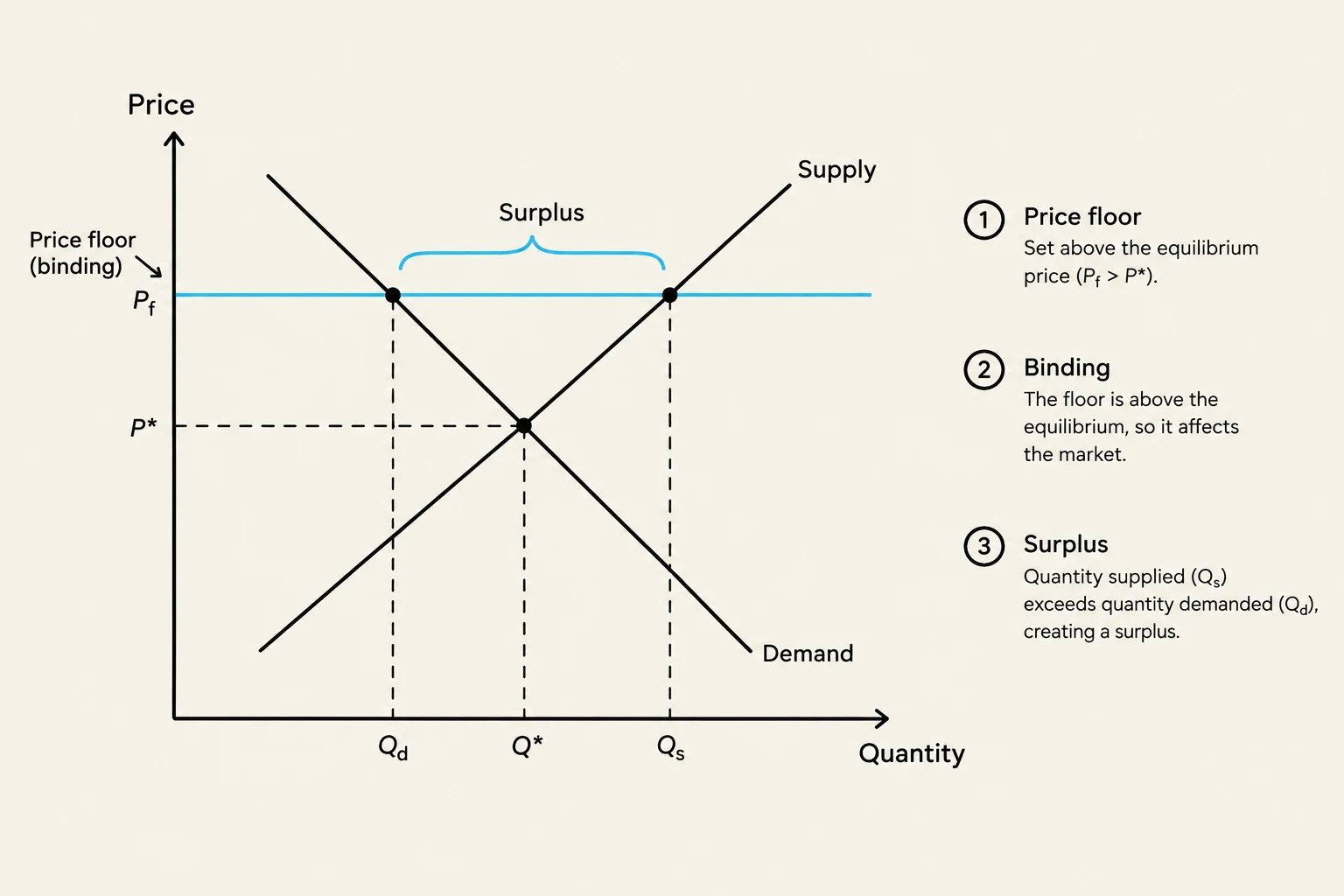
A price floor is binding only if it is set above the market equilibrium price. When the floor is binding, the market is legally prevented from reaching its natural balance. Because the price is forced upward, the quantity supplied by producers increases, but the quantity demanded by consumers decreases.
Keep reading for free.
Create an account to finish this reading and make it part of your study routine.
Continue reading freeAlready have an account? Log in
Updated