Global Religions and Cultural Influences on Business
Examines the history, adherents, and regional distributions of major world religions (Christianity, Islam, Hinduism, Buddhism, Judaism, Confucianism) and their impact on international business policy, marketing, and consumption.
In the realm of international business, understanding culture is not merely a social courtesy; it is a strategic necessity. Culture is defined as a set of values, beliefs, rules, and institutions held by a specific group of people. For global managers, developing "cross-cultural literacy"—the detailed knowledge of a culture that enables one to work effectively within it—is essential to avoid ethnocentricity, the belief that one's own culture is superior to others. One of the most profound components of culture is religion, which shapes the values, attitudes, and behaviors of billions of people across the globe.
The Major World Religions
Religions vary significantly in their origins, demographics, and core tenets. Understanding these distinctions helps businesses navigate different social landscapes.
Christianity
Originating in Palestine approximately 2,000 years ago, Christianity is the world's largest religion, boasting over 2 billion followers. It is characterized by a diverse array of more than 300 denominations. The most prominent of these include the Roman Catholic, Protestant, and Eastern Orthodox churches.
Islam
Islam is the world's second-largest religion, with approximately 1.3 billion adherents. Founded by the prophet Muhammad around A.D. 600 in Mecca, the faith is centered around the five pillars of faith.
Hinduism
Formed roughly 4,000 years ago in present-day India, Hinduism is often viewed as a way of life rather than a traditional religion. It has about 900 million followers, with over 90% of them residing in India. A core belief in Hinduism is reincarnation, the idea that human souls are reborn into new forms; consequently, many strict practitioners avoid harming any living creature.
Buddhism
Founded in India about 2,600 years ago, Buddhism has roughly 380 million followers. While it shares a focus on spiritual matters with Hinduism, Buddhism explicitly rejects the Indian caste system. In formal ceremonies, devotees take refuge in the three jewels: Buddha, Dharma, and Sangha.
Judaism
As the first monotheistic religion, Judaism is over 3,000 years old and has approximately 18 million followers. It is defined by key observances such as the Sabbath, Rosh Ha-Shanah, Yom Kippur, Passover, and Hanukkah.
Confucianism
Unlike the other systems mentioned, Confucianism is based on the ethical teachings of Confucius from nearly 2,500 years ago. Rather than focusing on deity worship, it emphasizes ethical principles that influence the social and organizational structures of China, Japan, and South Korea.
Regional Distribution of Faith
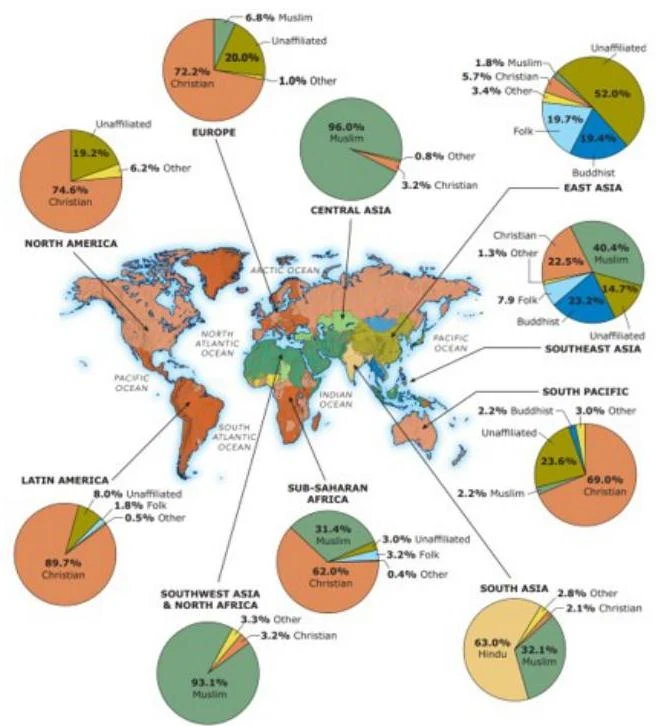
Religions are not distributed evenly across the globe. Their concentration in specific geographic areas dictates where certain business practices or marketing strategies may be most relevant.
This world map illustrates the religious demographics of various regions, including Europe, North America, Latin America, Central Asia, East Asia, Southeast Asia, South Pacific, Sub-Saharan Africa, Southwest Asia & North Africa, and South Asia, with pie charts showing the percentage distribution of major religions and unaffiliated populations in each area.Source: Adapted from Figure 6-7: Most Numerous Religions by Region, in (Revel) James Rubenstein, Human Geography: The Cultural Landscape, 13e (2020), by Pearson Education.
Christianity: Global presence, but major concentrations exist in the Americas, Europe, and Sub-Saharan Africa.
Islam: Concentrated in North Africa, the Middle East, Central Asia, Pakistan, and parts of Southeast Asia, such as Indonesia.
Hinduism: Primarily centered in India and Nepal.
Buddhism: Primarily found in East and Southeast Asia, including China, Tibet, Korea, Japan, Vietnam, and Thailand.
Confucianism: Deeply ingrained in the cultures of East Asian nations like China, Japan, and South Korea.
Exam Tip: When studying religious distribution, remember that while many religions have global followers, their concentration (the highest density of adherents) is often tied to specific historical and geographic regions.
Impact on Business Policy and Consumption
Religion is a powerful driver of consumer behavior and corporate policy. Businesses that fail to account for religious influences risk alienating entire markets or facing significant backlash.
Marketing and Consumption
Religious dietary restrictions and holidays are critical factors for marketers. For example, strict Jewish dietary laws must be respected when marketing food products. Similarly, the Hindu belief in reincarnation and the sanctity of life can influence consumer preferences regarding animal products.
Business Policy and Social Influence
Religious organizations can exert significant pressure on business policies through social causes and consumer boycotts. For instance, companies like the Walt Disney Company have faced boycotts related to social and religious values. Furthermore, Confucianism can manifest in the very way a company is run; in South Korea, for example, business organizational structures often reflect Confucian ethical principles.
Organizational Structure
In some cultures, religious or ethical systems dictate how authority and responsibility are viewed. In Confucian-influenced cultures, the emphasis on group harmony and respect for hierarchy can shape how management and employees interact within a firm.
Case Study: The Cultural Lens
Consider a company launching a new food product. In a region with a high concentration of Muslims, the company must ensure compliance with Islamic dietary laws. In a Hindu-majority region, they might avoid beef-based ingredients entirely to respect the belief in the sanctity of living creatures.
By integrating religious and cultural knowledge into their strategic planning, international firms can move beyond mere survival and achieve true cross-cultural literacy.
Keep reading for free.
Create an account to finish this reading and make it part of your study routine.