


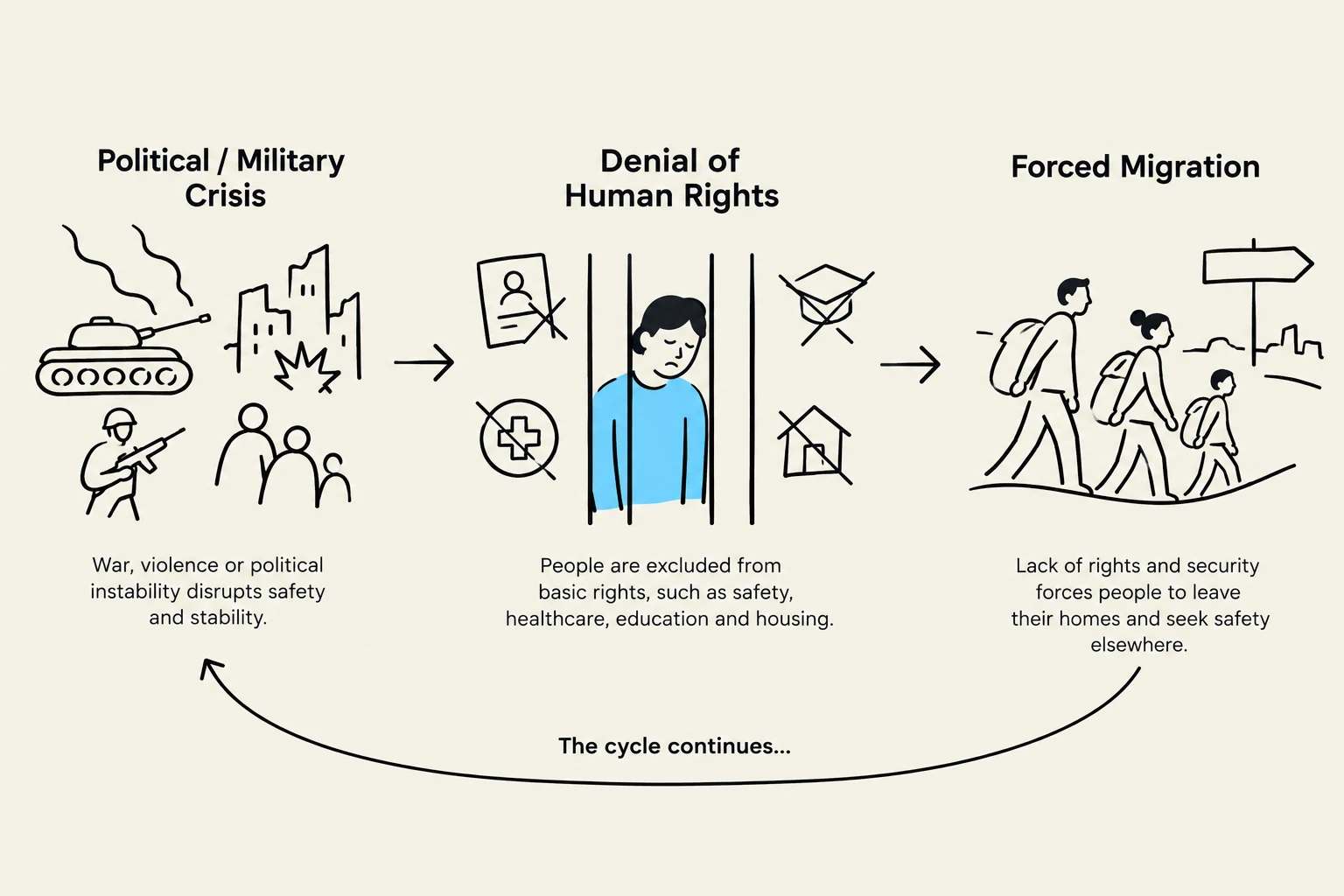
Migration is often discussed in the news as a series of statistics, waves, or "floods." However, beneath these macro-level descriptions lies a complex web of individual decisions driven by the fundamental need for self-preservation. Global migration is rarely a choice made in a vacuum; rather, it is a response to systemic failures, political violence, and the denial of basic human rights in "sending countries". To understand migration, we must look past the political rhetoric and examine the specific geopolitical drivers and the human agency of those in transit.
Major Global Migration Corridors
Migration flows are not uniform; they follow specific geographic and political corridors shaped by the crises in their respective regions.
The Mediterranean Sea Route
One of the most perilous pathways is the Mediterranean Sea route. This corridor serves as a junction for migrants from diverse regions:
- West Africa: Including countries such as Nigeria and Niger.
- East Africa: Specifically Eritrea, Somalia, and Sudan.
- West Asia: Most notably Syria.
The journey across the Mediterranean is frequently tragic, with thousands of individuals losing their lives to drowning during these attempted voyages.
The Rohingya Crisis in Southeast Asia
While much media attention focuses on routes toward Europe or North America, significant crises occur within regional borders. In Myanmar, the Rohingya—a Muslim minority in a predominantly Buddhist nation—faced extreme persecution. The Myanmar government stripped them of their citizenship, leading to widespread torture, disappearance, and arrest. This forced millions to flee to neighboring countries, such as Bangladesh, where they reside in massive refugee camps.
Central American Flows
Another major corridor involves migration from South and Central American nations, such as Venezuela and Colombia, moving through Guatemala and Mexico toward the United States border.
Keep reading for free.
Create an account to finish this reading and make it part of your study routine.
Continue reading freeAlready have an account? Log in
Updated