Global Funding Access for Multinational Corporations
This guide explores how multinational corporations (MNCs) leverage international financial markets, including forex, money, credit, stock, and bond markets, to optimize their cost of capital and fuel global growth. It details various debt and equity instruments like Eurobonds, ADRs, and GDRs, and discusses strategic li
For Multinational Corporations (MNCs), the ability to move capital across borders is not just a logistical necessity; it is a strategic tool for value maximization. By accessing diverse international financial markets, MNCs can exploit market asymmetries—such as differences in interest rates, regulatory environments, and currency valuations—to lower their overall cost of capital. Whether seeking short-term liquidity or long-term structural financing, the modern MNC operates within a complex web of interconnected markets that require sophisticated management of exchange rate risks and regulatory compliance.
The Landscape of International Financial Markets
MNCs do not rely on a single source of funding. Instead, they navigate a hierarchy of markets categorized by the duration and purpose of the funds required:
Foreign Exchange (Forex) Market: The foundation of all international transactions, used to exchange currencies for imports, exports, and hedging.
International Money Market: Used for short-term funding and managing immediate cash flow needs.
International Credit Market: Provides medium-term loans to support business operations.
International Stock and Bond Markets: The primary venues for securing long-term financing.
This diagram illustrates the various financial components and relationships of a Parent Multinational Corporation (MNC), including Forex, Money markets, Capital Markets, International Investors, and Global Banks.
Exam Tip: When analyzing MNC funding, always distinguish between the duration of the instrument (short-term vs. long-term) and the market type (money market vs. capital market).
Long-Term Debt: International Bond Markets
When an MNC needs to raise significant long-term capital, it often looks beyond its domestic borders to the international bond market. This allows the firm to tap into deeper pools of liquidity or take advantage of lower interest rates in specific jurisdictions.
Categorizing International Bonds
Bonds are classified by how they are issued and the currency in which they are denominated:
Foreign (Exotic) Bonds: These are issued by a foreign borrower in a host country's currency and market. Common examples include Yankee bonds (issued in the US) and Samurai bonds (issued in Japan).
Eurobonds: A highly flexible instrument, these are denominated in a currency other than that of the country where they are sold (e.g., a US dollar-denominated bond sold in Europe).
Parallel Bonds: A hybrid strategy where an MNC splits a single issuance to sell bonds in multiple currencies simultaneously.
Specialized Debt Instruments
To manage the inherent risks of international lending, firms use specialized tools:
Fully Hedged Bonds: These utilize forward markets to eliminate the risk of currency fluctuations.
Floating Rate Notes (FRNs): Bonds with variable interest rates that adjust based on market benchmarks.
Foreign Currency Convertible Bonds: Debt that can be converted into equity, offering investors a way to participate in the firm's growth.
Long-Term Equity: International Stock Markets
While bonds represent debt, issuing stock allows an MNC to raise equity capital through Initial Public Offerings (IPOs) for new listings or Seasoned Equity Offerings (SEOs) for existing public companies.
Beyond just raising money, international listings offer strategic advantages: they can increase brand recognition in new markets, provide access to more sophisticated and efficient exchanges (like the US market), and diversify the shareholder base to reduce price volatility.
Mechanisms for Global Equity Access
Because trading stocks across borders can be legally and logistically difficult, several instruments have been developed to facilitate access:
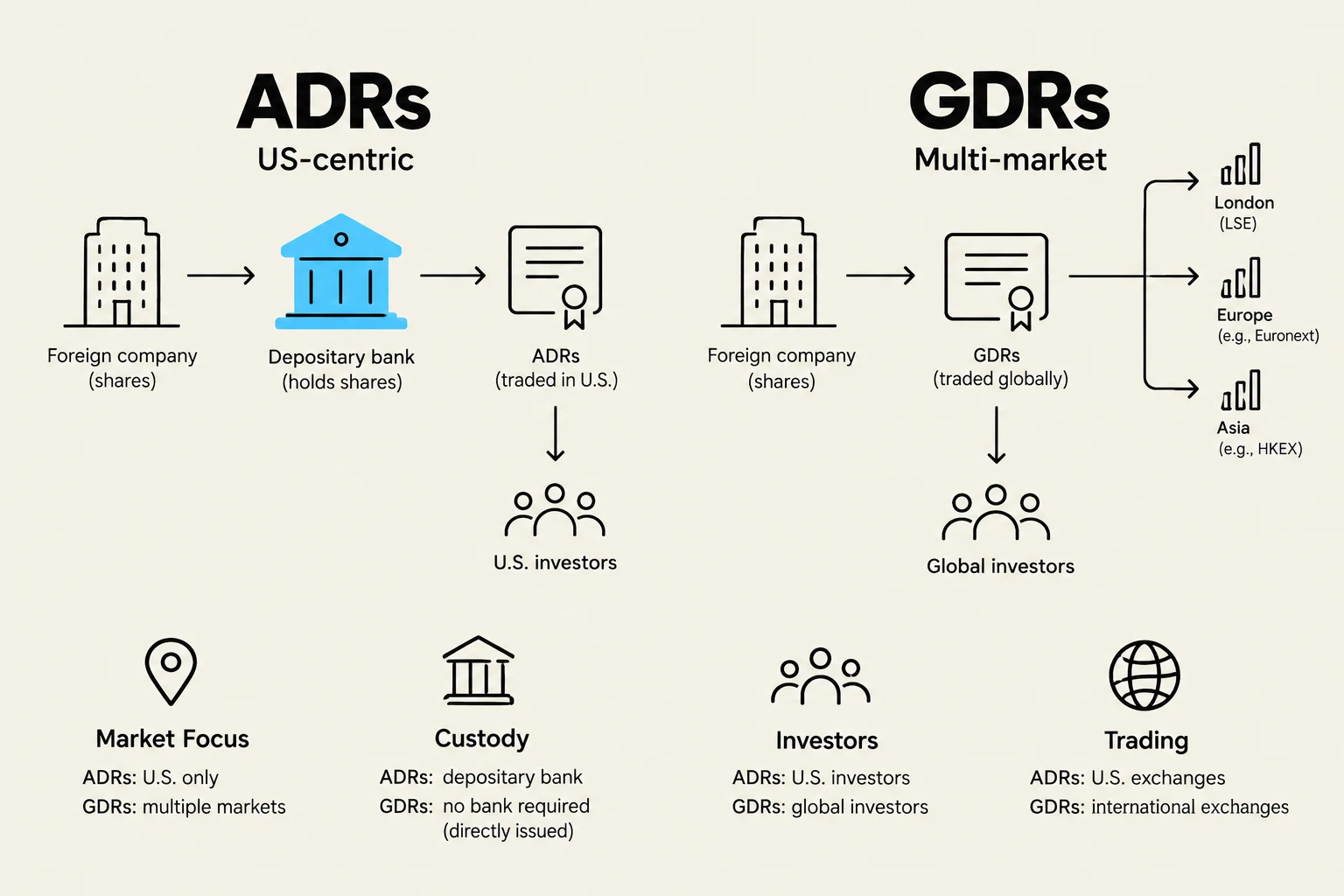
American Depository Receipts (ADRs): These are certificates representing bundles of foreign stocks that trade in the US. They allow non-US firms to access US capital while making it easy for American investors to hold them without dealing with foreign exchanges.
Global Depositary Receipts (GDRs): Similar to ADRs, but they can be traded across multiple global markets, excluding the US.
Global Registered Shares (GRS): These are highly integrated securities that trade in multiple currencies and can be transferred across borders without conversion, with shareholders holding the shares directly.
This diagram illustrates the differences between American Depositary Receipts (ADRs) and Global Depositary Receipts (GDRs), detailing their market focus, custody, investor base, and trading mechanisms.
Listing Strategies: Dual vs. Cross-Listing
MNCs must decide how to present themselves to the world. Dual listing involves listing on two or more exchanges to maximize liquidity and capital access. In contrast, cross-listing refers to listing on exchanges other than the company's primary home exchange, often as a more cost-effective way to gain international visibility.
Case Study: The Strategic Dilemma of Prada
The complexities of global funding are best illustrated by the real-world challenges faced by luxury brand Prada. In the early 2000s and again in 2011, Prada evaluated various ways to raise capital for expansion:
The Bond Option: Prada could have issued bonds in different markets. For instance, issuing Eurobonds in Asia could have allowed them to tap into high demand while avoiding the volatility of the Chinese yuan by denominating the debt in US dollars.
The Equity Option (IPO): Prada considered an IPO in Hong Kong to benefit from higher valuations in Asia, or a primary listing in Milan followed by a Hong Kong depositary receipt.
Ultimately, Prada's experience shows that market timing is as important as market choice. External shocks—such as the September 11th attacks, the WorldCom scandal, or the 2008 financial crisis—can force even the most well-planned international funding strategies into postponement.
Summary Table: Equity Access Comparison
Instrument
Primary Market
Ownership Type
Key Advantage
ADR
United States
Held by Depositary Bank
Access to US liquidity/efficiency
GDR
Global (excl. US)
Held by Depositary Bank
Access to multiple international pools
GRS
Multiple
Held directly by Investor
Seamless cross-border transfer
Conclusion
Navigating global funding requires a deep understanding of the interplay between debt and equity, currency risk and interest rate differentials. By leveraging international bond and stock markets, MNCs can optimize their capital structure and fuel global growth, provided they can manage the regulatory and economic complexities inherent in a multipolar financial system.
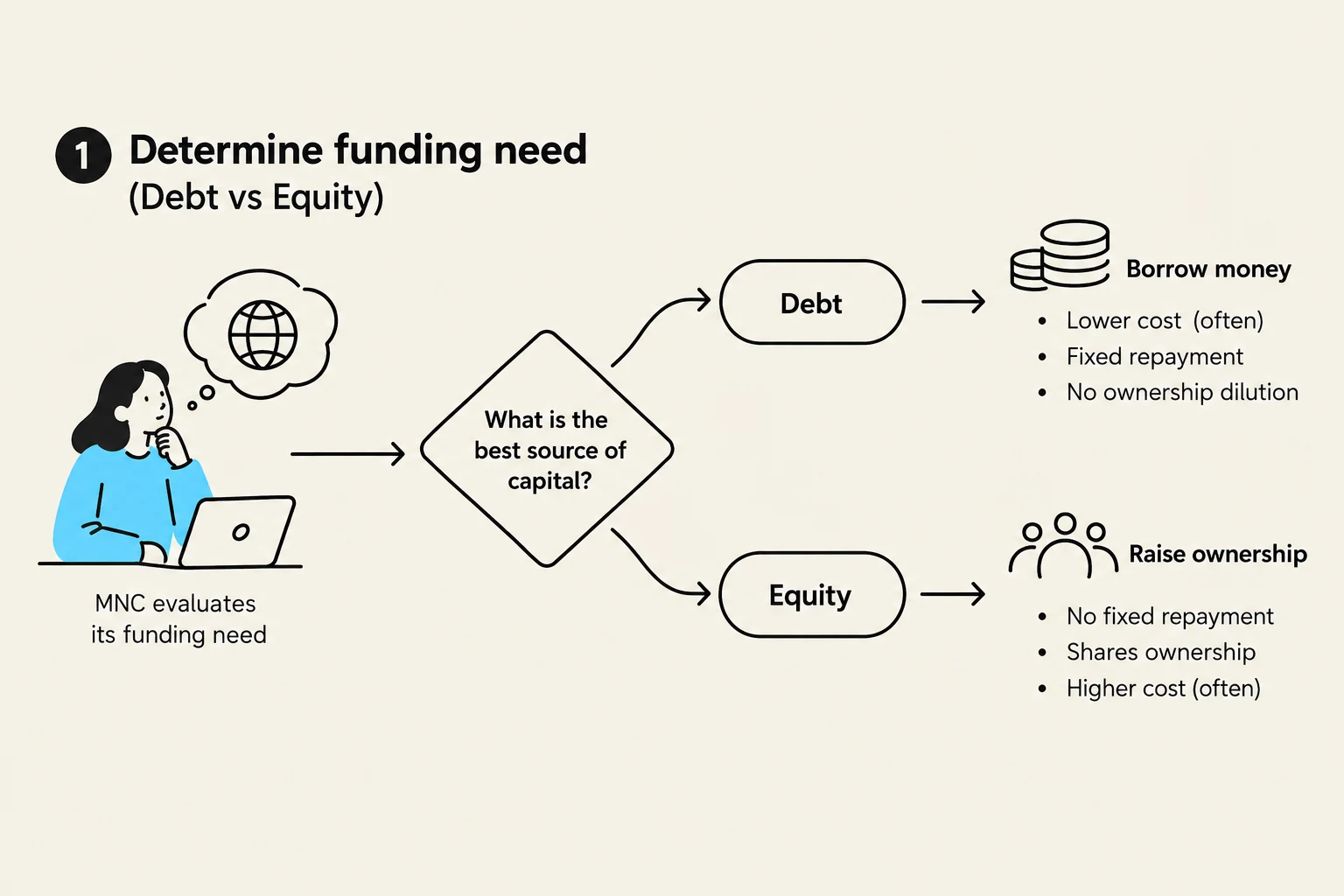
This diagram illustrates the decision-making process for a company to determine its funding needs, comparing debt and equity financing options. It outlines the characteristics of each, such as cost, repayment terms, and ownership implications.
Keep reading for free.
Create an account to finish this reading and make it part of your study routine.