Explains the fundamental drivers of global climate patterns, including solar radiation, atmospheric circulation cells, the Coriolis effect, and ocean currents. It also details how these global patterns influence regional climates, biomes, and aquatic environments, and discusses biological responses to these physical dr
Understanding the natural world requires a clear distinction between short-term atmospheric conditions, known as weather, and the long-term average of these patterns, known as climate. While weather tells us what is happening outside right now, climate describes the predictable patterns of temperature and precipitation that define a region over significant periods of time. These patterns are not random; they are driven by fundamental physical processes involving solar radiation, the Earth's rotation, and the movement of air and water.
The Drivers of Global Climate Patterns
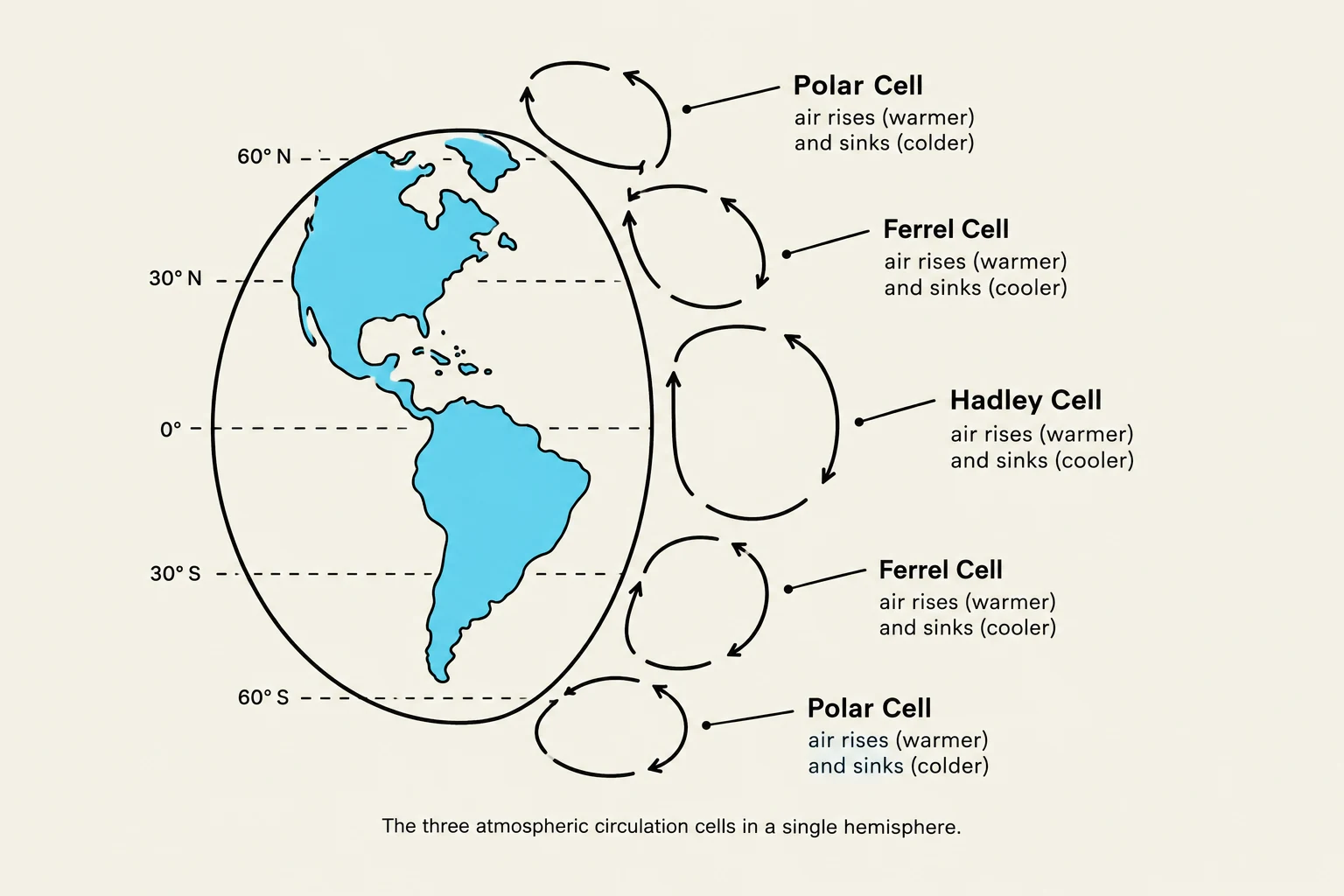
Diagram illustrating the three atmospheric circulation cells (Hadley, Ferrel, and Polar) in a single hemisphere, showing air rising and sinking at different latitudes.
The primary engine of Earth's climate is the unequal heating of the Earth's surface via radiation. Because the sun's rays are most intense when they strike the Earth directly overhead, the tropical regions at lower latitudes receive concentrated solar energy. In contrast, higher latitudes receive sunlight at a more oblique angle, spreading the same amount of energy over a larger area, which results in cooler temperatures.
This differential heating, combined with the Earth's tilt, creates significant seasonal changes in temperature, sunlight intensity, and day length. At any specific location, the temperature is determined by the delicate balance between energy gains (solar radiation absorbed) and energy losses (radiation emitted back into space).
Atmospheric Circulation Cells
To redistribute this unequal heat, the atmosphere organizes itself into three distinct circulation cells in each hemisphere:
Hadley Cell: Located near the equator.
Ferrel Cell: The mid-latitude cell.
Polar Cell: Located near the poles.
The Coriolis Effect and Ocean Currents
The movement of air within these cells is not a straight line from equator to pole. Because the Earth rotates—at a rate of 15∘ per hour—moving air masses are deflected. This phenomenon is known as the Coriolis effect.
Exam Tip: Remember the direction of deflection! In the Northern Hemisphere, air currents are deflected to the right, while in the Southern Hemisphere, they are deflected to the left.
These wind patterns do more than just move air; as they sweep across the ocean surface, they drive ocean surface currents. This interaction between the atmosphere and the ocean is vital for global heat transport.
Regional Climate and Biomes
While global patterns set the stage, local geography determines the specific environment of a region. One way biologists categorize these environments is through biomes—areas classified based on their terrestrial plant communities.
The distribution of biomes is dictated by two key abiotic factors: temperature and precipitation. Similar climates tend to host organisms with similar adaptations.
Latitude and Elevation Gradients
Both latitude and elevation create predictable transitions in biological communities:
Feature
Low/Low Elevation
Mid/Mid Elevation
High/High Elevation
Latitude Gradient
Tropical Forest
Deciduous/Coniferous Forest
Tundra → Polar Ice
Elevation Gradient
Tropical Forest
Deciduous/Coniferous Forest
Tundra → Mountain Ice
Local Geographic Influences
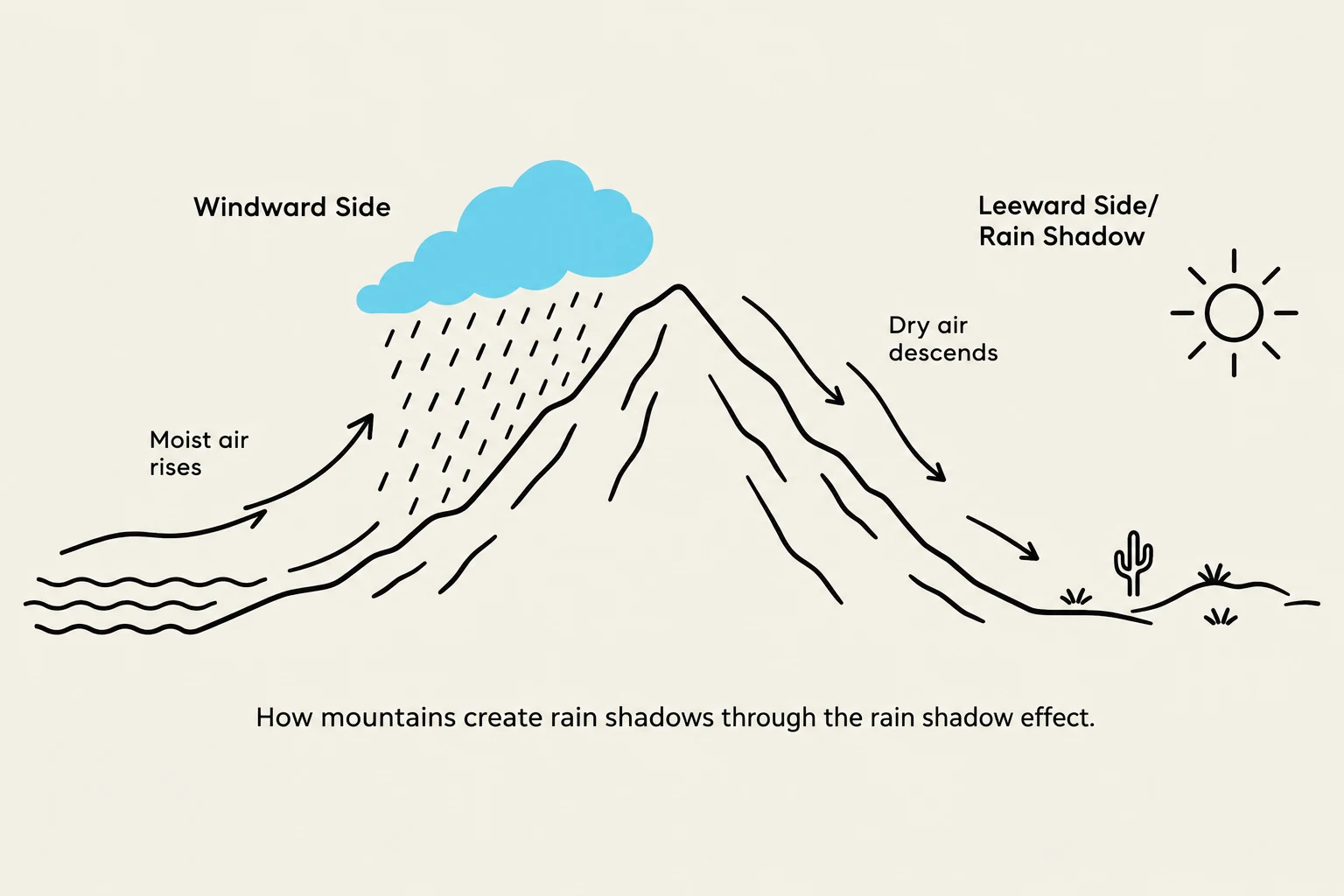
This diagram illustrates how mountains create rain shadows due to the rain shadow effect. Moist air rises on the windward side, causing precipitation, while dry air descends on the leeward side, resulting in a drier climate.
Regional climates are further modified by several landscape features:
Water Proximity: Large bodies of water moderate seasonal temperature changes, whereas the center of a large continent experiences more extreme fluctuations.
Mountains and the Rain Shadow Effect: Mountains create distinct microclimates. As air rises over a mountain, it cools and loses moisture (the windward side), often resulting in high precipitation. As the air descends on the other side (the leeward side), it warms and dries out, creating a "rain shadow".
Mountain-Valley Breezes: These are daily cycles driven by unequal heating. During the day, warmer, less dense air rises up the slopes (a valley breeze). At night, cooler, denser air flows down from higher elevations into the valley (a mountain breeze).
Aquatic Environments
The ocean covers 70% of the Earth's surface and stores a thousand times more heat than the atmosphere. In aquatic ecosystems, environmental variation is driven by changes in light, temperature, and nutrients along the depth of the water.
Vertical Stratification
Vertical stratification of temperature, oxygen, and nutrients in the ocean.
Water is most dense at 4∘C. This can lead to stratification, where warm surface water sits on top of colder, denser water, preventing the layers from mixing. A critical transition zone is the thermocline, a layer where temperature decreases rapidly with depth.
Environmental profiles in the ocean typically show:
Oxygen: Highest at the surface (due to atmospheric exchange and photosynthesis) and declining with depth.
Nutrients: Low at the surface (consumed by primary producers) and high at depth (due to the decomposition of sinking organic matter).
Upwelling: A Biological Engine
A vital process in marine ecology is upwelling. This occurs when prevailing winds blow parallel to a coastline, pushing surface water away and allowing deep, cold, nutrient-rich water to rise to the surface. This influx of nutrients significantly increases primary productivity, supporting complex food webs.
Biological Responses to Physical Drivers
Physical environments do not just sit passively; they force organisms to adapt or move. A classic example is bird migration. Some species, such as the Common Swift (Apus apus), undertake massive journeys—up to 30,000 km round-trip annually—to move between breeding sites in Eurasia and wintering areas in Africa. These movements are direct biological responses to the seasonal shifts in resources and climate driven by the Earth's physical systems.
Keep reading for free.
Create an account to finish this reading and make it part of your study routine.