


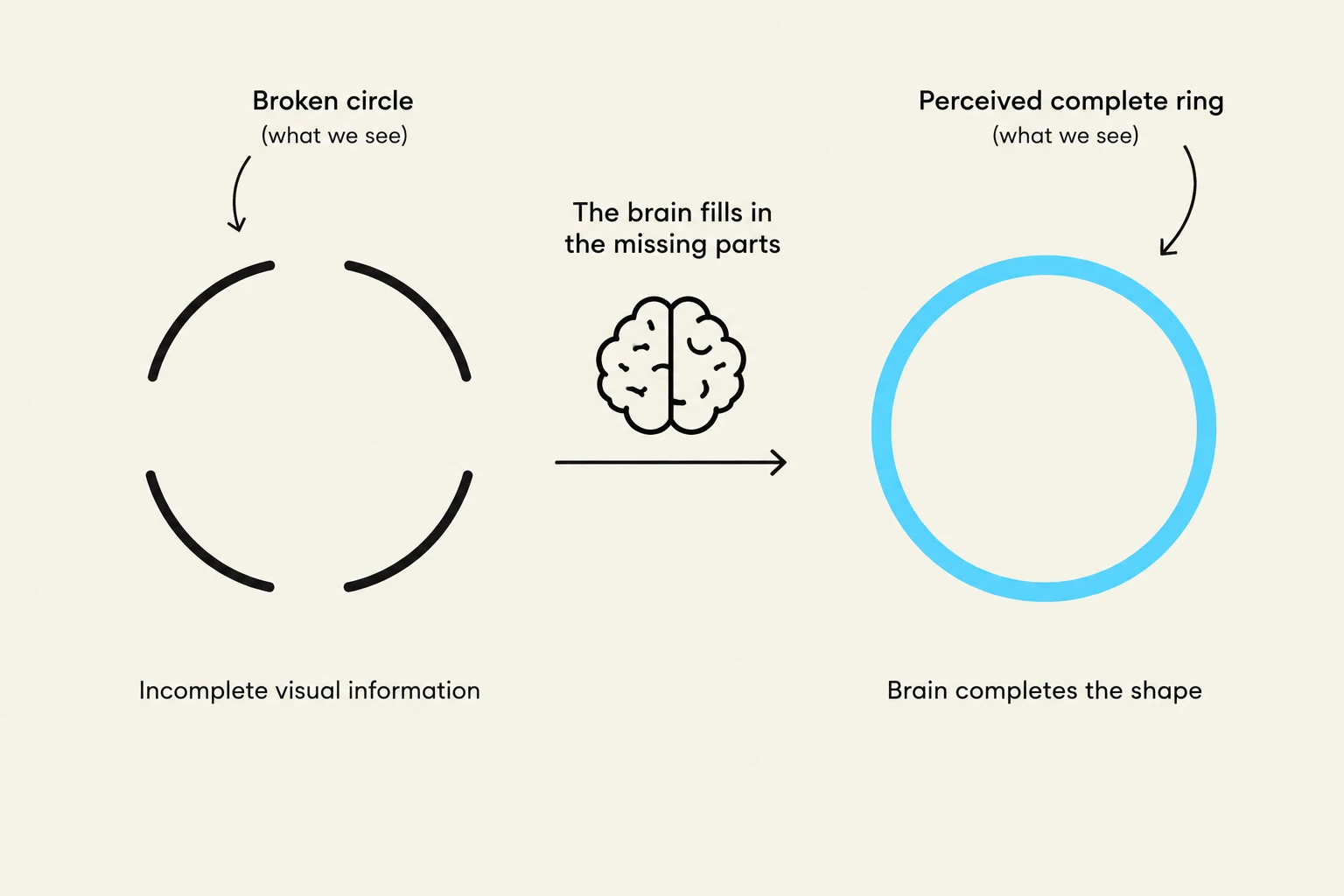
Have you ever looked at a series of disconnected dots and seen a perfect circle, or watched a group of birds flying in formation and perceived them as a single, moving entity? This ability to see patterns where there is only raw data is not a coincidence; it is a fundamental aspect of how the human brain functions. While sensation involves the simple detection of physical energy by our sensory organs, perception is the much more complex process of attending to, organizing, and interpreting that sensory input.
Gestalt psychology focuses specifically on this second stage. It seeks to understand the laws that allow us to acquire and maintain meaningful perceptions in what might otherwise appear to be a chaotic world.
The Core Principle: The Law of Pragnanz
At the heart of Gestalt theory is the Law of Pragnanz. This principle suggests that when we are presented with a complex or ambiguous set of stimuli, our brains naturally organize them into the simplest, most stable, and most meaningful form possible. Instead of struggling to process every tiny, disconnected detail, our minds take a "shortcut" to create a coherent mental image.
Exam Tip: If a question asks why we see a complex shape as a simple square rather than a collection of many small triangles, the answer is the Law of Pragnanz. Our brains prioritize simplicity and stability.
Principles of Perceptual Organization
To achieve this simplicity, the brain utilizes several specific "rules" or laws of organization. These laws dictate how we group individual elements into unified wholes.

Keep reading for free.
Create an account to finish this reading and make it part of your study routine.
Continue reading freeAlready have an account? Log in
Updated