


When you look at a photograph of a forest, you do not see millions of individual green pixels or a chaotic collection of disconnected lines; instead, you see "a forest". This ability to perceive meaningful patterns rather than just a collection of sensory data is the foundation of Gestalt psychology. The term Gestalt is a German word that refers to a whole form, pattern, or configuration.
The core premise of this psychological framework is that the human mind perceives objects as entire configurations rather than merely the sum of their individual parts. While sensation involves our sensory receptors detecting stimuli, perception is the active process by which the brain organizes and interprets that information to create a coherent mental representation.
The Figure-Ground Relationship
One of the most fundamental ways our brain organizes visual information is through the Figure-Ground relationship. This principle dictates that our visual field is organized into two distinct components:
- The Figure: The object of focus, the primary shape, or the item that stands out.
- The Ground: The background or the surrounding area against which the figure is perceived.
In any given visual scene, your brain must decide which elements constitute the "subject" and which constitute the "backdrop." If this distinction becomes blurred, or if the brain struggles to assign which part is the figure and which is the ground, we encounter visual ambiguity.
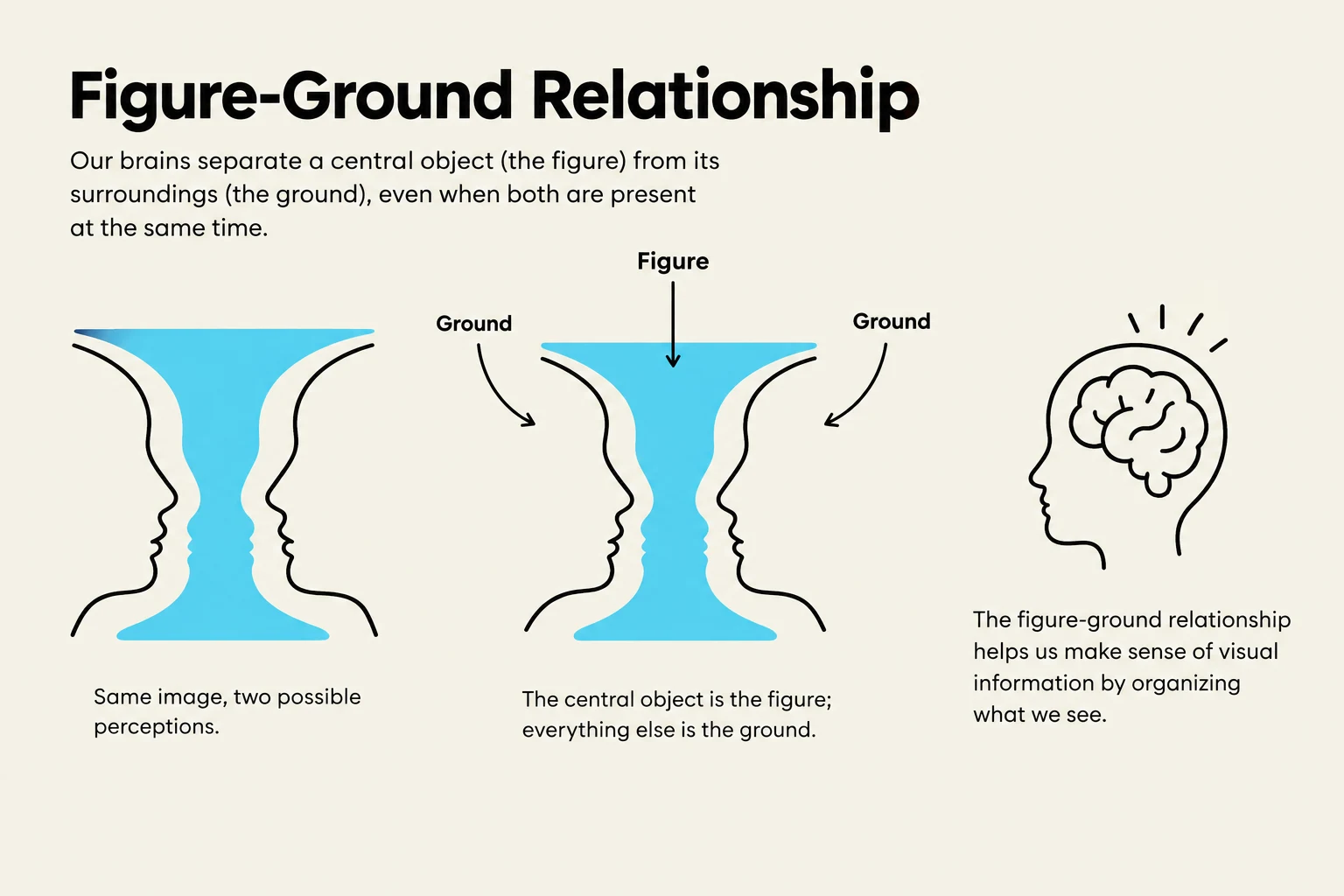
Study Tip: Think of a black silhouette of a person against a white wall. The person is the figure, and the wall is the ground. If you were to look at a "Rubin Vase" illusion, your brain would constantly flip between seeing a vase (figure) and two faces (figure) against a white background (ground).
Keep reading for free.
Create an account to finish this reading and make it part of your study routine.
Continue reading freeAlready have an account? Log in
Updated