Geopolitical Boundaries and the Construction of European Identity
Examines how European identity is a historical construction shaped by shifting geopolitical boundaries, selective narratives, and mechanisms of othering, rather than a fixed geographic entity. Discusses the tension between liberal and illiberal frameworks, the role of political myths, and the evolution of the state and
The concept of "Europe" is often perceived as a natural, stable geographic entity. However, historical analysis reveals that European identity is not a fixed phenomenon but a continuous historical construction shaped by shifting geopolitical boundaries and selective narratives. From the religious definitions of the Middle Ages to the complex supranational structures of the modern European Union, the borders that define "us" versus "them" have always been in flux. Understanding Europe requires looking beyond maps to examine the mechanisms of identity formation: how certain groups are included, how others are excluded, and how political myths are used to justify modern power structures.
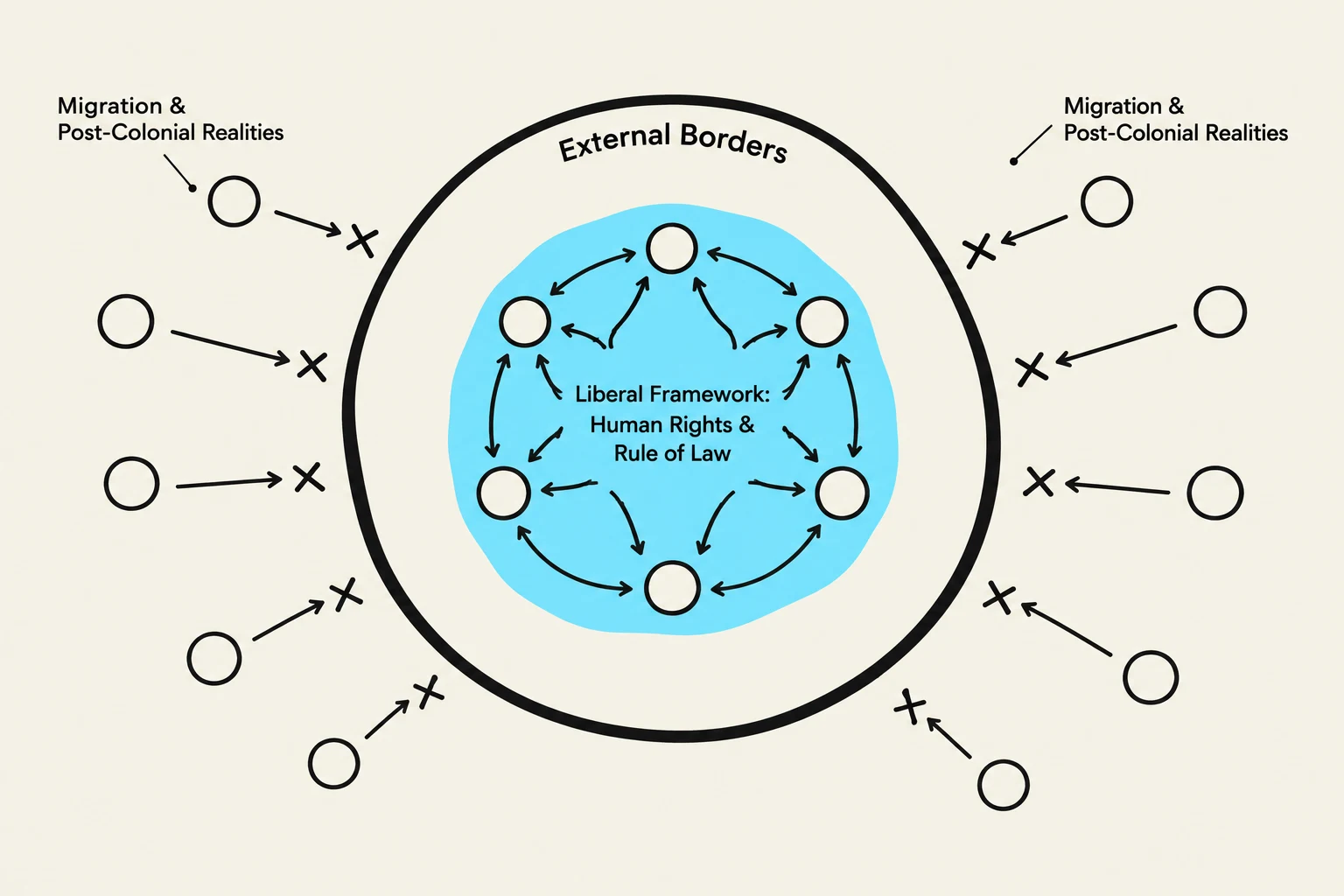
Diagram illustrating the concept of external borders and their relationship to a liberal framework of human rights and the rule of law, with external factors labeled as 'Migration & Post-Colonial Realities'.
The Fluidity of Boundaries and the Modern Divide
Historically, Europe's external borders have never been static. Geographical definitions remain unstable, and any argument claiming that certain populations are "un-European" based on fixed markers like religion or ethnicity is historically flawed.
In the contemporary era, European politics is characterized by a tension between two competing frameworks:
The Liberal Framework: Rooted in the foundational principles of the EU, emphasizing human rights, the rule of law, and democratic institutions.
The Illiberal Framework: Driven by anti-establishment movements from political extremes that seek to restructure or abolish the existing EU order.
This tension is further complicated by Euro-regionalism. The EU functions as a system that facilitates privileged movement for internal citizens while simultaneously erecting strict external borders against non-Europeans. This creates a persistent center-periphery dynamic, where the European center maintains control while often overlooking the nuanced realities of migration and post-colonialism in the periphery.
Mechanisms of Identity: Othering and Essentialism
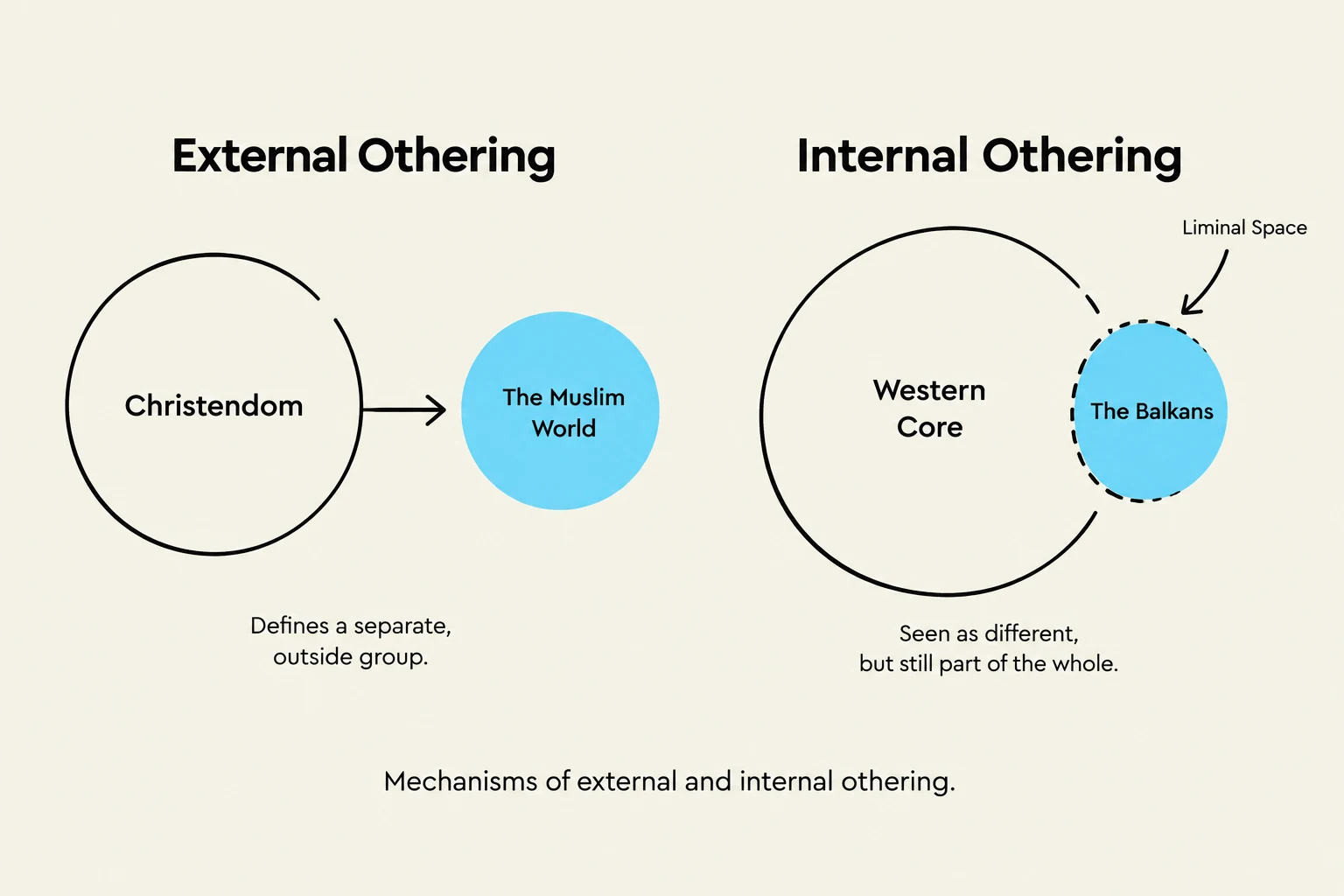
Diagram illustrating the concepts of external and internal othering, with examples of Christendom and the Muslim World for external othering, and the Western Core and the Balkans for internal othering.
A central theme in European studies is the process of "othering"—the act of forging a collective identity by defining what a group is not. This process relies heavily on essentialism, the flawed reduction of complex, diverse populations to a single, fixed trait such as religion or race.
External and Internal Othering
Historically, European unity was often forged through the concept of Christendom, which positioned the Muslim world as an external "other". However, this narrative often ignores the reality of indigenous European Muslim populations, such as the Bosniaks and Albanians in the Balkans. Scholars identify three primary mechanisms through which European identity has been constructed:
Cross-border Cultural Transfers: The transmission of classical Greek knowledge to Europe via Islamic Spain (Al-Andalus) and Jewish translators.
External Othering: The framing of the broader Muslim world as outside the European sphere.
Internal Othering: The stigmatization of the Balkans and Eastern Europe as "lesser" or "different" from the Western core.
Exam Tip: Distinguishing Analytical Frameworks
When analyzing European identity, distinguish between Orientalism and Balkanism. While Edward Said’s Orientalism describes the framing of the "Orient" as an inferior "other" to justify Western hegemony, Maria Todorova’s Balkanism applies similar essentialist stigmas specifically to the Balkan region to treat it as a bridge or a "liminal" space rather than a fully European one.
Political Myth and the Management of Memory
Identity is not just built on facts, but on heritage and memory. While heritage refers to the tangible and intangible legacy passed down through generations, memory is the active, often political, selection of what a society chooses to remember or forget.
This selective process often results in the creation of political myths—historical narratives mobilized to serve contemporary goals. For example, a popular myth suggests the EU was founded solely on a moral "never again" peace consensus following the horrors of WWII. While the desire for peace was real, this narrative often obscures the pragmatic, economic, and geopolitical drivers of integration, such as post-war economic weakness, the need for defense against Soviet communism, and significant U.S. financing.
The Evolution of the State and Sovereignty
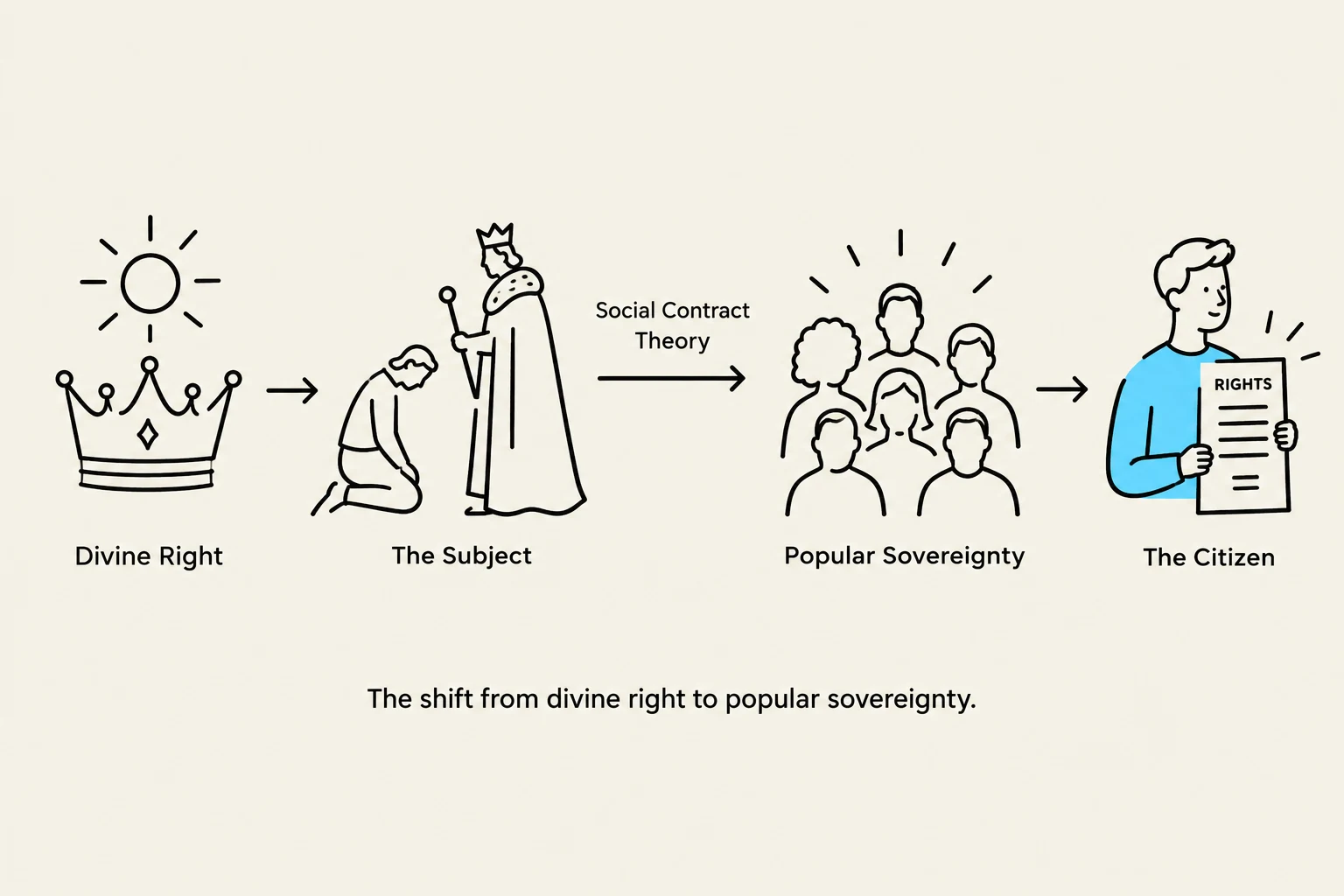
This diagram illustrates the evolution of political thought from divine right to popular sovereignty, mediated by the concept of the social contract.
The modern understanding of European borders is deeply tied to the evolution of the "state." In the 17th century, the concept of the state shifted from a loose "state of affairs" to a defined territorial entity.
Territorial Sovereignty: Figures like Louis XIV and his military strategist Vauban transformed the state into a physical entity with defensible "natural borders" (such as the "hexagon" of France).
Social Contract Theory: Philosophers like Thomas Hobbes, John Locke, and Jean-Jacques Rousseau redefined the relationship between the ruler and the ruled. They moved the source of authority from "divine right" toward the "social contract" and popular sovereignty—the idea that power resides in the people.
From Subjects to Citizens: This intellectual shift replaced the feudal "subject" (who owed obedience to a lord) with the "citizen" (who possesses rights within a state), anchoring human rights to formal legal status.
Hegemony, Colonialism, and Eurocentrism
The expansion of European power was not merely territorial but also cultural and ideological. Through imperialism, European powers exercised global hegemony, often using a "civilizing mission" to justify the subjugation of non-European peoples.
This era gave rise to Eurocentrism, a worldview that places Europe at the center of history and progress. This bias is visible in:
Cartographic Bias: Standard Western maps that position Europe centrally.
Scientific Racism: The use of pseudo-sciences like physiognomy and eugenics to categorize humans into hierarchies, often labeling non-European bodies as "degenerate" or "inferior".
Structural Inequality: The concept of path dependency, where former colonies remain economically structured to serve European industrial needs, maintaining global inequalities long after formal independence.
In conclusion, European identity is a complex tapestry of shared heritage, contested borders, and manufactured narratives. By analyzing the mechanisms of othering and the myths of the past, we gain a clearer understanding of the geopolitical tensions defining the continent today.
Keep reading for free.
Create an account to finish this reading and make it part of your study routine.