An overview of Earth's dynamic systems, including the lithosphere, hydrosphere, atmosphere, and biosphere, and how geological processes shape the planet's surface and influence human life.
Earth is not merely a static rock floating in space; it is a complex, dynamic system where various components constantly interact to reshape the planet's surface and influence the life it supports. To understand geology, one must look beyond individual rocks and instead view the world as a series of interconnected "spheres" that exchange energy and matter, driven by forces ranging from the heat of the Earth's core to the light of the Sun.
The Four Spheres of Earth
Geologists categorize the Earth into four primary interacting spheres. These systems overlap, meaning a change in one often triggers a reaction in another.
Lithosphere: This is the solid portion of the Earth, encompassing the crust (both continental and oceanic) and the uppermost, strong part of the mantle. It provides the structural foundation for our landscapes, from the highest mountains to the deep ocean floor.
Hydrosphere: This includes all water in its various forms: oceans, lakes, streams, glaciers, and even the water droplets in clouds. Notably, over 96% of Earth's water is saltwater, while most freshwater is locked away in glaciers and groundwater.
Atmosphere: The gaseous envelope surrounding the planet, composed primarily of nitrogen and oxygen. It regulates temperature, facilitates weather through wind and precipitation, and protects the surface from harmful UV radiation.
Biosphere: This encompasses all living organisms, from microscopic microbes living deep underground to the vast ecosystems of the oceans, land, and air.
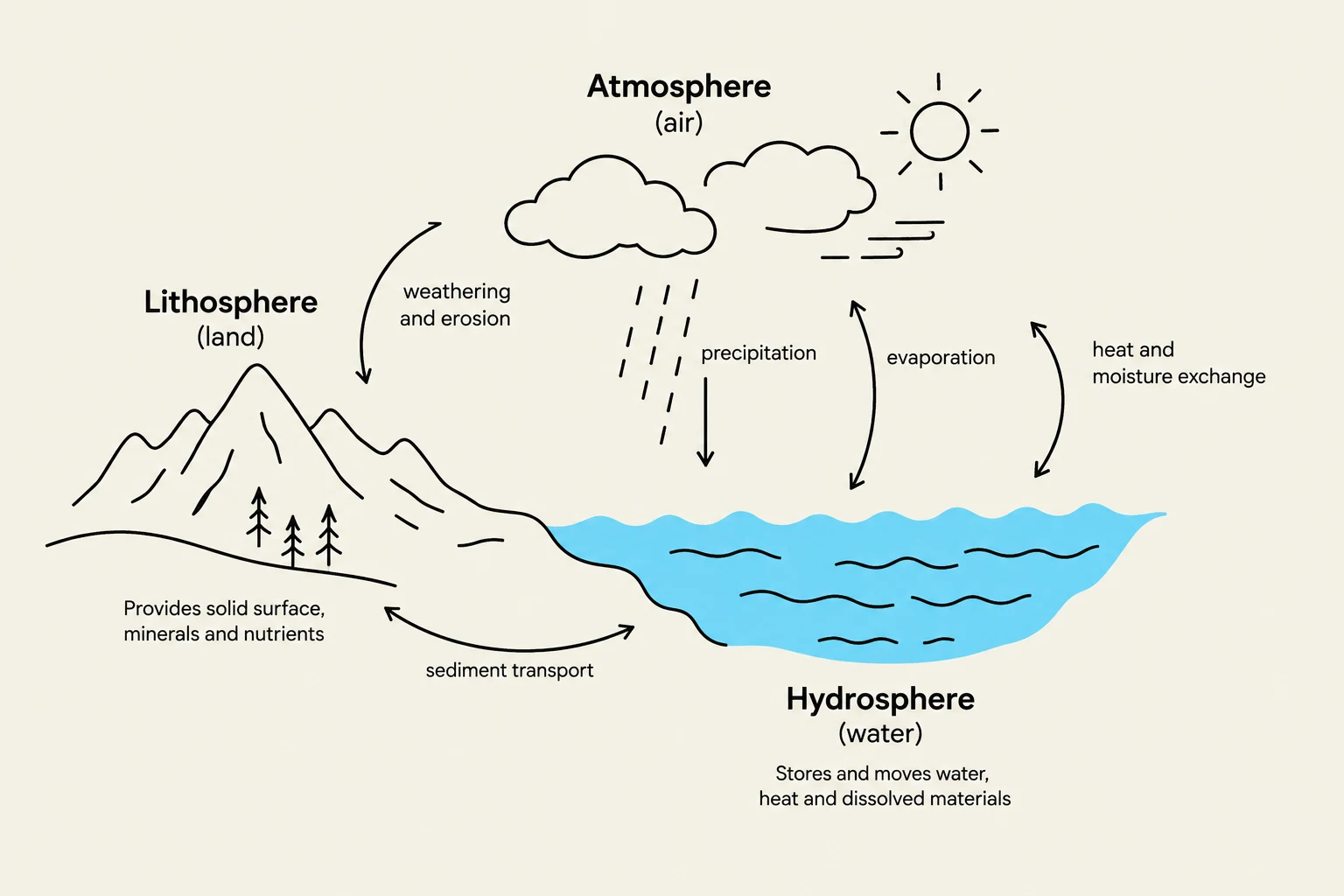
This diagram illustrates the Earth's water cycle, showing the interaction between the lithosphere, atmosphere, and hydrosphere through processes like weathering, erosion, precipitation, evaporation, and sediment transport.
Observation vs. Interpretation
A fundamental skill in studying geology is the ability to distinguish between what you actually see and what you infer from those sights.
Observation involves direct, objective descriptions of features. For example, observing that a rock is red, that a cliff has vertical fractures, or that there are loose, angular rocks on a slope.
Interpretation is the process of using those observations to explain how or why something happened. If you observe red rocks, you might interpret this as evidence that the sediment was deposited on land. If you see loose rocks at the base of a cliff, you interpret this as the result of erosion from the overlying rock.
Study Tip: When looking at a landscape, always start with a list of "What is there?" (Observations) before asking "How did it get there?" (Interpretations).
Sculpting the Landscape: Geological Processes
The Earth's surface is constantly being remodeled by various agents of change. These processes can be driven by internal forces (like volcanic activity) or external forces (like the water cycle).
The Power of Water and Ice
Flowing water is the most significant sculpting agent on Earth. Rivers transport sediment, carve valleys, and provide essential nutrients for soil. Water moves through a continuous cycle: evaporating from oceans into the atmosphere, falling as precipitation, and flowing through rivers or sinking into the ground as groundwater.
Other forms of water also play massive roles:
Glaciers: These massive bodies of ice carve deep landforms and transport materials of all sizes, from fine silt to massive boulders.
Ocean Currents and Waves: These constantly move the upper layers of the ocean, eroding and shaping coastlines.
Volcanism and Tectonics
Internal heat drives processes that create new land. Volcanic activity can result in the eruption of lava or explosive ash clouds. While volcanoes can be destructive, they also provide essential nutrients to the soil.
Furthermore, the movement of the lithosphere creates significant geological features. Faults (fractures in the crust) can lead to earthquakes, while the warping of rock layers can create natural reservoirs for resources like petroleum.
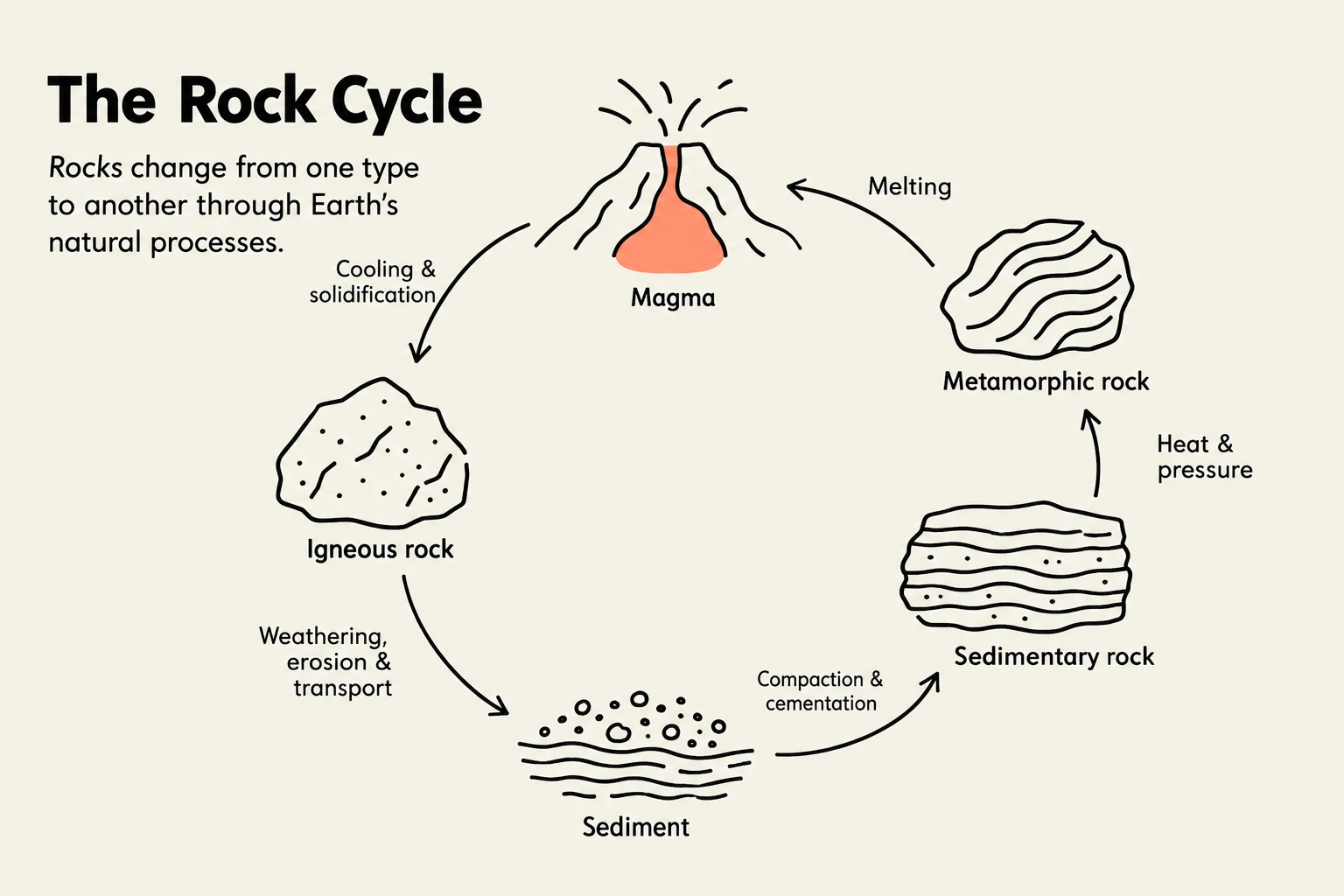
The rock cycle illustrates how rocks transform between igneous, sedimentary, and metamorphic types through geological processes like melting, cooling, weathering, erosion, compaction, and cementation.
Geology and Human Life
Geology is not just an abstract science; it dictates where and how humans live. The distribution of natural resources, such as iron and copper mines, is controlled by the specific geologic history and age of the rocks in a region.
The physical landscape also influences safety and economy:
Agriculture: Flat areas and river valleys provide fertile soil and water for farming.
Safety: Steep slopes may be prone to landslides, and proximity to active faults increases earthquake risk.
Infrastructure: The movement of water, such as mountain snowmelt feeding rivers, determines where cities can be built and where flood hazards might exist.
Earth in the Solar System
To understand Earth fully, we must place it in the context of the Solar System. Earth orbits the Sun, which is the center of our system and provides the electromagnetic energy that drives our weather and atmosphere. Unlike some other planets—such as Mercury, which lacks a significant atmosphere, or Venus, which has a runaway greenhouse effect—Earth possesses the unique combination of liquid water, a protective atmosphere, and life.
Tools of the Geologist: Concept Sketches
Because geological processes often happen over millions of years or deep underground, geologists use concept sketches to organize their thoughts. A good concept sketch is not just a drawing; it is a simplified, annotated tool that uses complete sentences to explain the relationships between features and processes. By sketching a landscape, a student can move from mere observation to a deeper understanding of the complex systems at work.
Keep reading for free.
Create an account to finish this reading and make it part of your study routine.