


Ancient China was one of the world's earliest and longest-lasting civilisations. A civilisation is defined as a large, organised society where people live together and develop their own unique ways of life, beliefs, customs, and systems of government. Throughout its long history, China was ruled by different families of rulers known as dynasties. The development of this vast society was not accidental; it was profoundly shaped by the unique physical landscape of East Asia.
Natural Barriers and Isolation
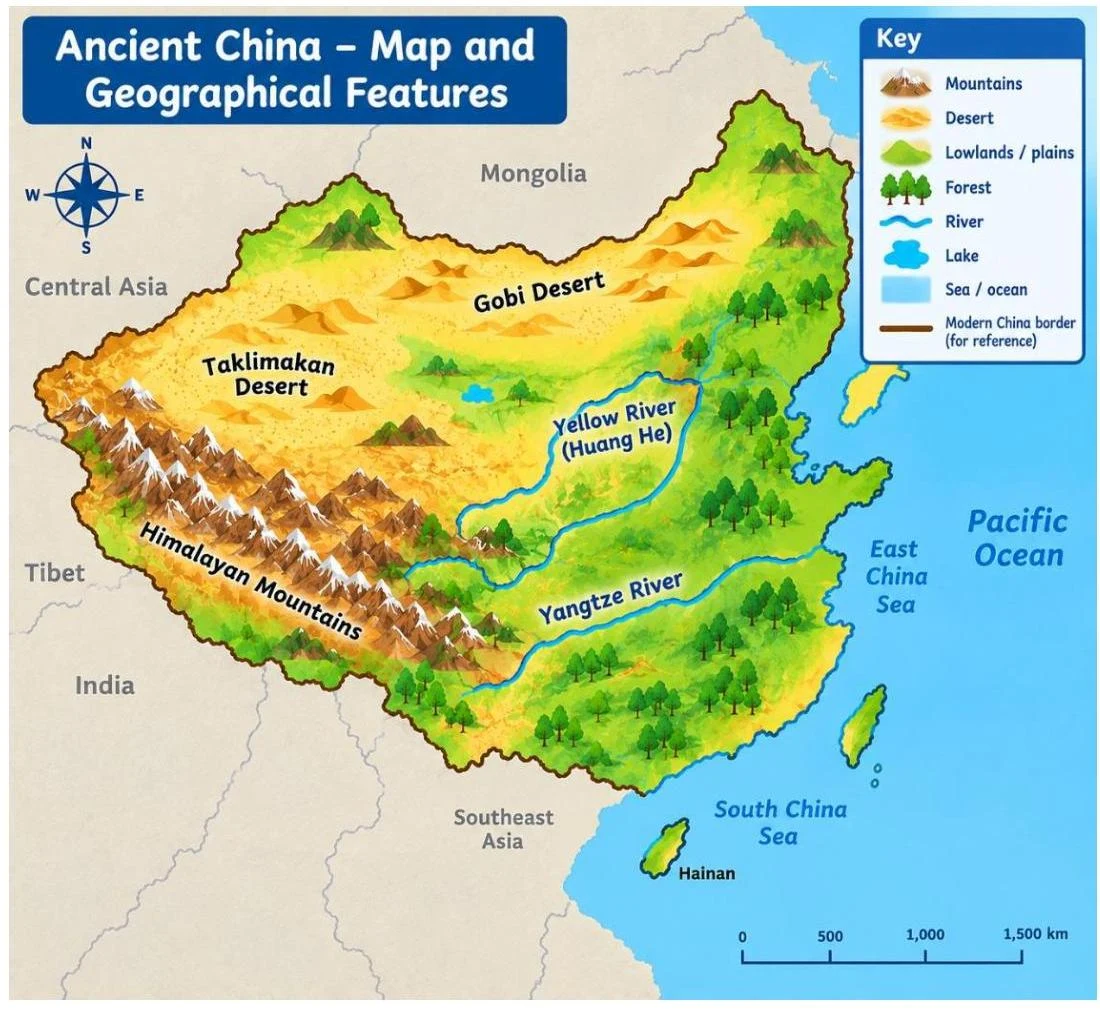
The geography of East Asia provided Ancient China with significant natural barriers that acted as protective walls. These features made it difficult for outsiders to enter or leave the region, which allowed Chinese civilisation to develop its own distinct traditions, ideas, and ways of life with minimal outside interference.
Key geographical features included:
- Deserts: To the north and northwest lay the vast Gobi Desert and the Taklamakan Desert.
- Mountains: The massive Himalayan Mountains provided a formidable barrier to the southwest.
- Ocean: To the east, the Pacific Ocean limited maritime access from many directions.
Keep reading for free.
Create an account to finish this reading and make it part of your study routine.
Continue reading freeAlready have an account? Log in
Updated