Explains the legal concept of genuine mutual assent in contract law, detailing how factors like mistake, misrepresentation, undue influence, and duress can undermine a contract's validity and lead to rescission. It also covers excuses for non-performance and contractual remedies.
In the world of contract law, a signature on a page is not always enough to create a binding obligation. For a contract to be valid and enforceable, there must be a "meeting of the minds," technically known as genuine mutual assent. This means that all parties must have entered into the agreement voluntarily and with a shared, accurate understanding of the terms and facts involved. If this assent is undermined by factors such as mistake, misrepresentation, undue influence, or duress, the legal integrity of the contract is compromised, potentially allowing for rescission—the cancellation of the contract.
The Impact of Mistake
A "Mistake of Fact" occurs when one or both parties hold an incorrect understanding of a material fact at the exact moment the contract is formed. Not all mistakes allow a party to escape their obligations; the law distinguishes between mistakes made by one party and those made by both.
Mutual Mistake
A mutual mistake occurs when all parties to the contract misunderstand the same material fact. Because there was no true "meeting of the minds" regarding the core of the deal, the contract is rescindable by either party.
Unilateral Mistake
In a unilateral mistake, only one party is mistaken about a material fact. As a general rule, the contract remains binding, and the mistaken party cannot simply back out. However, there are three critical exceptions where a court may grant rescission:
The non-mistaken party knew (or had reason to know) of the mistake.
The mistake was a simple clerical or typographical error.
Enforcing the contract would be unconscionable (grossly unfair).
This diagram illustrates the legal concept of mutual mistake in contract law, differentiating it from unilateral mistake, and explaining the consequences for contract rescission.
Misrepresentation: Untruthful Statements
Misrepresentation involves making an untruthful statement regarding a material fact. The legal remedies available depend heavily on the intent and the level of care taken by the party making the statement.
Innocent Misrepresentation: The party honestly believed the statement was true. In this case, the primary remedy is rescission (canceling the contract), but the victim cannot claim monetary damages.
Negligent Misrepresentation: The party may have believed the statement was true, but a reasonable person in their position would have known it was false. Here, the victim may seek both rescission and damages.
Fraudulent (Intentional) Misrepresentation: The party purposely misled the other, such as through the active concealment of facts (e.g., rolling back an odometer). This is the most serious form, allowing for both rescission and damages.
Undue Influence and Duress
Even if the facts are stated clearly, a contract may lack genuine assent if the decision-making process was compromised by pressure or coercion.
Undue Influence
Undue influence occurs when a party in a dominant position exploits a relationship of trust or a fiduciary relationship to interfere with a subservient or vulnerable party's ability to make a free decision.
Duress
Duress involves forcing a party into an agreement against their will through threats. This can take two forms:
Physical Duress: Direct coercion or threats of physical harm/extortion.
Economic Duress: Coercing a party by threatening financial injury, such as threatening to breach an existing contract unless a new, unfavorable one is signed.
Excuses for Non-Performance
Sometimes, a contract is formed with perfect mutual assent, but unforeseen circumstances make it impossible or irrational to follow through. In these cases, a party may be legally excused from performing.
Impracticability: An unforeseen, extreme burden makes performance nearly impossible.
Frustration of Purpose: An unforeseen event destroys the core economic purpose for which the contract was originally made.
Exam Tip: These legal excuses for non-performance generally do not apply if the contract contains a Force Majeure Clause that specifically dictates how unforeseen events should be handled.
Contractual Remedies
When a party fails to perform and no legal excuse exists, the law provides remedies to compensate the injured party.
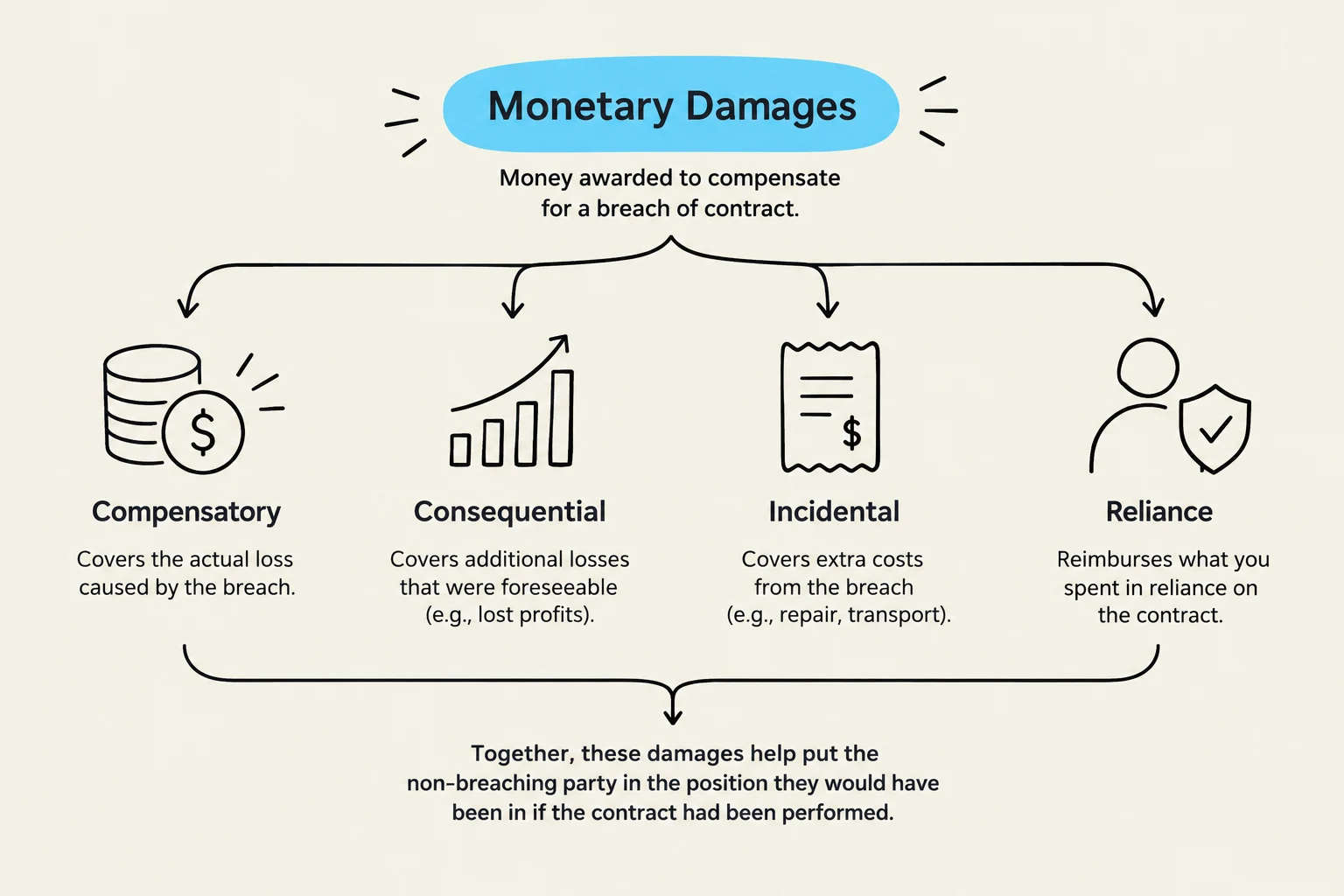
Monetary Damages
Monetary remedies aim to place the non-breaching party in the financial position they would have occupied had the contract been fully performed.
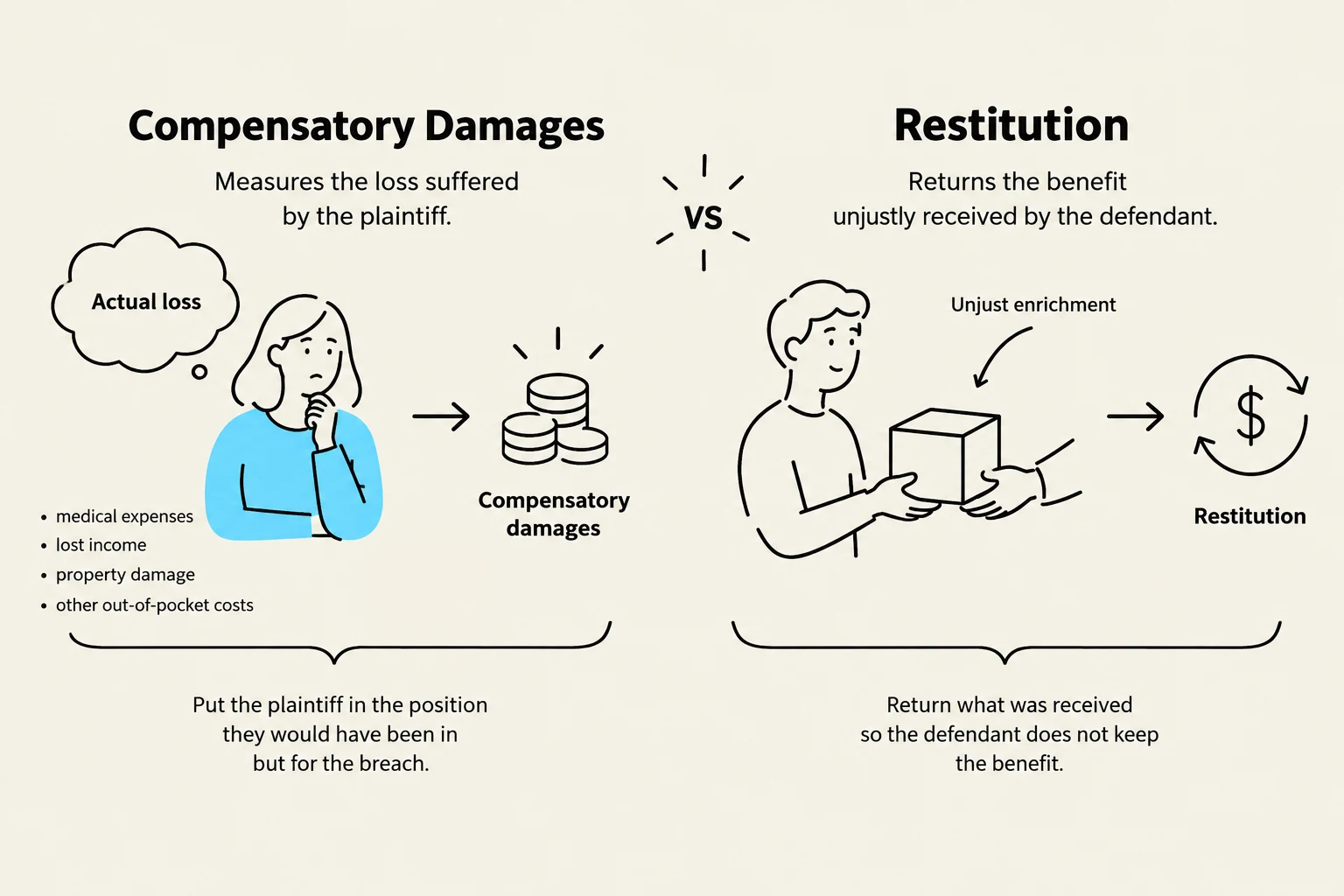
Compensatory Damages: These cover direct losses.
For Buyers:
Damages=Cover Price−Original Contract Price
For Sellers:
Damages=Original Contract Price−Open Market Price Obtained
Consequential Damages: Foreseeable indirect losses (e.g., lost profits), provided the breaching party knew of the special circumstances.
Incidental Damages: Minor administrative or logistical costs, such as travel or storage.
Reliance Damages: Money spent in foreseeable reliance on the contract, used when expectancy interest cannot be proven with certainty.
Liquidated Damages: A pre-agreed amount specified in the contract; must be reasonable and not a penalty.
Nominal Damages: A small token sum (e.g., $1) for technical breaches where no actual financial loss occurred.
Punitive Damages: Generally unavailable for standard breaches unless the conduct also constitutes an independent tort, like fraud.
This diagram illustrates the four types of monetary damages awarded in contract law: Compensatory, Consequential, Incidental, and Reliance damages, all aimed at compensating the non-breaching party.
The Duty to Mitigate: It is important to note that an injured party has a duty to mitigate; they cannot recover damages that could have been avoided through reasonable efforts.
Equitable Remedies
When money is not enough to make the injured party whole, courts may turn to equitable remedies:
Specific Performance: An order to perform the exact obligation; limited to unique assets like land or rare art.
Injunction: A court order requiring a party to act or refrain from acting.
Reformation: Rewriting the contract to reflect the parties' true mutual intent.
Restitution and Quasi-Contract
If a contract is void or unenforceable, the law still seeks to prevent unjust enrichment.
Restitution: Returns a benefit conferred by the injured party to the defendant.
Quasi-Contract: An obligation imposed by law (an "implied-in-law" contract) to ensure justice when no formal contract exists.
This illustration contrasts Compensatory Damages, which measures the loss suffered by a plaintiff (including medical expenses, lost income, property damage, and other costs), with Restitution, which returns benefits unjustly received by a defendant to prevent unjust enrichment.
Virginia Statutes of Limitations
If you intend to sue for a breach of contract in Virginia, you must be aware of the following deadlines:
Oral Contracts: 3 years.
Sale of Goods (UCC): 4 years.
Written Contracts (Non-UCC): 5 years.
Keep reading for free.
Create an account to finish this reading and make it part of your study routine.