Genetic Mutations, Imprinting, and X-Chromosome Inactivation
An overview of genetic damage, including somatic and germline mutations, chromosomal aneuploidies like Down syndrome, and epigenetic phenomena such as genetic imprinting and X-chromosome inactivation.
The blueprint of human development is governed by a complex interplay of DNA sequences and regulatory mechanisms. When this blueprint is altered—whether through the addition, loss, or silencing of genetic material—the consequences can range from subtle phenotypic variations to severe developmental disorders. Understanding the distinction between different types of mutations and the specialized regulatory processes like imprinting and X-inactivation is fundamental to the study of genetics and developmental biology.
Somatic vs. Germline Mutations
To understand the impact of genetic damage, we must first categorize it by the type of cell in which the mutation occurs.
Somatic Mutations: These occur in developing somatic cells (non-reproductive cells). Because these mutations are not present in the gametes, they are not heritable; they affect only the individual in whom they arise.
Germline Mutations: These occur in the germ cells (the egg or sperm). If a mutant germ cell is fertilized, the mutation will be present in every cell of the resulting offspring, making it a heritable trait.
Exam Tip: If a question asks whether a mutation found in a skin cell can be passed to a child, the answer is "No" because it is a somatic mutation. If the mutation is in the sperm, it is a germline mutation and can be inherited.
Chromosomal Aneuploidies
Aneuploidy refers to a condition where the number of chromosomes in a cell is not an exact multiple of the haploid set, typically involving the gain or loss of a single chromosome. Most aneuploidies arise from errors during meiosis, particularly during maternal meiosis I.
Trisomies and Viability
A trisomy occurs when there is an extra copy of a chromosome, resulting in three instead of the usual two. While many trisomies are incompatible with life, several are "viable," meaning the individual can survive birth, though often with significant clinical challenges:
Trisomy 21 (Down syndrome): One of the most well-known viable trisomies.
Trisomy 18 (Edwards syndrome): A viable but severe trisomy.
Trisomy 13 (Patau syndrome): Another viable trisomy with profound developmental impacts.
In contrast, Full Trisomy 16 is non-viable. It accounts for approximately 1–2% of all conceptions and is a leading cause of first-trimester miscarriages, appearing in roughly 15% of such cases.
Sex Chromosome Abnormalities
Aneuploidy also frequently affects the sex chromosomes (X and Y). Common variations include:
Monosomy (45,X): The absence of one sex chromosome.
Trisomies (47,XXY; 47,XXX; 47,XYY): The presence of an extra sex chromosome.
Genetic Imprinting
In most autosomal genes, an individual inherits two alleles (one from each parent) and expresses both simultaneously. However, genetic imprinting is a specialized epigenetic phenomenon where expression occurs from only one allele, while the other is silenced.
This process affects less than 1% of genes in mammals. Because imprinting relies on the parent-of-origin to determine which allele is active, it prevents naturally occurring parthenogenesis (reproduction without fertilization) in mammals.
Imprinted genes are typically organized in clusters on specific chromosomes. Two major human clusters are located on:
11p15 (the short arm of chromosome 11).
15q11–q13 (the long arm of chromosome 15).
Clinical Implications: Prader-Willi and Angelman Syndromes
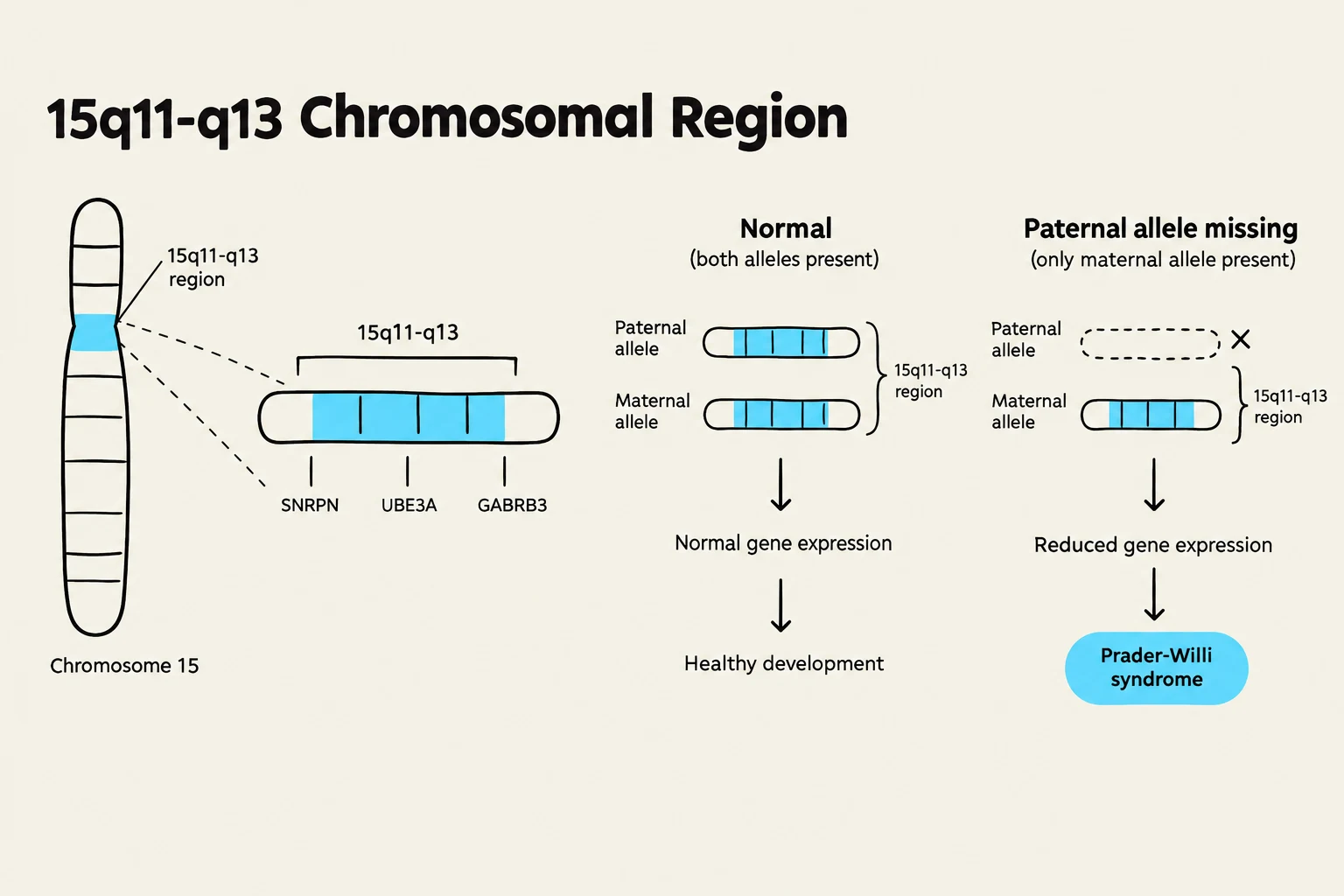
Disruptions in the 15q11–q13 region provide a classic example of how imprinting works. Because one copy is normally maternal and the other paternal, the clinical outcome depends entirely on which parent's contribution is lost or defective:
Prader-Willi Syndrome (PWS): Results from the loss of the paternally expressed genes in this region. Symptoms include hyperphagia (an insatiable appetite leading to obesity), short stature, hypogonadism, and intellectual disabilities.
Angelman Syndrome: Results from abnormalities affecting the maternal copy in the same region.
This diagram illustrates the 15q11-q13 chromosomal region, explaining how the absence of the paternal allele in this region can lead to Prader-Willi syndrome due to reduced gene expression.
X-Chromosome Inactivation
In female mammals, having two active X chromosomes would result in a double dose of X-linked gene products compared to males. To balance this "gene dosage," females undergo X-chromosome inactivation during development.
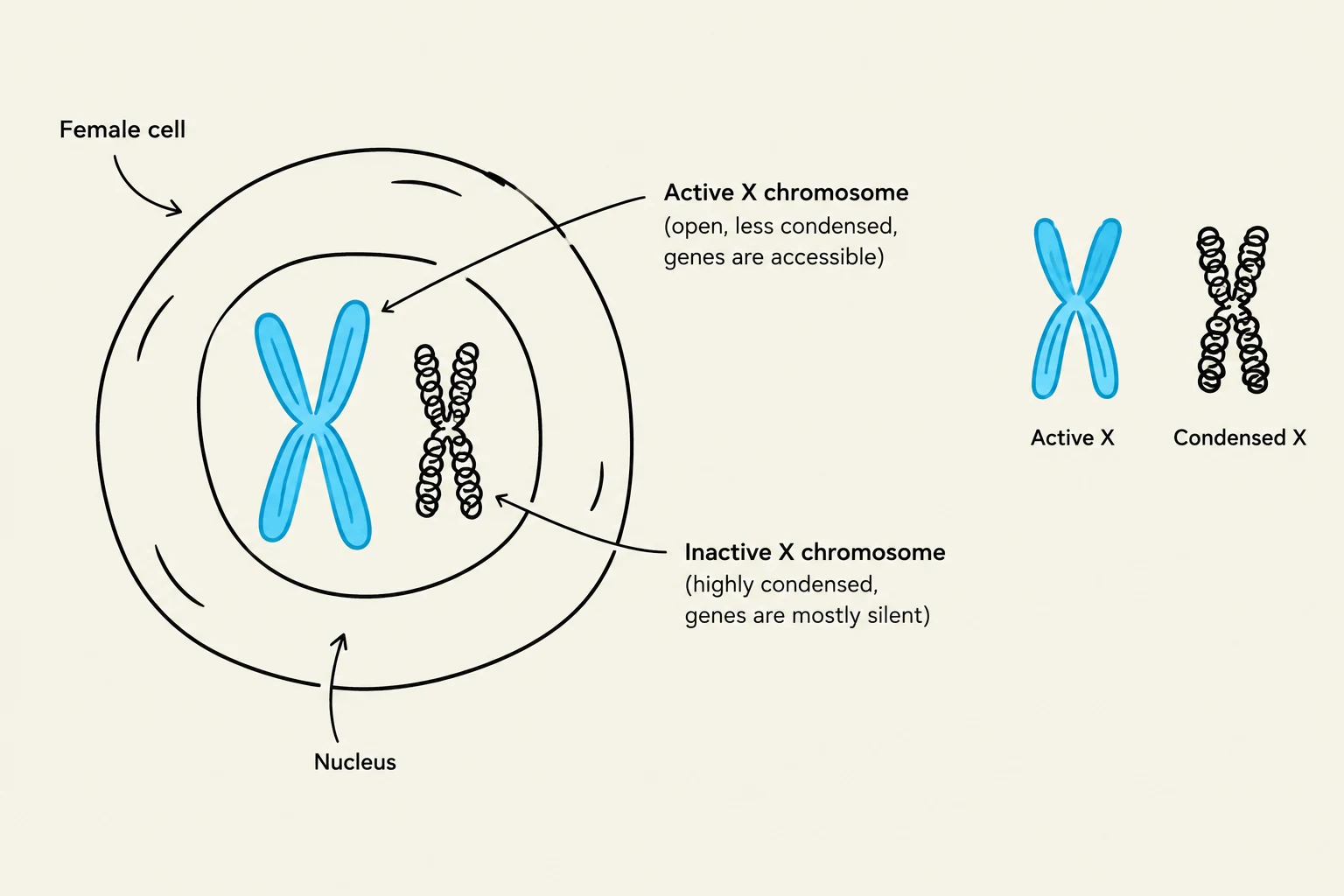
This process is mediated by the Xist gene. The Xist gene produces a long noncoding RNA (lncRNA) that coats the X chromosome from which it is transcribed. This coating occurs in cis, meaning the RNA acts on the same chromosome that produced it, effectively silencing it into a heterochromatic state.
It is important to note that inactivation is not absolute for every single gene. Approximately 12% of human X-linked genes consistently "escape" inactivation and remain expressed from the inactive X chromosome (Xi). These escape regions often lack the repressive histone marks and DNA methylation found on the rest of the silenced chromosome.
Diagram illustrating the concept of X chromosome inactivation in a female cell, showing an active X chromosome with accessible genes and an inactive X chromosome that is highly condensed and transcriptionally silent.
Summary Table of Key Concepts
Concept
Mechanism
Heritability
Key Example
Somatic Mutation
DNA change in non-reproductive cells
No
Cancerous growths
Germline Mutation
DNA change in egg or sperm
Yes
Inherited genetic disorders
Aneuploidy
Gain or loss of whole chromosomes
Often (if germline)
Down Syndrome (Trisomy 21)
Imprinting
Epigenetic silencing of one parental allele
Yes (via germline)
Prader-Willi Syndrome
X-Inactivation
Xist RNA coats and silences one X chromosome
N/A (Developmental)
Dosage compensation in females
Keep reading for free.
Create an account to finish this reading and make it part of your study routine.