Generic Business-Level Strategies and Cost Leadership
Explore the core concepts of business-level strategies, including cost leadership, differentiation, and focus strategies. Understand how firms achieve competitive advantage through operational efficiency, economies of scale, and strategic implementation.
In the world of strategic management, a firm's success is not merely determined by its products, but by how it chooses to compete. To achieve long-term success, a company must develop a business-level strategy—a plan designed to exploit a competitive advantage within a specific competitive scope.
A competitive advantage is achieved when a firm performs activities differently to lower costs or performs different activities to create unique value that customers prize. The "scope" refers to the breadth of the target market: a firm might use a "shotgun" approach to target the entire industry (broad scope) or a "laser" approach to target a specific niche (narrow scope).
The Five Generic Business-Level Strategies
Firms generally choose from five distinct strategic paths based on the combination of their competitive advantage (cost vs. differentiation) and their competitive scope (broad vs. narrow).
Cost Leadership: The firm aims to be the lowest-cost producer in a broad industry.
Differentiation: The firm creates unique products or services that customers perceive as superior, allowing the firm to charge a premium price.
Focus Cost Leadership: The firm seeks a cost advantage within a narrow, specific niche.
Focus Differentiation: The firm seeks to provide unique value tailored specifically to a narrow niche.
Integrated Cost Leadership and Differentiation: A complex approach where a firm attempts to achieve both low cost and high differentiation simultaneously.
This diagram illustrates Porter's Generic Strategies, which are strategies a company can use to achieve a competitive advantage. The strategies are Cost Leadership, Differentiation, Cost Focus, and Differentiation Focus, categorized by the scope of the target market (broad or narrow) and the source of competitive advantage (lower cost or unique value).
Deep Dive: Cost Leadership
Cost leadership is often misunderstood as simply "having the lowest prices." In reality, cost leadership focuses on internal efficiency and minimizing the total cost of doing business. A firm with a cost advantage has two strategic options: it can charge lower prices than competitors to aggressively gain market share, or it can charge industry-standard prices to capture significantly higher profit margins.
The Drivers of Cost Advantage
To maintain a cost leadership position, firms must master several operational levers:
Location: Selecting land that is inexpensive or situated near major transportation hubs to minimize logistics and shipping costs.
Information Technology: Implementing advanced inventory management software to optimize stock levels, reducing the capital tied up in excess goods and minimizing storage costs.
Volume Purchasing: Leveraging massive scale to engage in volume purchasing, which allows the firm to demand lower prices from its suppliers.
Economies of Scale and the Efficiency Limit
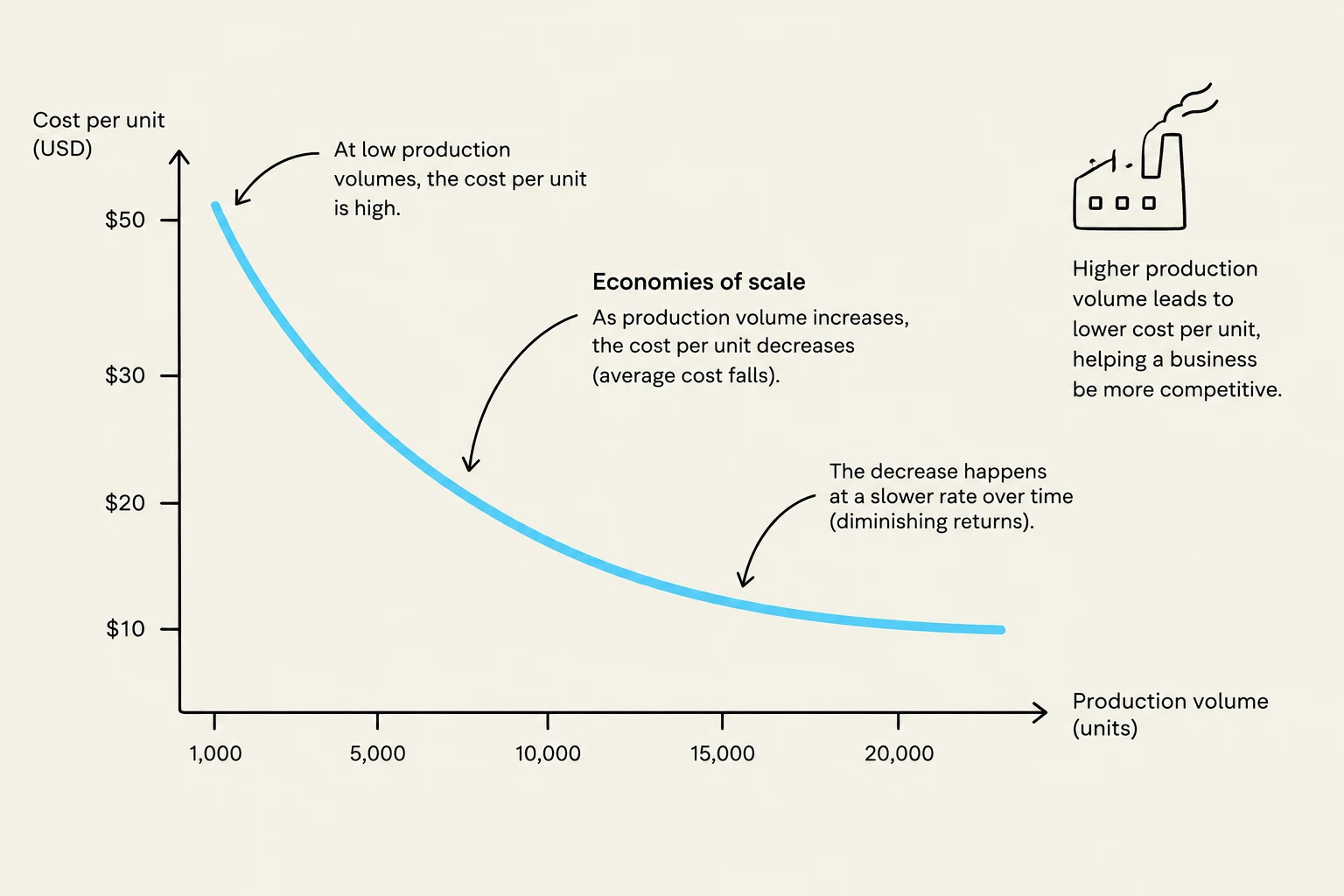
One of the most powerful drivers of cost leadership is economies of scale. As a firm increases its production volume, the cost per unit decreases because the fixed costs (such as factory rent or machinery) are spread over a larger number of units.
The efficiency of a firm typically improves until it reaches its minimum efficient scale—the point where the cost per unit is at its absolute lowest. However, firms must be wary of growing too large. If a firm expands beyond this point, it may encounter diseconomies of scale, where the cost per unit begins to rise due to increased bureaucracy, logistical complexities, or higher defect rates.
This graph illustrates the concept of economies of scale, showing how the cost per unit decreases as production volume increases. It also depicts diminishing returns, where the rate of cost decrease slows down over time.
Exam Tip: Remember that a firm can maintain a competitive advantage even if it faces diseconomies of scale, provided its competitors are suffering from even greater diseconomies.
Strategic Implementation and Competitive Dynamics
Choosing a strategy is only the first step; the second is implementation. As organizations grow and adopt complex strategies like cost leadership or multi-divisional structures, they must manage information flow and decision-making effectively.
In a competitive environment, firms must also understand competitive dynamics—the ongoing actions and responses between rivals. This involves recognizing mutual interdependence: the understanding that an attack on a competitor (such as a price war) can often result in "slashing your own throat" by reducing the profit potential for the entire industry.
Tactical vs. Strategic Actions
When competing, firms engage in two types of moves:
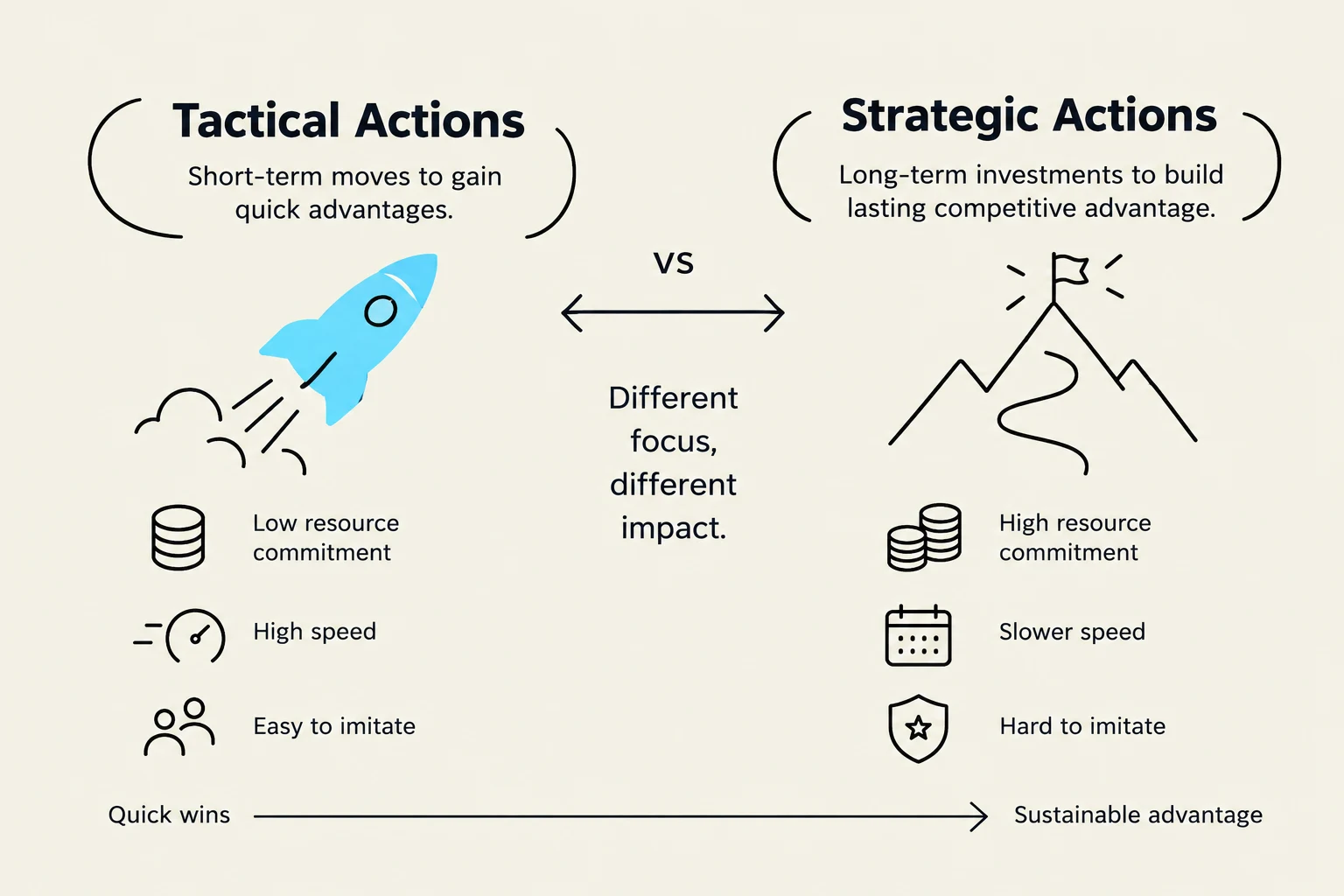
Tactical Actions: These are refinements or extensions of an existing strategy. They draw on resources the firm already possesses and can be implemented quickly, such as changing a distribution channel or a minor price adjustment. Because they are easy to implement, they are also easily imitated.
Strategic Actions: These involve major changes to the firm's overall way of competing. They require significant commitments of unique resources and are much harder to undo once started, such as entering a completely new geographic market or launching a brand-new product line.
This diagram illustrates the differences between tactical and strategic actions, highlighting their respective focuses, resource commitments, speeds, imitation difficulty, and ultimate impacts on achieving quick wins versus sustainable advantage.
By understanding these generic strategies and the mechanics of cost and scale, managers can better position their firms to navigate the complexities of the modern marketplace.
Keep reading for free.
Create an account to finish this reading and make it part of your study routine.