In the complex web of life, every organism is engaged in a constant struggle to survive and pass on its genetic information. To succeed, species must navigate the challenges of resource availability, environmental stability, and competition. Ecologists study these survival methods by looking at two primary dimensions: how a species utilizes its environment (niche breadth) and how it allocates its energy toward reproduction (life history strategies).
Niche Breadth: Generalists vs. Specialists
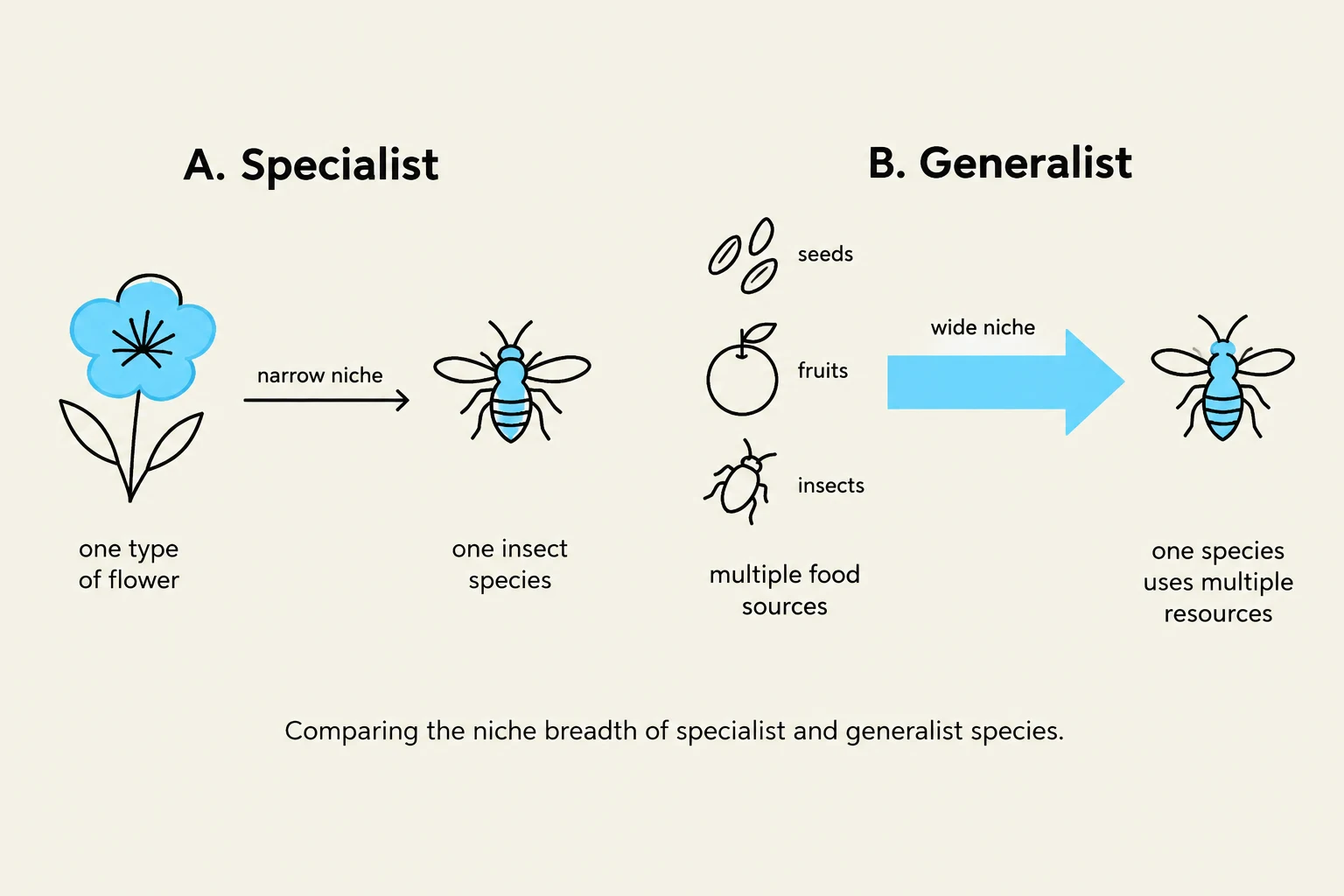
Comparing the niche breadth of specialist and generalist species.
The first way to categorize organisms is by their ecological niche—the specific role they play in an ecosystem, including what they eat and where they live. This can be viewed through the lens of "niche breadth," or how wide a variety of resources a species can utilize.
Generalist Species
Generalist species are the "jacks-of-all-trades" of the natural world. They possess a broad niche, meaning they can thrive in a wide variety of environmental conditions and utilize many different types of food sources.
Because of this flexibility, generalists are highly advantaged in changing or unpredictable habitats. If one food source disappears due to a seasonal shift or a localized disturbance, a generalist can simply switch to another. This adaptability makes them resilient to environmental fluctuations.
Specialist Species
In contrast, specialist species have a narrow niche. They require very specific environmental conditions or a limited diet to survive.
While this sounds like a disadvantage, specialists are highly efficient in stable, constant habitats. Because they are so finely tuned to a specific role, they can often outcompete generalists for a specific resource in a predictable environment. However, this specialization comes at a cost: they are extremely vulnerable to environmental shifts. If their specific habitat changes or their primary food source declines, they face a high risk of extinction.
Exam Tip: When comparing these two, remember: Generalists = Flexibility (good for change), while Specialists = Efficiency (good for stability).
Reproductive Strategies: r/K Selection Theory
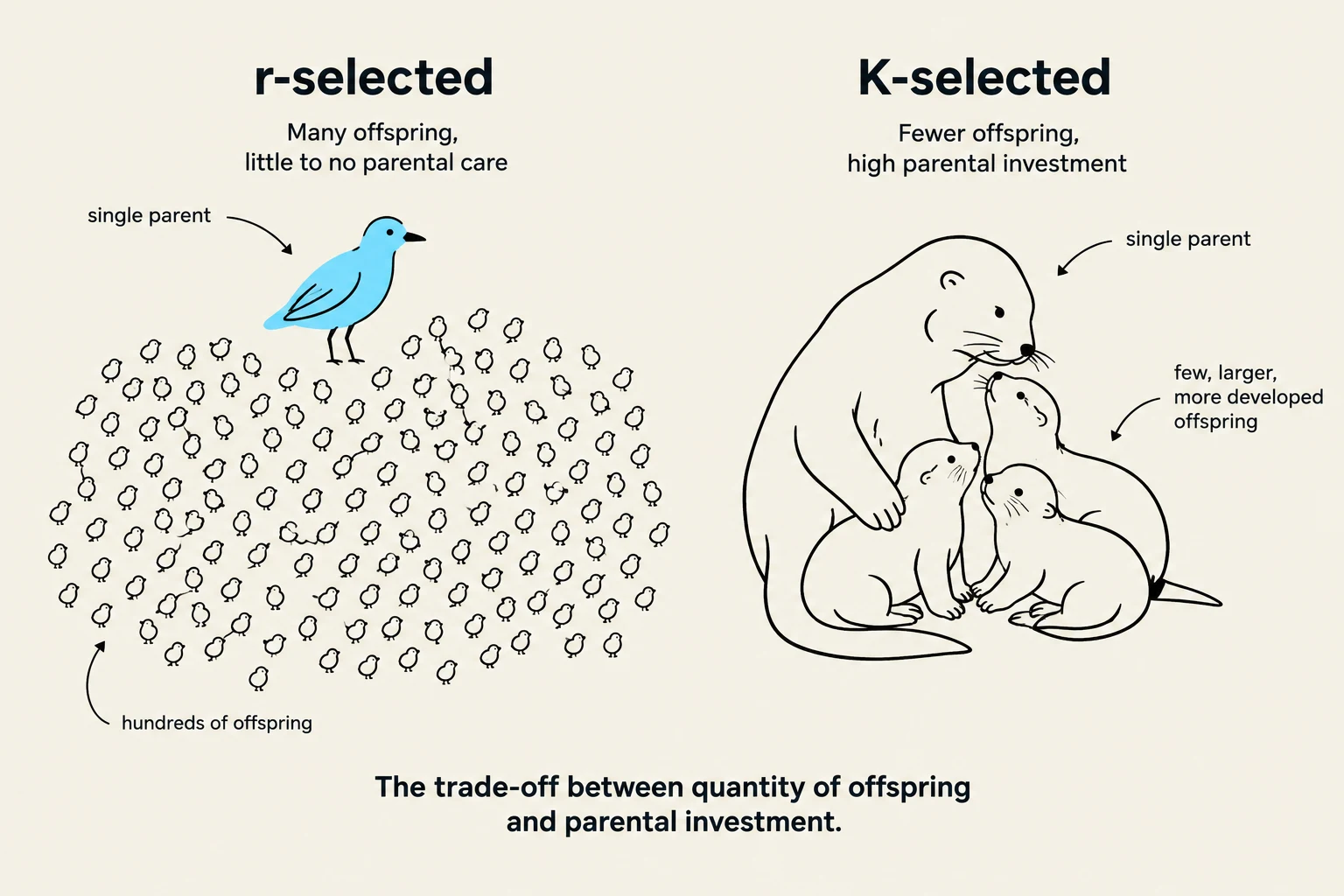
This illustration depicts the biological concepts of r-selected and K-selected species, highlighting the trade-off between the quantity of offspring produced and the level of parental investment.
Once an organism has secured its place in an environment, it must decide how to invest its limited energy. Should it produce a massive number of offspring and hope a few survive, or should it produce a few offspring and invest heavily in their care? This trade-off is described by the r/K selection theory.
r-selected Species: The "Quantity" Strategy
The "r" in r-selection refers to the intrinsic rate of increase. These species are adapted to unstable or unpredictable environments where competition for resources is typically low. Their goal is to maximize population growth quickly.
Key Characteristics:
Body Size & Lifespan: Generally small body size and short lifespans.
Development: Early maturity and rapid development.
Offspring: Production of many offspring per reproductive event.
Parental Investment: Minimal energy investment or parental care per individual offspring.
Reproductive Frequency: Some may reproduce only once in their lifetime.
K-selected Species: The "Quality" Strategy
The "K" refers to the carrying capacity of an environment. These species are adapted to stable environments where the population is often near the maximum number the habitat can support, meaning competition for resources is high.
Key Characteristics:
Body Size & Lifespan: Large body size and long lifespans.
Development: Late maturity following an extended period of youth.
Offspring: Production of few offspring per reproductive event.
Parental Investment: Significant energy expenditure and high levels of parental care for each offspring.
Reproductive Frequency: The ability to reproduce multiple times throughout their lives.
Biotic Potential and Population Dynamics
To understand how these strategies play out in real-world numbers, we must consider biotic potential. This is defined as the maximum reproductive rate a population can achieve under ideal, non-limiting conditions.
In a perfect world with unlimited food, space, and no predators, a population would grow according to its biotic potential. However, in reality, environmental resistance (such as disease, predation, and resource scarcity) keeps populations from reaching this theoretical maximum.
Note on Complexity: It is important to realize that these categories are not rigid boxes. Many species do not fit strictly into one category, and some species may even shift their strategies depending on changing environmental conditions.
Ecological Disturbances and Invasive Species
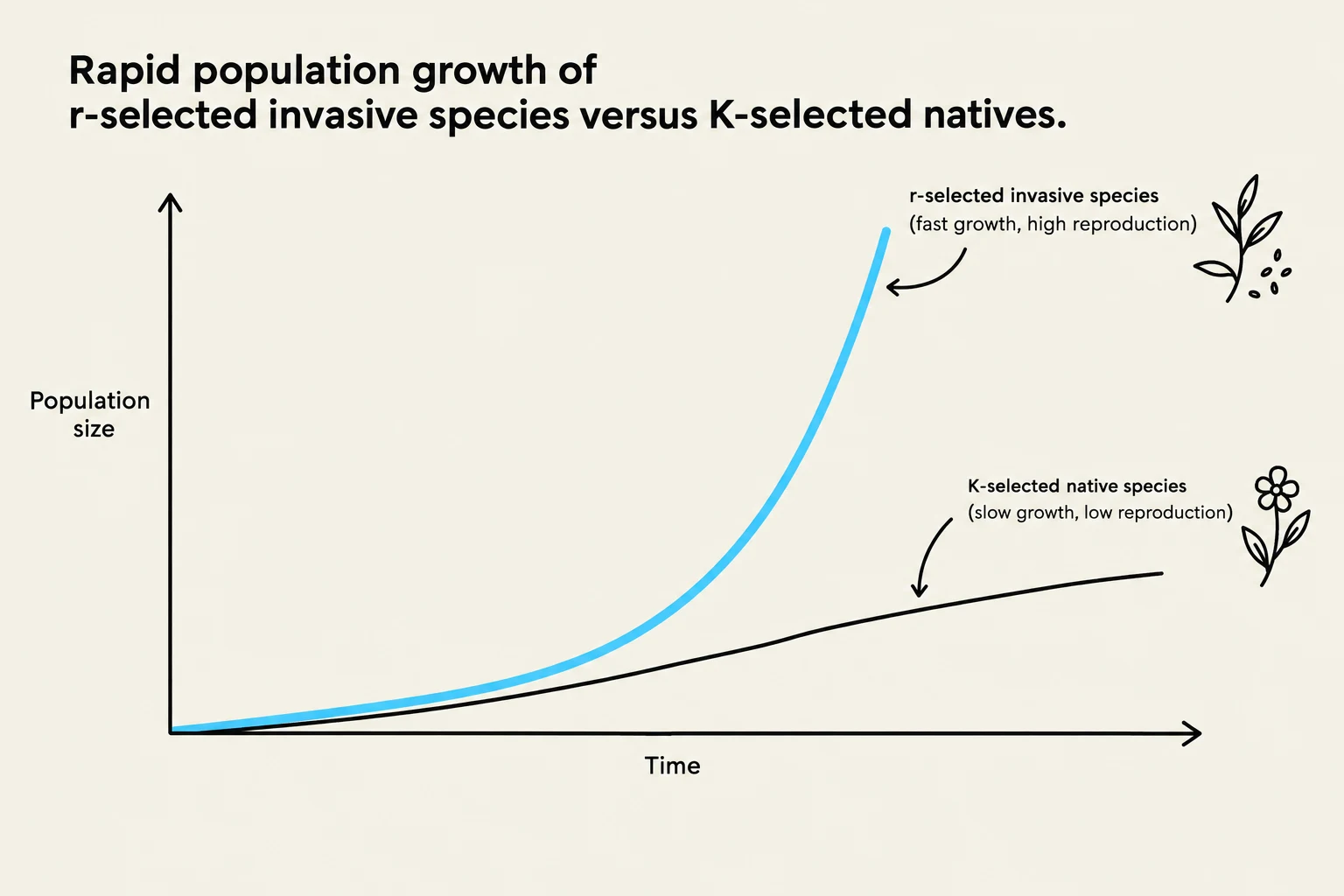
This graph illustrates the difference in population growth rates between r-selected invasive species and K-selected native species, showing exponential growth for the former and slower growth for the latter.
The relationship between these strategies becomes critically important when discussing ecological disturbances and the introduction of invasive species.
Invasive species are non-native organisms that cause harm to an ecosystem. Most invasive species are r-selected. Because they reproduce rapidly, mature early, and produce many offspring, they can quickly colonize a new area and overwhelm existing populations.
This creates a significant imbalance in the ecosystem:
r-selected species (including many invasives) are highly resilient and minimally affected by the presence of other invasive species.
K-selected species are typically more adversely affected by invasive species. Because they grow slowly and have few offspring, they cannot recover as quickly from the competition or habitat changes introduced by an invasive population.
Keep reading for free.
Create an account to finish this reading and make it part of your study routine.