General Chemistry II: Stoichiometry, Solutions, and Reactions
A comprehensive guide to General Chemistry II, covering stoichiometry, the mole concept, solution chemistry, concentration, precipitation, redox reactions, and acid-base chemistry. Essential for understanding chemical calculations and reaction types.
General Chemistry II is a pivotal course that transitions from the microscopic behavior of individual atoms to the macroscopic quantitative analysis of chemical systems. To succeed in this subject, students must master the interplay between mathematical precision and conceptual understanding. This guide breaks down the core pillars of the curriculum—stoichiometry, solution chemistry, and redox reactions—using the fundamental principles found in standard examination materials.
The Foundation: Stoichiometry and the Mole Concept
At the heart of all chemical calculations lies the mole, a fundamental unit representing 6.022×10²³ particles (atoms, molecules, or ions). Stoichiometry is the "accounting" of chemistry; it uses balanced chemical equations to establish the relationship between reactants and products.
A balanced equation ensures that the Law of Conservation of Mass is respected, meaning the number of atoms for each element is identical on both sides of the reaction. The numbers preceding the formulas in these equations are known as stoichiometric coefficients.
Exam Tip: When balancing equations, always start with the most complex molecule and leave single elements (like O2 or Al) for last. This prevents you from undoing your work in earlier steps.
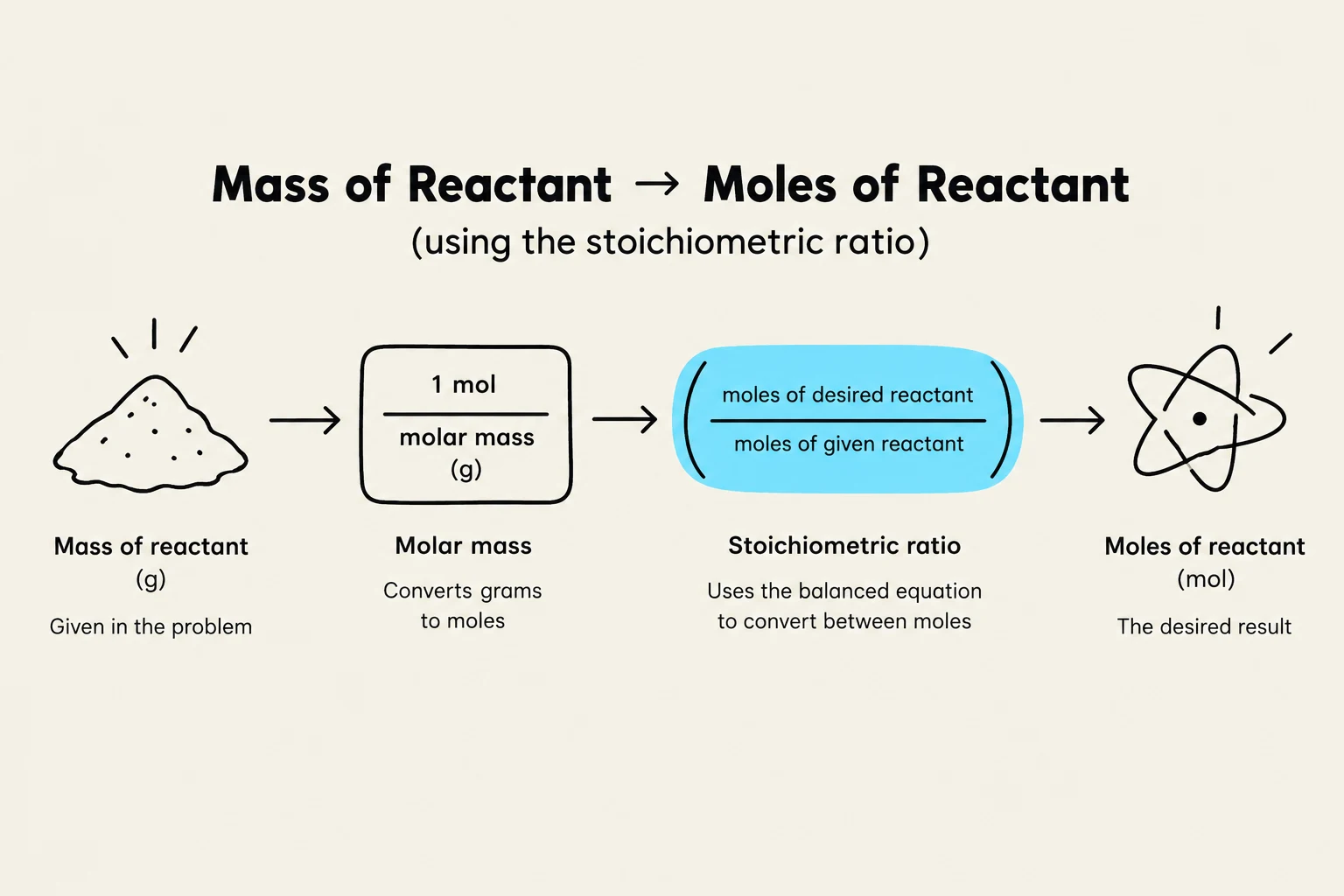
To perform calculations, you must be proficient in mass-to-mole conversions using molar mass. For example, if you are given a mass in grams, you divide by the molar mass to find the moles, which can then be used to find the volume of a gas or the mass of another substance via the stoichiometric ratio.
This diagram illustrates the process of converting the mass of a reactant to moles using molar mass and the stoichiometric ratio.
Yield and Empirical Formulas
In a laboratory setting, the amount of product you actually collect is often less than what you calculated on paper. This is the actual yield. The calculated amount is the theoretical yield. The efficiency of your reaction is expressed as percent yield:
Another critical skill is determining the empirical formula—the simplest whole-number ratio of elements in a compound. This is frequently achieved through combustion analysis, where a sample is burned to produce CO2 and H2O. By measuring the masses of these products, you can back-calculate the mass of carbon and hydrogen present in the original sample.
Solution Chemistry and Concentration
Much of General Chemistry II focuses on aqueous chemistry, where solutes are dissolved in water. The most common way to express the concentration of these solutions is through molarity (M).
Molarity (M)=liters of solutionmoles of solute
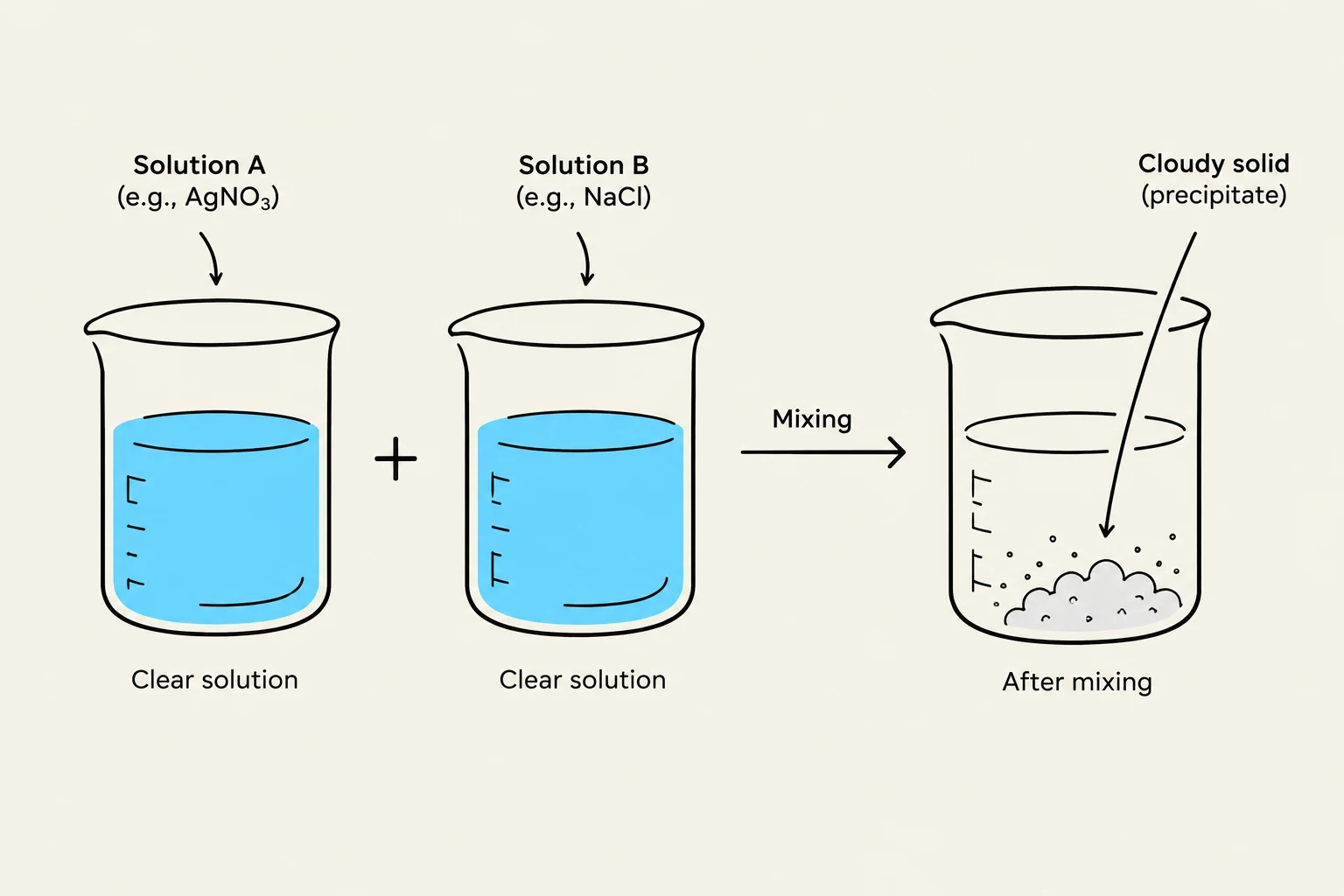
Understanding concentration is vital for predicting how much of a reagent is needed to react completely with another. For instance, if you are mixing a silver nitrate (AgNO3) solution with a chloride source, the concentration determines how much precipitate will form.
Precipitation and Ionic Equations
When two aqueous solutions react to form an insoluble solid, known as a precipitate, a precipitation reaction has occurred. To describe these reactions accurately, chemists use complete ionic equations, which show all chemically active ions in their dissociated forms.
In these equations, we can identify spectator ions—ions that appear on both sides of the equation unchanged and do not participate in the chemical change. Removing these spectators leaves us with the "net ionic equation," which focuses solely on the species undergoing transformation.
Illustration showing the mixing of two clear solutions, Solution A (e.g., silver nitrate) and Solution B (e.g., sodium chloride), resulting in the formation of a cloudy solid precipitate.
Reaction Types: Redox and Acid-Base
Chemical reactions are categorized by the nature of the transformation taking place. Two of the most important types are Redox and Acid-Base reactions.
Oxidation-Reduction (Redox) Chemistry
Redox reactions involve the transfer of electrons between species. To track these changes, we assign oxidation states to every atom in a reaction.
Oxidation: The loss of electrons (the oxidation state increases).
Reduction: The gain of electrons (the oxidation state decreases).
The species that loses electrons is the reducing agent (because it provides electrons to reduce another substance), and the species that gains electrons is the oxidizing agent.
Acid-Base and Electrolytes
Acid-base reactions typically involve the transfer of protons (H+). A classic example is a neutralization reaction, where an acid (like HClO4) reacts with a base (like Ca(OH)2) to produce water and a salt.
Finally, we classify substances by their ability to conduct electricity in solution, known as their electrolyte status:
Strong Electrolytes: Substances that dissociate completely into ions (e.g., strong acids or soluble salts).
Weak Electrolytes: Substances that only partially dissociate (e.g., acetic acid).
Nonelectrolytes: Substances that dissolve but do not produce ions, thus not conducting electricity.
By mastering these quantitative and qualitative tools, you will be well-equipped to navigate the complexities of chemical reactivity and solution behavior.
Keep reading for free.
Create an account to finish this reading and make it part of your study routine.