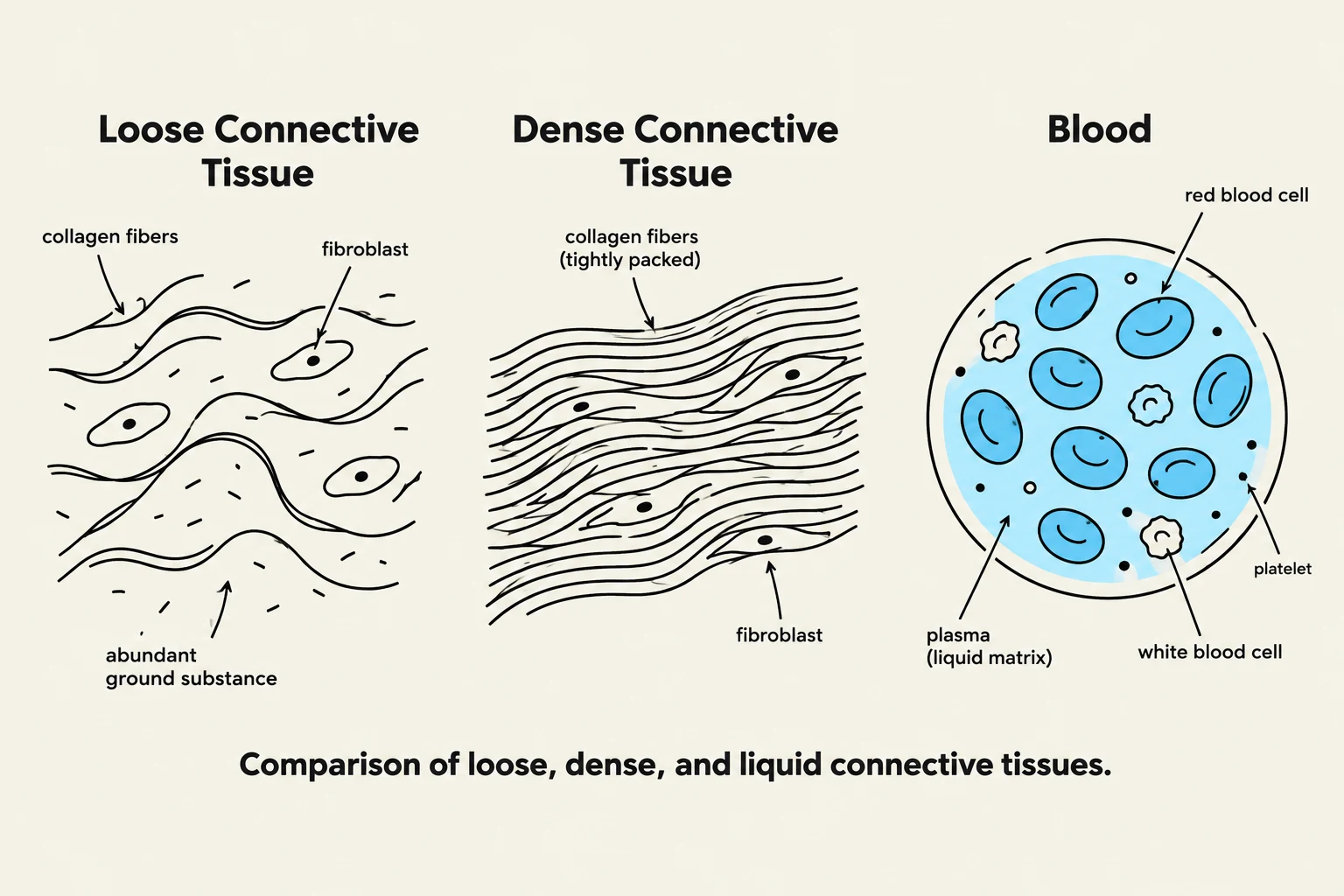
1. Connective Tissue Proper
This category includes tissues with a relatively balanced amount of cells, fibers, and ground substance. It is further divided into:
- Loose Connective Tissue: Features sparse fibers and abundant ground substance. Examples include areolar tissue, which cushions organs, and adipose tissue.
- Dense Connective Tissue: Characterized by a high concentration of fibers (usually collagen), providing great strength. This includes tendons (connecting muscle to bone) and ligaments (connecting bone to bone).
2. Specialized Connective Tissues
Beyond the "proper" forms, certain tissues have evolved highly specialized matrices to perform unique functions:
- Cartilage: A firm, semi-rigid matrix that provides support with flexibility.
- Bone (Osseous Tissue): A hard, calcified matrix that provides the structural framework for the body.
- Blood: A unique liquid connective tissue where the "matrix" is the blood plasma.
3. Adipose Tissue Types
Adipose tissue, or fat, is a specialized form of loose connective tissue designed for energy storage, insulation, and protection. While often discussed as a single entity, it can be categorized by its distribution and function, such as subcutaneous fat (under the skin) or visceral fat (surrounding internal organs).
Supporting Tissue Functions
Connective tissue is not merely a passive filler; it is an active participant in physiological homeostasis. Its primary roles include:
- Structural Support: Providing the physical framework for the body (bone and cartilage) and anchoring epithelial layers.
- Protection: Acting as a mechanical buffer (adipose tissue) and a barrier against pathogens.
- Nutrient and Waste Exchange: Because many connective tissues are vascularized (containing blood vessels), they serve as the primary transport medium for oxygen and nutrients to reach non-vascularized tissues like epithelium.
- Immune Defense: Housing various white blood cells that migrate through the matrix to fight infection.
Exam Tip: Vascularity Matters!
When studying tissue types, always note their vascularity. Epithelial tissue is typically avascular (no blood vessels), meaning it relies entirely on the underlying vascularized connective tissue for survival via diffusion.
Integration with Muscle Tissue
While connective tissue provides the "scaffolding," muscle tissue provides the "engine" for movement. It is important to understand how these two systems interface. Muscle tissue is composed of specialized, elongated cells known as muscle fibers.
Muscle Fiber Anatomy
To function effectively, muscle fibers contain specialized organelles:
- Sarcolemma: The plasma membrane of the muscle cell.
- Sarcoplasm: The cytoplasm of the muscle cell.
- Sarcoplasmic Reticulum: A specialized smooth endoplasmic reticulum that stores calcium ions.
- Sarcosomes: The mitochondria of the muscle cell, providing the ATP necessary for contraction.
The Connective Tissue Wrap in Muscles
Muscle tissue is organized into distinct layers of connective tissue that ensure force is transmitted efficiently to the bones:
- Endomysium: A thin layer of connective tissue surrounding each individual muscle fiber.
- Perimysium: A thicker layer that bundles groups of muscle fibers into units called fascicles.
- Epimysium: The outermost, dense layer of connective tissue that encloses the entire muscle.
This hierarchical organization (Fiber → Fascicle → Muscle) allows for precise control and structural integrity during intense physical activity.