Explores the sophisticated regulatory mechanisms bacteria use to control gene expression, including transcriptional, translational, and posttranslational controls, operons, and catabolite repression.
In the microscopic world of bacteria, survival depends on the ability to adapt rapidly to a changing environment. If a bacterium were to express every single one of its genes at all times, it would waste immense amounts of energy and resources. To prevent this, bacteria utilize sophisticated regulatory mechanisms to control when and how much of a specific protein is produced.
While some genes are constitutive—meaning they are expressed constantly because their products are continuously necessary for survival—most genes are regulated. This regulation can occur at several stages, including transcription, translation, and posttranslation.
Transcriptional Regulation: The Primary Control Point
The most common way bacteria regulate gene expression is at the initiation of transcription. By controlling the rate of RNA synthesis, the cell can decide whether or not to commit to making a specific protein. This is achieved through the interaction of DNA sequences and regulatory proteins.
Negative and Positive Control
Transcriptional regulation is categorized based on whether the regulatory protein inhibits or enhances the process:
Negative Control (Repressors): This involves repressor proteins that inhibit transcription. A repressor typically binds to a specific DNA sequence called the operator, which physically blocks RNA polymerase from proceeding down the DNA strand.
Positive Control (Activators): This involves activator proteins that increase transcription. Activators enhance the ability of RNA polymerase to bind to the promoter, thereby accelerating the rate of transcription.
Cis-effects vs. Trans-effects
When studying these interactions, scientists distinguish between how these elements function:
Cis-effect (Cis-acting element): A DNA sequence, such as an operator or a promoter, that must be physically adjacent to the gene it regulates.
Trans-effect (Trans-acting factor): A regulatory protein (like a repressor) that is encoded by a gene elsewhere in the genome. Because these proteins can diffuse through the cell, they can act on DNA segments that are not physically adjacent to their own gene of origin.
Exam Tip: If a mutation occurs in a cis-acting element, providing a normal version of that gene on a different piece of DNA (complementation) will not fix the problem. However, if the mutation is in a trans-acting factor, providing a normal copy of the gene elsewhere will restore function.
Operons: Inducible and Repressible Systems
Bacteria often group genes with related functions into a single regulatory unit called an operon. An operon consists of a promoter, an operator, and several structural genes that are transcribed together into a single polycistronic mRNA.
Inducible Operons and Catabolism
Inducible systems are typically involved in catabolism, the process of breaking down complex substances for energy. These operons are usually "off" and are turned "on" only when a specific substrate is present.
The classic example is the lac operon in E. coli, which manages lactose metabolism.
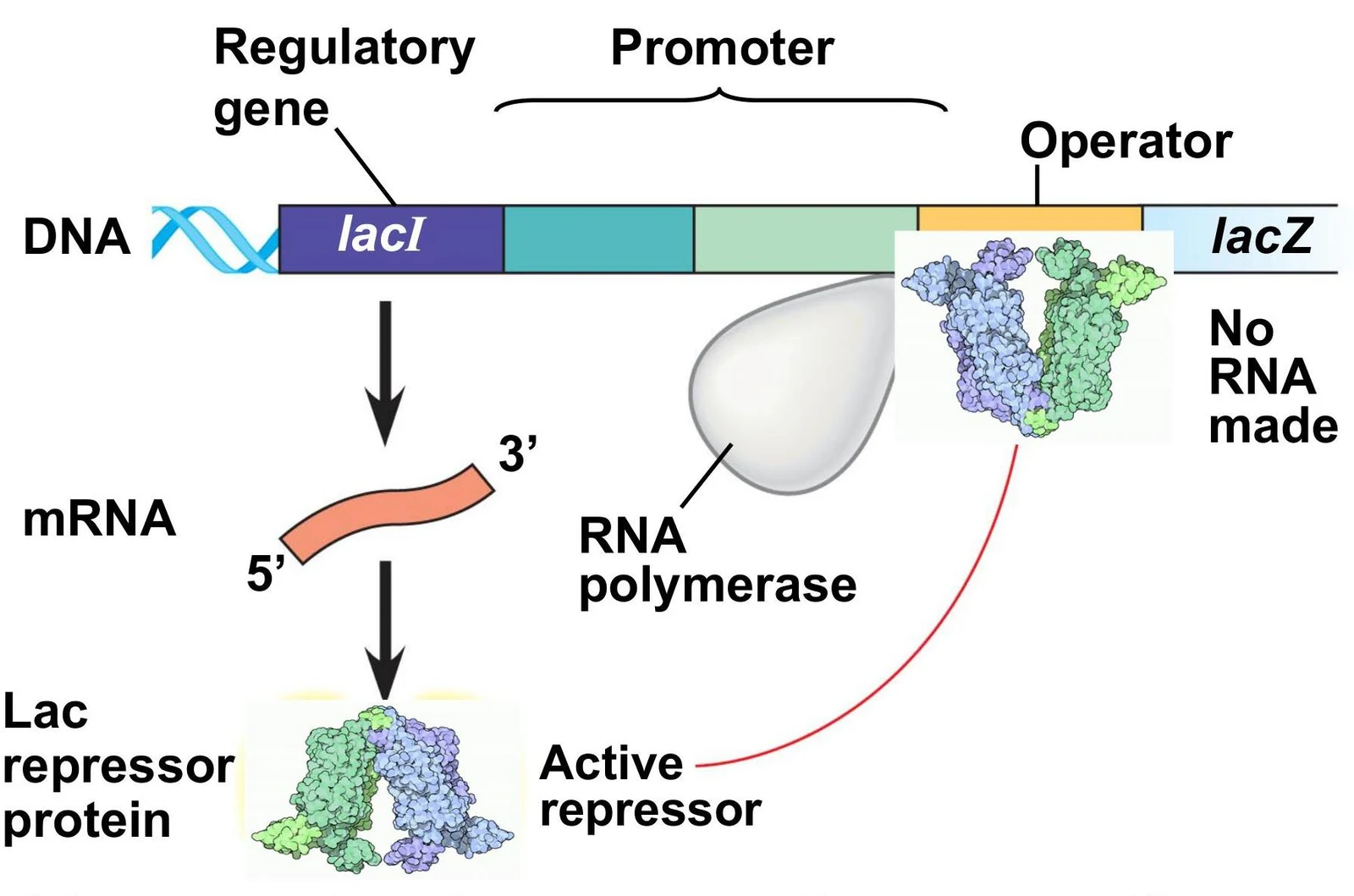
In the absence of lactose: The lac repressor protein binds to the operator, blocking RNA polymerase and keeping the operon off.
In the presence of lactose: A derivative of lactose called allolactose acts as an inducer. Allolactose binds to the repressor, changing its shape so it can no longer bind to the operator. This allows RNA polymerase to transcribe the genes needed to digest lactose.
Diagram illustrating the lac operon in bacteria, showing how the lacI gene regulates gene expression by producing a repressor protein that can bind to the operator region, preventing RNA polymerase from transcribing the lacZ gene.
Repressible Operons and Anabolism
Repressible systems are typically involved in anabolism, the biosynthesis of necessary molecules like amino acids. These operons are usually "on" and are turned "off" when the end product is abundant.
The trp operon is a prime example, as it controls the synthesis of the amino acid tryptophan.
When tryptophan is low: The repressor protein is inactive and cannot bind to the operator, allowing transcription to proceed so the cell can make more tryptophan.
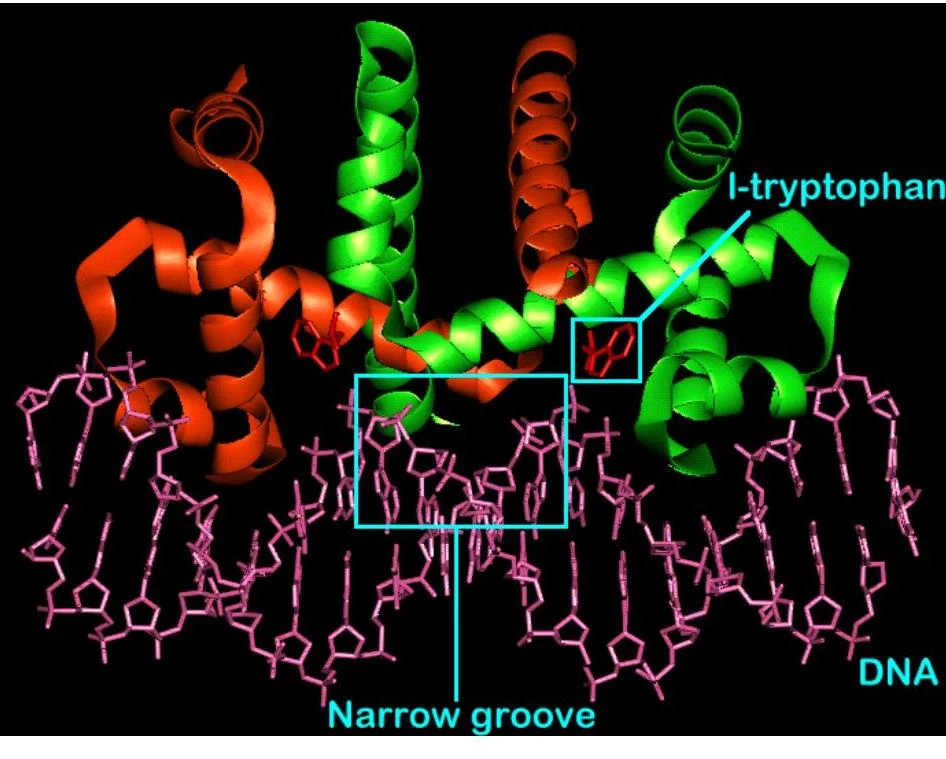
When tryptophan is high: Tryptophan acts as a corepressor. It binds to the repressor protein, activating it. The active repressor-tryptophan complex then binds to the operator, blocking further production.
A molecular illustration showing the interaction between a protein (represented by orange and green helices) and DNA, highlighting the narrow groove and a molecule labeled l-tryptophan.
Catabolite Repression and Diauxic Growth
Bacteria are efficient; if multiple energy sources are available, they will prioritize the most efficient one. In E. coli, glucose is the preferred sugar. This preference is managed through catabolite repression.
When glucose levels are high, the production of cyclic AMP (cAMP) is inhibited. However, when glucose is depleted, cAMP levels rise. The cAMP then binds to the Catabolite Activator Protein (CAP). The cAMP-CAP complex binds to a specific site near the lac promoter, increasing the affinity of RNA polymerase for the promoter and significantly accelerating transcription.
This sequential use of sugars—using glucose first and then switching to lactose once glucose is gone—is known as diauxic growth.
A protein interacting with a DNA strand.
Beyond Transcription: Translational and Posttranslational Control
While transcription is the primary checkpoint, bacteria also regulate gene expression at later stages.
Translational Regulation
Regulation at the translation stage prevents the ribosome from synthesizing a protein from an existing mRNA.
Translational Repressors: These proteins can bind near the Shine-Dalgarno sequence (the ribosome binding site) to physically block the ribosome.
Antisense RNA: Some bacteria produce short RNA strands that are complementary to a specific mRNA. For example, the micF transcript is antisense to the ompF mRNA; when they bind, they prevent the translation of the OmpF porin protein, helping the cell manage osmotic pressure (osmoregulation).
Riboswitches
Riboswitches are specialized RNA elements found in both prokaryotes and eukaryotes. These RNA structures can switch between different conformations (shapes) upon binding to a small molecule. This conformational change can either terminate transcription early or hide the Shine-Dalgarno sequence to prevent translation.
Posttranslational Regulation
The final level of control involves modifying the protein itself after it has been synthesized.
Reversible Modifications: Small chemical groups can be added to amino acids to change protein function. Common examples include phosphorylation, acetylation, and methylation.
Irreversible Modifications: These include proteolytic processing (cleaving the protein) or the attachment of permanent prosthetic groups, sugars, or lipids.
Feedback Inhibition: A common metabolic strategy where the final product of a pathway acts as an inhibitor for an enzyme that acts early in that same pathway, ensuring the cell does not overproduce a substance.
Keep reading for free.
Create an account to finish this reading and make it part of your study routine.