An exploration of fungi, covering their evolutionary history, biological characteristics (unicellular yeasts and multicellular mycelia), nutritional strategies (saprophytes and symbionts), reproduction, dispersal, and their impact as pathogens and beneficial organisms in ecosystems.
Fungi represent a diverse and essential monophyletic lineage of large, terrestrial eukaryotes. From microscopic single-celled yeasts to massive multicellular networks that span kilometers, fungi play indispensable roles in our planet's health, ranging from nutrient cycling to acting as both beneficial partners and devastating pathogens.
Phylogeny and Evolutionary History
Fungi are one of the three major lineages of large, terrestrial eukaryotes. Their evolutionary journey began in aquatic environments approximately 800–1000 million years ago (Mya), and marine fungi still account for roughly 6% of the biomass in the world's oceans. They colonized land approximately 500 Mya, predating the arrival of land plants.
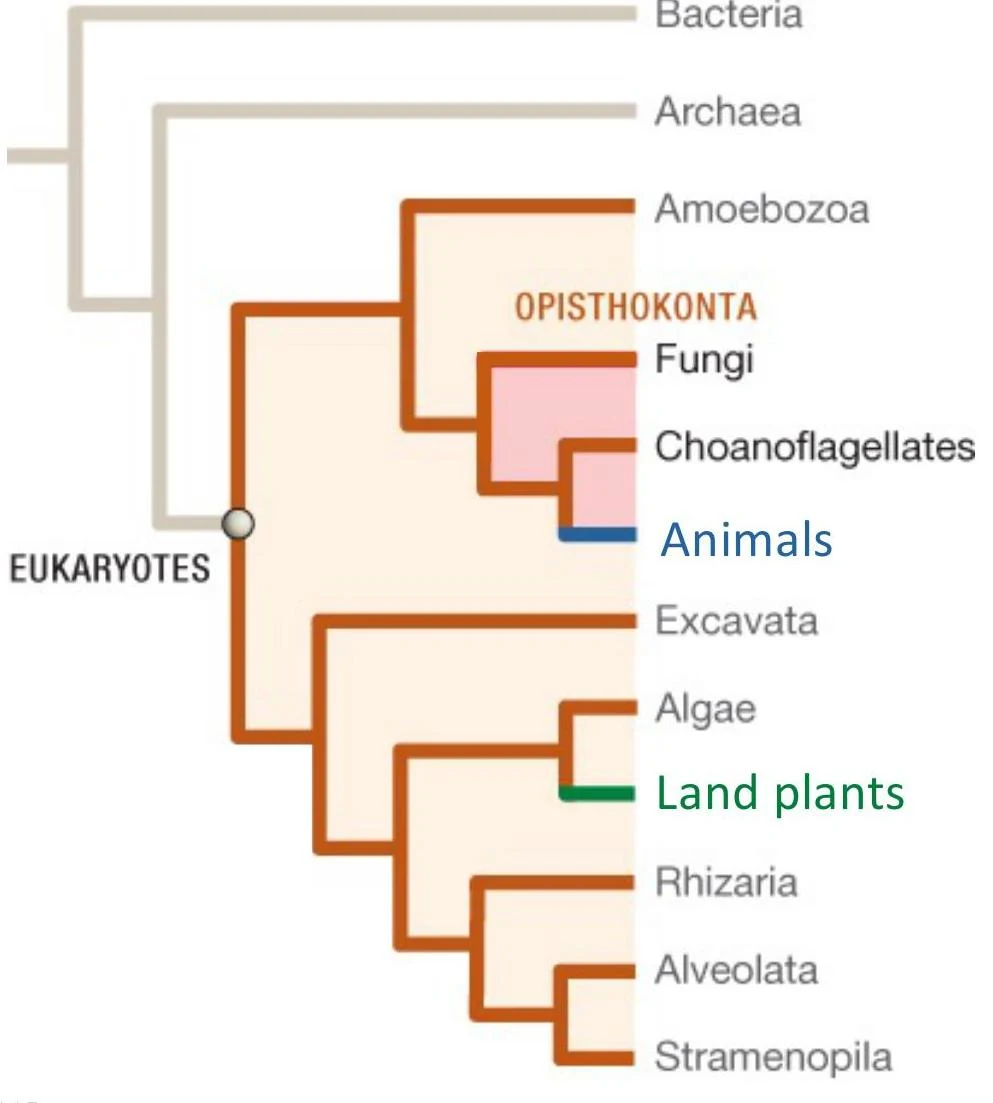
This phylogenetic tree illustrates the evolutionary relationships between major groups of eukaryotes, including Fungi, Animals, Algae, and Land plants, as well as other domains like Bacteria and Archaea.
A key evolutionary innovation for fungi was developing mechanisms to extract nutrients effectively within a terrestrial environment. While their fossil record is sparse, making their history difficult to study, modern taxonomy relies heavily on DNA sequence data and the study of sexual reproductive structures to classify them.
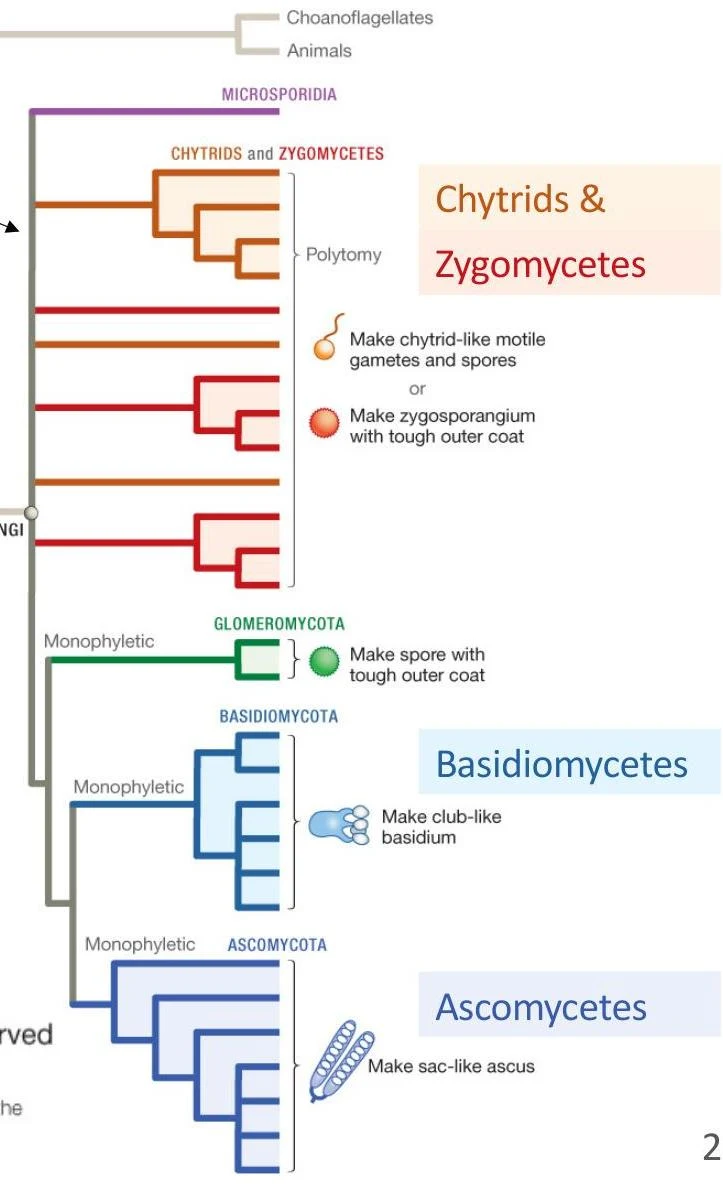
This phylogenetic tree illustrates the evolutionary relationships between different fungal groups, including Microsporidia, Chytrids, Zygomycetes, Glomeromycota, Basidiomycota, and Ascomycota. It highlights key characteristics of each group, such as the formation of motile gametes and spores, zygosporangia, and asci.
Current classification shows that while fungi are monophyletic, many internal relationships remain unresolved, resulting in "polytomies" in phylogenetic trees. As of 2018, approximately 120,000 species had been named, though estimates suggest a true diversity of 2.2 to 3.8 million species.
Biological Characteristics and Structure
Fungi are eukaryotes, meaning their cells contain a membrane-bound nucleus. This distinguishes them from bacteria, which are prokaryotes. Structurally, fungi can be single-celled or composed of filaments. They possess cell walls containing chitin—a substance also found in animal exoskeletons—which provides structural integrity.
Unicellular vs. Multicellular Forms
Single-celled fungi, often referred to as "yeasts," occur in several taxonomic groups, including Ascomycota and Basidiomycota. Because single-celledness appears in different groups, it is not considered a monophyletic trait.
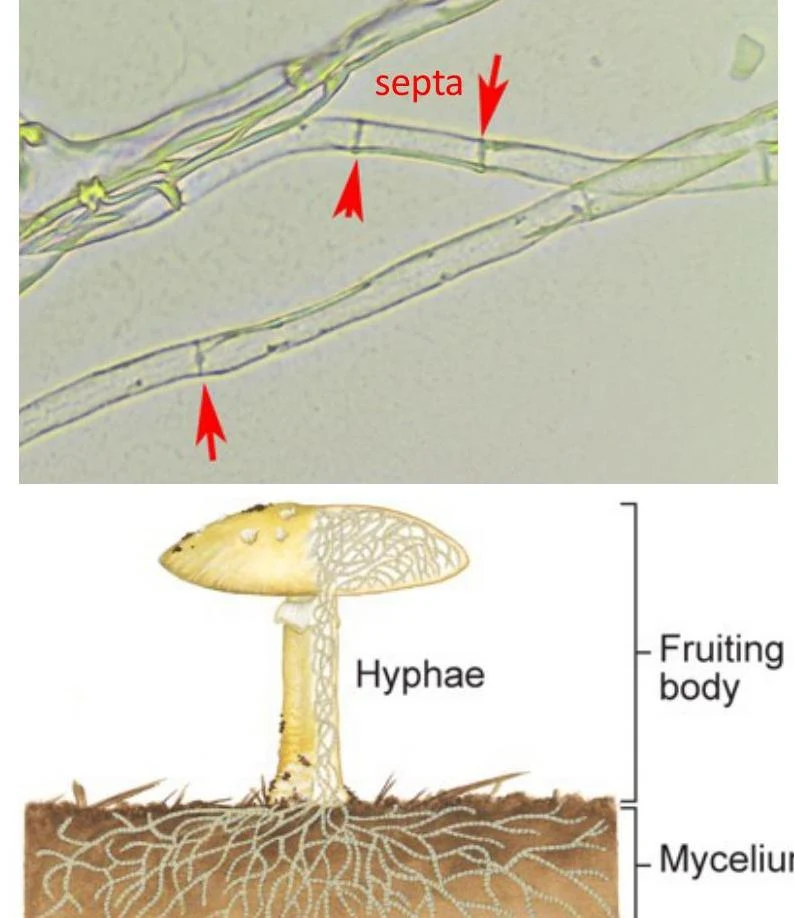
In multicellular fungi, the primary structure is the mycelium, a network made of long, thin filaments called hyphae. These hyphae are often separated by cross-walls known as septa, which contain large pores that allow for the passage of nutrients and even nuclei.
Diagram illustrating the structure of a mushroom, showing the fruiting body and the underground mycelium composed of hyphae, with septa indicated.
Nutrition and Ecosystem Functioning
Unlike plants that photosynthesize or animals that ingest food, fungi are absorbers. They secrete digestive enzymes externally to break down organic matter and then absorb the nutrients directly from their surroundings. This makes them "master absorbers" and critical players in the Carbon (C), Nitrogen (N), and Phosphorus (P) cycles.
Fungi can be categorized by their nutritional strategies:
Saprophytes: Decomposers that break down dead organic matter. Fungi were the first and most efficient decomposers of lignin and cellulose, the most abundant molecules on Earth.
Symbionts: Organisms that live in close association with others. Examples include lichens (fungi + algae/cyanobacteria) and mycorrhizae (fungi + plant roots).
Exam Tip: If asked about fungal nutrition, remember that they do not perform photosynthesis. They absorb nutrients externally via secreted enzymes.
The "Humongous Fungus"
The scale of fungal structures can be staggering. The largest known organism is an Armillaria ostoyae (Honey Mushroom) colony in the Malheur National Forest, Oregon. Known as the "Humongous Fungus," this organism is thought to be over 8,000 years old and covers approximately 9 km² (2,385 acres).
The massive size is achieved through a network of mycelial cords that connect genetically identical colonies (genets) underground, allowing for the transfer of nutrients. While the underground network is vast, the visible mushrooms only appear briefly in the fall.
Reproduction and Dispersal
Fungal reproduction is highly complex and can occur through both asexual and sexual pathways.
Asexual Reproduction
This is the simplest form of reproduction, often involving fragmentation or the production of vegetative spores called conidia on specialized structures called conidiophores.
Sexual Reproduction
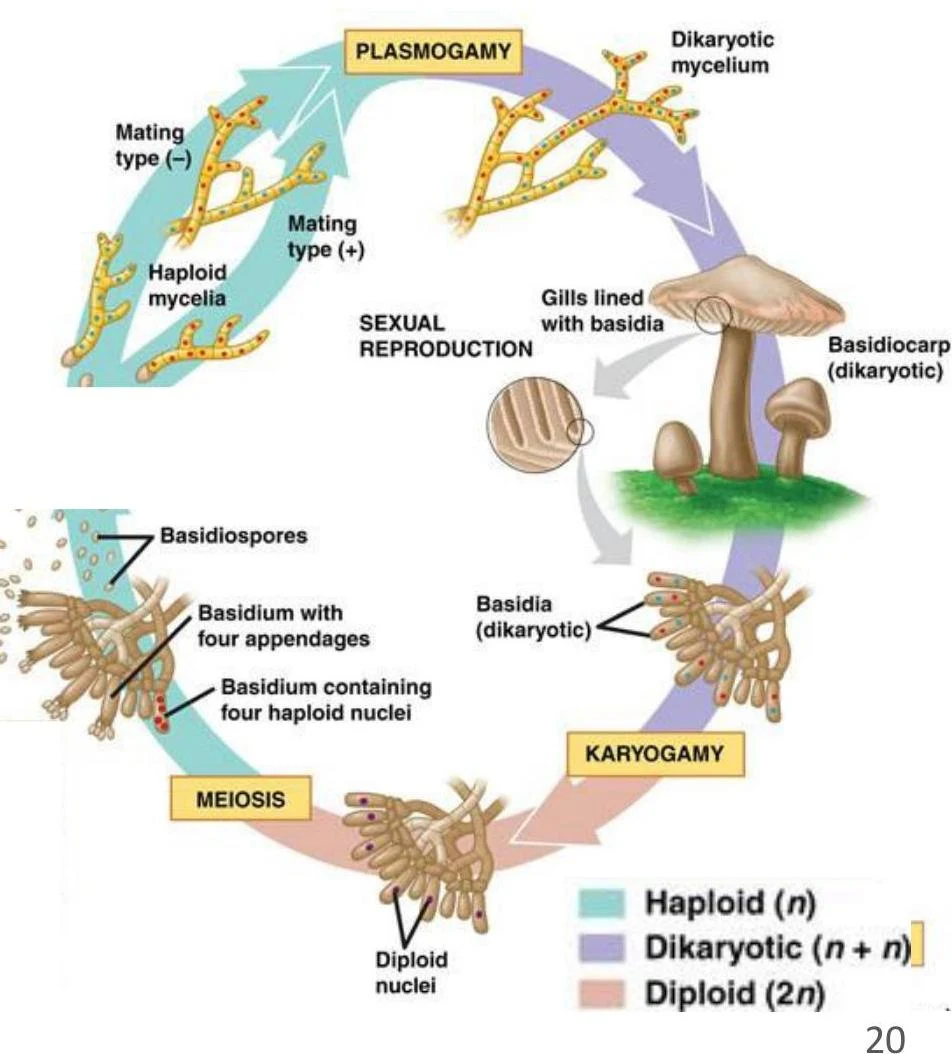
Sexual cycles often involve distinct ploidy stages:
Plasmogamy: Compatible hyphae fuse, joining their cytoplasm but leaving the nuclei separate. This creates a dikaryotic mycelium (n+n).
Karyogamy: The two haploid nuclei finally fuse to form a diploid ($2n$) nucleus.
Meiosis: The diploid nucleus undergoes meiosis to produce four haploid (n) spores.
Diagram illustrating the life cycle of a basidiomycete fungus, showing stages of plasmogamy, karyogamy, and meiosis.
Dispersal
Fungi primarily disperse via spores. Because spores are small, they are easily carried by wind. Some fungi have evolved specialized ejection mechanisms (like puffballs) or use animals as dispersers (like stinkhorns).
Pathogens and Human Impact
While fungi are vital for life, some species act as significant pathogens:
Human Health: Fungi cause infections such as athlete's foot, ringworm, and yeast infections.
Wildlife: The aquatic chytrid fungus (Batrachochytrium dendrobatidis) has caused massive declines in amphibian populations worldwide.
Insects: Certain fungi, like Cordyceps, act as parasites that can manipulate the behavior of their insect hosts.
Conversely, humans utilize fungi for fermentation (bread, alcohol, cheese), bioremediation (using white rot to devour lignin), and as model organisms in biological research.
Keep reading for free.
Create an account to finish this reading and make it part of your study routine.