Explore the fundamental biology of fungi, including their unique methods of external digestion and nutrient absorption through hyphae and mycelia. Understand their critical ecological impacts on decomposition, nutrient cycling, and symbiotic relationships like lichens and mycorrhizae. Learn about fungal reproduction, d
Fungi are one of the three major lineages of large, terrestrial eukaryotes, having colonized land approximately 500 million years ago—predating the arrival of plants. While they range from single-celled yeasts to massive multicellular networks, they share fundamental defining features: they are eukaryotes with cell walls made of chitin, they absorb nutrients directly from their surroundings, and they disperse via spores. From the "Humongous Fungus" in Oregon, which covers nearly 9 km2, to the microscopic chytrids in our oceans, fungi are critical drivers of Earth's biological and chemical processes.
The Mechanics of Fungal Nutrition
Unlike plants, which produce their own food through photosynthesis, or animals, which ingest food, fungi utilize a unique method of external digestion. This process is made possible by their specific physical structure.
Hyphae and Mycelia
The body of most fungi consists of a network of long, thin filaments called hyphae. These hyphae are incredibly fine—often 100 times thinner than the thinnest plant root—allowing them to penetrate tiny crevices in substrates. When these hyphae pack together, they form a mass known as a mycelium. In many species, the hyphae are divided by cross-walls called septa, which contain large pores that allow for the passage of nutrients and even nuclei between cells.
External Digestion
Because fungi cannot "eat" in the traditional sense, they must break down complex organic matter outside of their bodies. They secrete external digestive enzymes into their environment to decompose organic molecules. Once the matter is broken down into smaller, absorbable units, the hyphae absorb the nutrients directly. This makes fungi "master absorbers" and highly efficient saprophytes (decomposers).
Exam Tip: If asked to distinguish fungi from bacteria, remember that fungi are eukaryotes (possessing a membrane-bound nucleus) and have cell walls made of chitin, whereas bacteria are prokaryotes with peptidoglycan cell walls.
Ecological Impacts: Decomposition and Nutrient Cycles
The ability of fungi to secrete powerful enzymes has profound implications for the planet's chemistry. They are the primary drivers of the Carbon (C), Nitrogen (N), and Phosphorus (P) cycles.
Breaking Down the Earth's Biomass
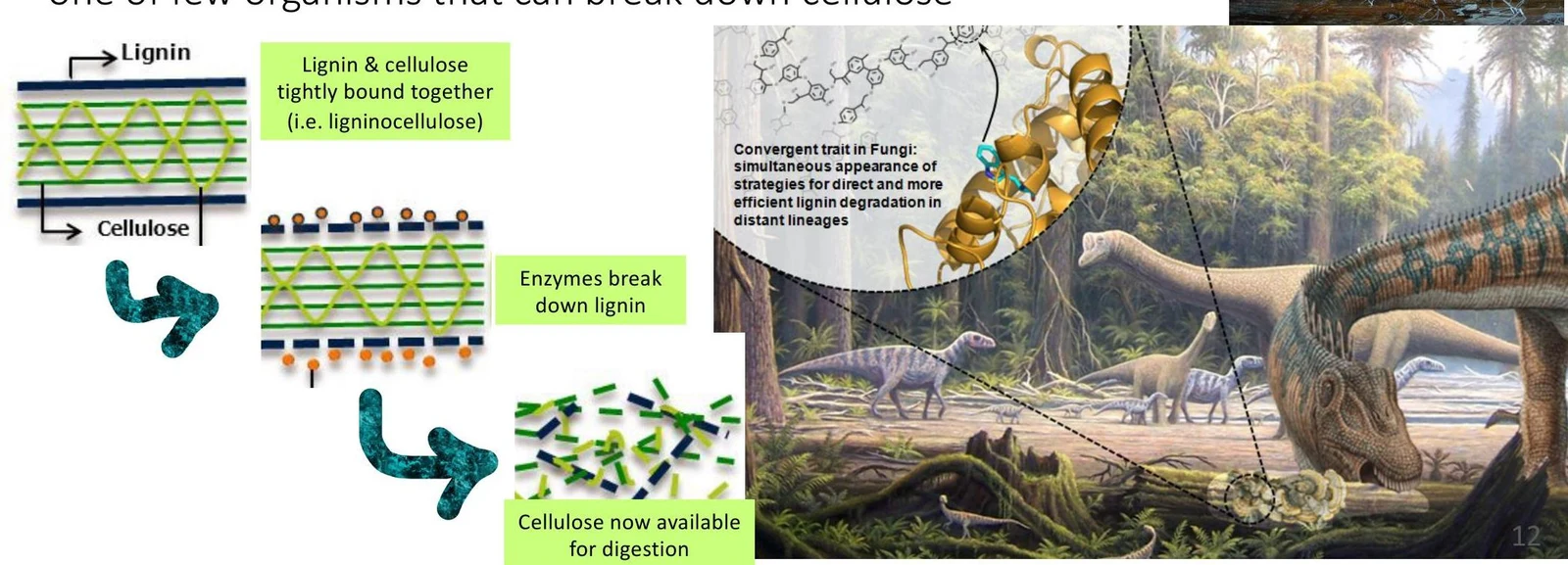
Two of the most abundant molecules on Earth are lignin and cellulose. Lignin alone makes up approximately 25% of all land-based biomass. Fungi were the first and remain one of the few organisms capable of efficiently decomposing lignin. By breaking down these tough structural components of plants, fungi release locked-away nutrients back into the soil, making them available for other life forms.
Diagram illustrating how enzymes break down lignin to make cellulose available for digestion, alongside an image of dinosaurs in a prehistoric forest and a close-up of a protein structure related to lignin degradation in fungi.
Symbioses: Living Together
Fungi do not just break things down; they also form complex, mutually beneficial relationships known as symbioses.
Lichens
Lichens represent one of the most famous fungal symbioses, consisting of a fungus living in partnership with either algae or cyanobacteria. These organisms cover roughly 6% of the Earth's surface.
Mycorrhizae
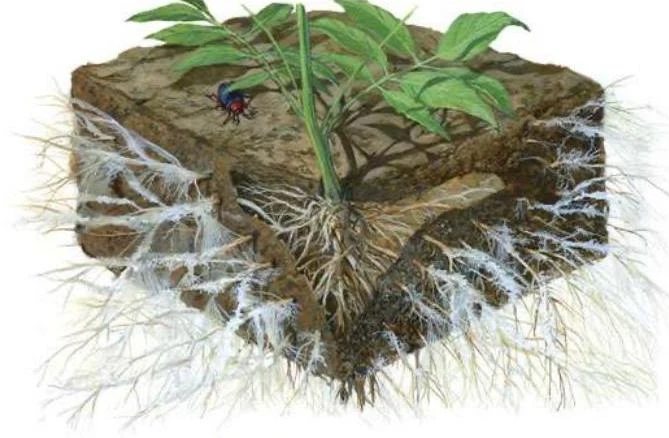
Perhaps even more critical to terrestrial life are mycorrhizae—symbiotic associations between fungi and plant roots. Approximately 80% of all angiosperms (flowering plants) partner with mycorrhizal fungi to acquire nutrients from the soil.
There are two primary types of mycorrhizal associations:
Ectomycorrhizae: The fungi grow around the root cells.
Endomycorrhizae: The fungi actually penetrate the root cells.
The presence or absence of these fungal partners can dictate where plant species can survive and can even facilitate the invasion of new territories by plants.
Illustration of a plant's root system, showing roots and mycorrhizal fungi in the soil, with a beetle on the surface.
Fungal Pathogens and Biodiversity
While many fungi are helpful, some can have devastating impacts on biodiversity. A notable example is Batrachochytrium dendrobatidis (Bd), an aquatic chytrid fungus. Bd causes a lethal skin disease in amphibians and has caused unprecedented declines in wildlife populations globally.
Reproduction and Dispersal
Fungal reproduction is highly diverse and can occur through both asexual and sexual cycles.
Asexual Reproduction
Asexual reproduction is often the simplest way for fungi to spread. This can occur through fragmentation or through the production of specialized vegetative spores called conidia. These conidia are typically produced on specialized structures called conidiophores.
Diagram and micrograph of Penicillium mold, illustrating conidia, conidiophore, and mycelium.
Sexual Reproduction
Sexual reproduction in fungi is more complex than in plants or animals and often involves several distinct phases:
Plasmogamy: Compatible hyphae fuse, bringing their cytoplasm together but leaving the nuclei separate. This creates a dikaryotic stage where each cell has two types of haploid nuclei.
Karyogamy: The two haploid nuclei finally fuse to form a diploid ($2n$) nucleus.
Meiosis: The diploid nucleus undergoes meiosis to produce four haploid (n) spores.
Dispersal Mechanisms
Fungi rely heavily on spores for dispersal. Because spores are extremely small, they can be easily carried by the wind. Some fungi have evolved specialized methods to ensure their spores reach new hosts, such as puffballs that eject spores, stinkhorns that use animals to spread them, or even Cordyceps species that manipulate insect behavior.
Summary Table: Fungal Life Stages
Stage
Ploidy
Description
Haploid
n
Standard mycelium or spore
Dikaryotic
n+n
Shared cytoplasm, but two separate nuclei
Diploid
$2n$
Result of nuclear fusion (karyogamy)
Keep reading for free.
Create an account to finish this reading and make it part of your study routine.