An overview of vital signs, including temperature, pulse, respirations, blood pressure, and oxygen saturation. Learn about normal ranges, influencing factors, and measurement techniques.
Vital signs serve as the primary objective measures of basic body function. By collecting these measurements, healthcare providers can establish a baseline for a patient and monitor trends over time, which is essential for identifying changes in health status. A complete vital signs assessment typically includes temperature, pulse, respirations, blood pressure, oxygen saturation, and the assessment of pain.
Body Temperature
Temperature is regulated by the hypothalamus, which works to balance the body's heat production with heat loss. A person's normal temperature is influenced by several factors, including the diurnal cycle (time of day), the menstrual cycle, physical exercise, and age. While the mean oral temperature for a resting adult is approximately 37∘C (98.6∘F), clinicians must be aware of specific clinical ranges.
When a patient's temperature rises above 38∘C (100.4∘F), they are considered febrile. Conversely, if the temperature falls below 36.0∘C (96.8∘F), the patient is experiencing hypothermia.
To obtain an accurate reading, clinicians must select the appropriate route. Common temperature routes include:
Oral
Rectal
Tympanic
Temporal
Axillary
This illustration shows four common methods for measuring body temperature: oral, tympanic (ear), temporal (forehead), and axillary (armpit).
Pulse Assessment
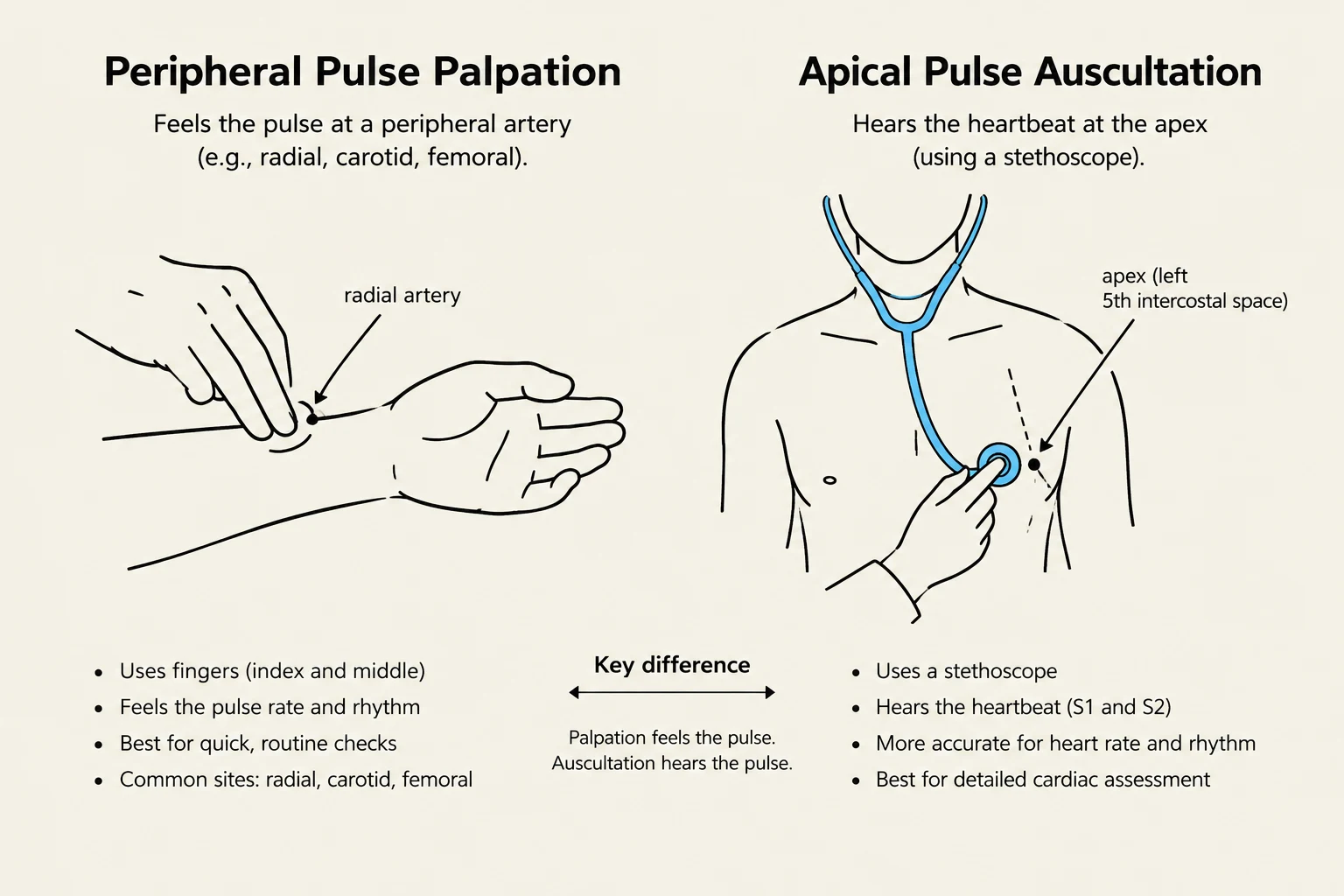
The pulse is a pressure wave caused by the heart's contraction. By using palpation, a clinician can determine both the rate and the rhythm of the heartbeat. Various factors can influence the heart rate, such as stress, temperature, dehydration, hemorrhage, and the administration of certain medications.
Pulse Rate and Rhythm
For a healthy adult at rest, the average pulse rate is between 60 and 100 beats per minute (bpm). Clinicians use specific terms to describe deviations from this range:
Bradycardia: A heart rate less than 60 bpm.
Tachycardia: A heart rate greater than 100 bpm.
Pulse Descriptors and Locations
When documenting a pulse, it is not enough to simply provide a number; you must also describe the quality of the pulse using specific descriptors:
3+: Increased, full, or bounding
2+: Normal
1+: Weak
0: Absent
Clinicians can assess pulses at various peripheral locations, including the temporal, carotid, brachial, radial, femoral, popliteal, posterior tibial (PT), and dorsalis pedis (DP) arteries.
Clinical Tip: Technique Matters
When assessing peripheral pulses, use the pads of your first three fingers. Count for 30 to 60 seconds. If you suspect an abnormality, you may also use a Doppler device to locate the pulse.
The Apical Pulse
The apical pulse is assessed differently than peripheral pulses. Instead of palpation, you must use a stethoscope to listen directly to the heart. The standard technique is to count for a full 60 seconds, though you may count for 30 seconds and multiply by two if the rhythm is regular.
This illustration compares peripheral pulse palpation and apical pulse auscultation, two methods for assessing a patient's pulse and heart function.
Respirations
Respirations are assessed by observing the patient's chest to visualize one full inspiration and one full expiration, which constitutes one respiration. A normal, healthy adult typically has a respiratory rate of 10 or 12 to 20 breaths per minute.
When assessing respirations, clinicians should note the rate, rhythm, and depth. Common patterns include:
Eupnea: Normal breathing.
Bradypnea: Abnormally slow breathing.
Tachypnea: Abnormally rapid breathing.
Apnea: Absence of breathing.
Exam Tip: The "Hidden" Assessment
To get the most accurate respiratory rate, try to assess the patient when they are not aware you are watching them. Patients often subconsciously change their breathing pattern if they know they are being monitored.
Blood Pressure
Blood pressure is the force exerted by the blood against the arterial walls during heart contraction (systole) and relaxation (diastole). It is recorded as systole/diastole.
Several physiological factors control blood pressure, including cardiac output, peripheral vascular resistance, blood volume, blood viscosity, and the elasticity of the vessel walls. Other influencing factors include age, race, weight, emotions, gender, diurnal rhythm, exercise, stress, and smoking.
Measurement Technique
To measure blood pressure, a sphygmomanometer and a stethoscope are required. It is critical that the cuff size is appropriate; the width should be approximately 40% of the arm's circumference. Using a cuff that is too small will result in a falsely elevated reading.
The standard procedure involves:
Palpating the brachial artery.
Aligning the cuff arrow with the brachial artery.
Palpating the radial artery while inflating the cuff to find the point where the radial pulse disappears.
Adding 30 mmHg to that pressure (to avoid the "auscultatory gap") to determine the "systolic high".
Placing the stethoscope diaphragm over the brachial artery and inflating to the "systolic high".
Slowly releasing the pressure while listening for Korotkoff sounds.
In adults, the first clear tapping sound represents the systolic pressure (Phase I), and the point where the sound disappears represents the diastolic pressure (Phase V).
Blood Pressure Ranges
Category
Systolic (mmHg)
Diastolic (mmHg)
Normal
< 120
< 80
Elevated
120–129
< 80
Stage 1 Hypertension
130–139
80–89
Stage 2 Hypertension
≥140
≥90
Oxygen Saturation (SpO2)
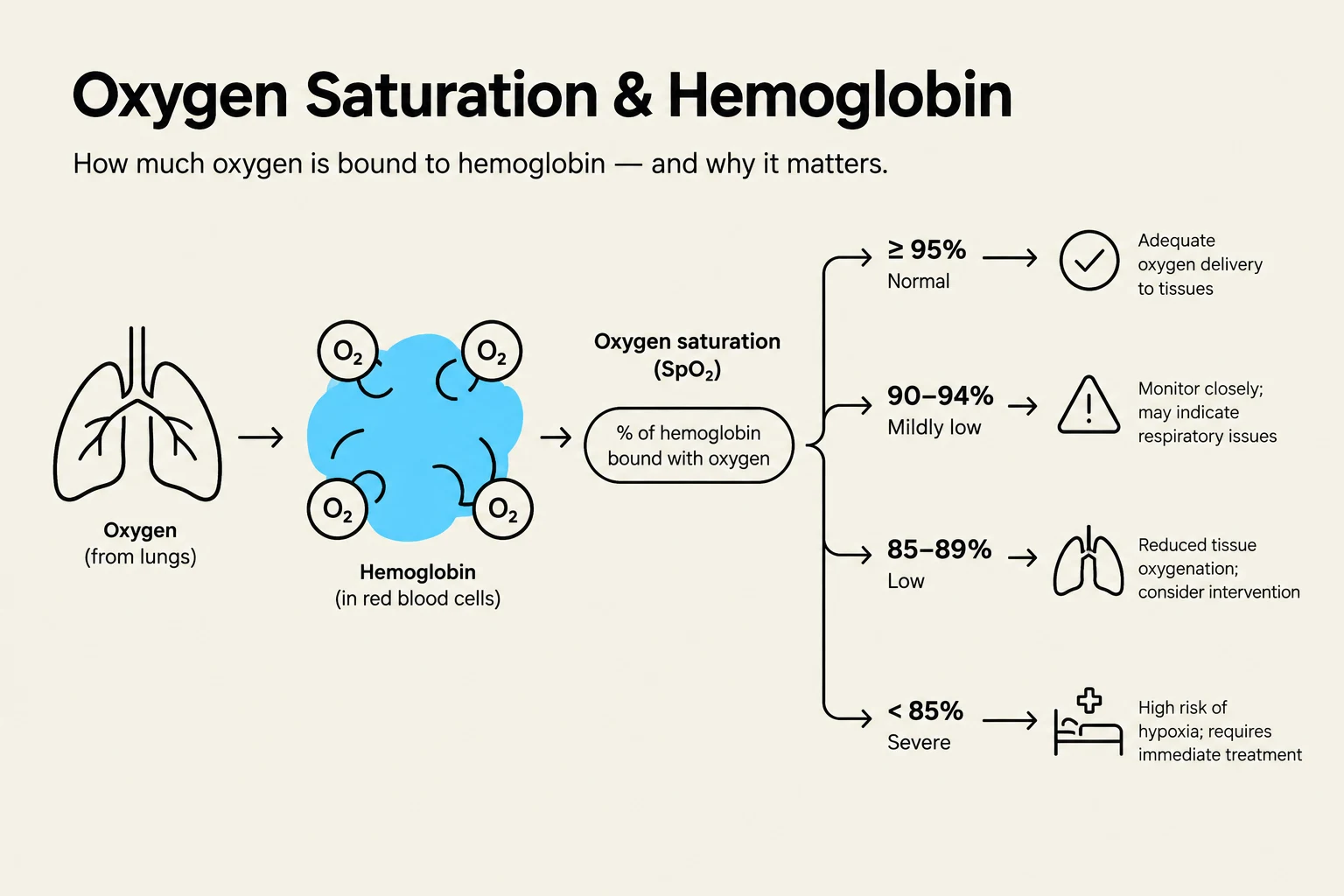
Oxygen saturation measures the diffusion and perfusion of oxygen in the body by assessing arterial oxygen saturation. A sensor measures the amount of oxygen bound to hemoglobin molecules. While a healthy adult on room air should ideally be at 100%, the clinical goal is generally to maintain a level >90–92% on room air.
This diagram illustrates the relationship between oxygen saturation levels (SpO2) and hemoglobin, explaining the implications of different saturation ranges for oxygen delivery to tissues and potential health concerns.
Summary Table of Vital Sign Normals
To ensure safe practice, remember these general ranges for a healthy adult:
Vital Sign
Normal Range
Temperature
37∘C
Blood Pressure
120/80 mmHg
Heart Rate
60–100 bpm
Respirations
12–20 breaths/min
Oxygen Saturation (SpO2)
>90% on room air
Keep reading for free.
Create an account to finish this reading and make it part of your study routine.