Explores the fundamental mechanics of how we interact with the world through sensation, transduction, and perception, with a deep dive into the physics of light and the biology of color vision.
How do we know that the red object in front of us is a rose, or that the sound we hear is a piano rather than a guitar? To answer these questions, we must distinguish between the raw data collected by our bodies and the complex interpretations made by our brains. This article explores the fundamental mechanics of how we interact with the world through sensation, transduction, and perception, with a deep dive into the physics of light and the biology of color vision.
This diagram illustrates the process of sensation and perception, showing how external stimuli like light waves from a rose are detected by the eye, processed by the brain as neural signals, and result in a conscious thought or perception, such as recognizing it as a 'Red Rose'.
Sensation vs. Perception: The Raw Data and the Interpretation
While often used interchangeably in everyday conversation, "sensation" and "perception" refer to two distinct stages of processing.
Sensation is the initial physiological process. It occurs when specialized sensory receptors detect physical stimuli from the environment—such as light waves, sound vibrations, or chemical molecules—and convert them into neural signals. For example, your eyes detecting light is a sensation.
Perception is the psychological process that follows. It is how the brain organizes, identifies, and interprets those sensory signals to create a meaningful experience. Using the same example: your brain interpreting that light as "a red rose" is perception.
Exam Tip: Remember that sensation provides the "raw data," while perception provides the "meaning." They are not the same thing.
Transduction: The Biological Bridge
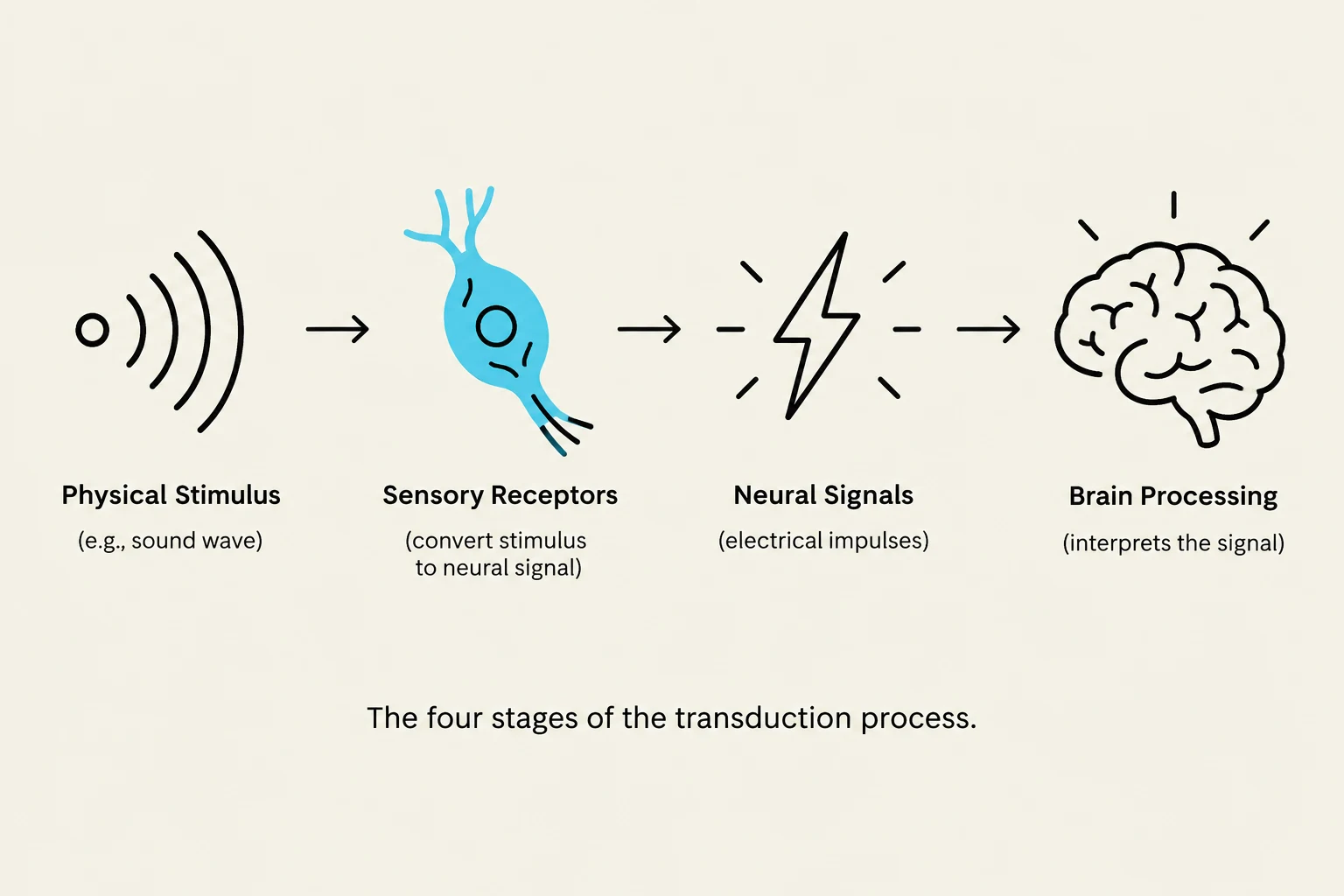
The four stages of the transduction process: physical stimulus, sensory receptors, neural signals, and brain processing.
For the brain to understand the world, physical energy must be translated into a language the nervous system speaks: electricity. This translation process is called transduction.
Transduction follows a specific sequence:
Physical Stimulus: Light, sound, pressure, or chemicals enter the system.
Sensory Receptors: Specialized cells (like those in your eyes or ears) detect the stimulus.
Neural Signals: The receptors convert the energy into electrical signals.
Brain Processing: The brain receives these signals and interprets them.
Without transduction, the brain would remain isolated from the physical world, as it cannot directly "feel" a sound wave or "see" a photon; it can only process the electrical impulses those things trigger.
The Physics of Vision: Light and the Electromagnetic Spectrum
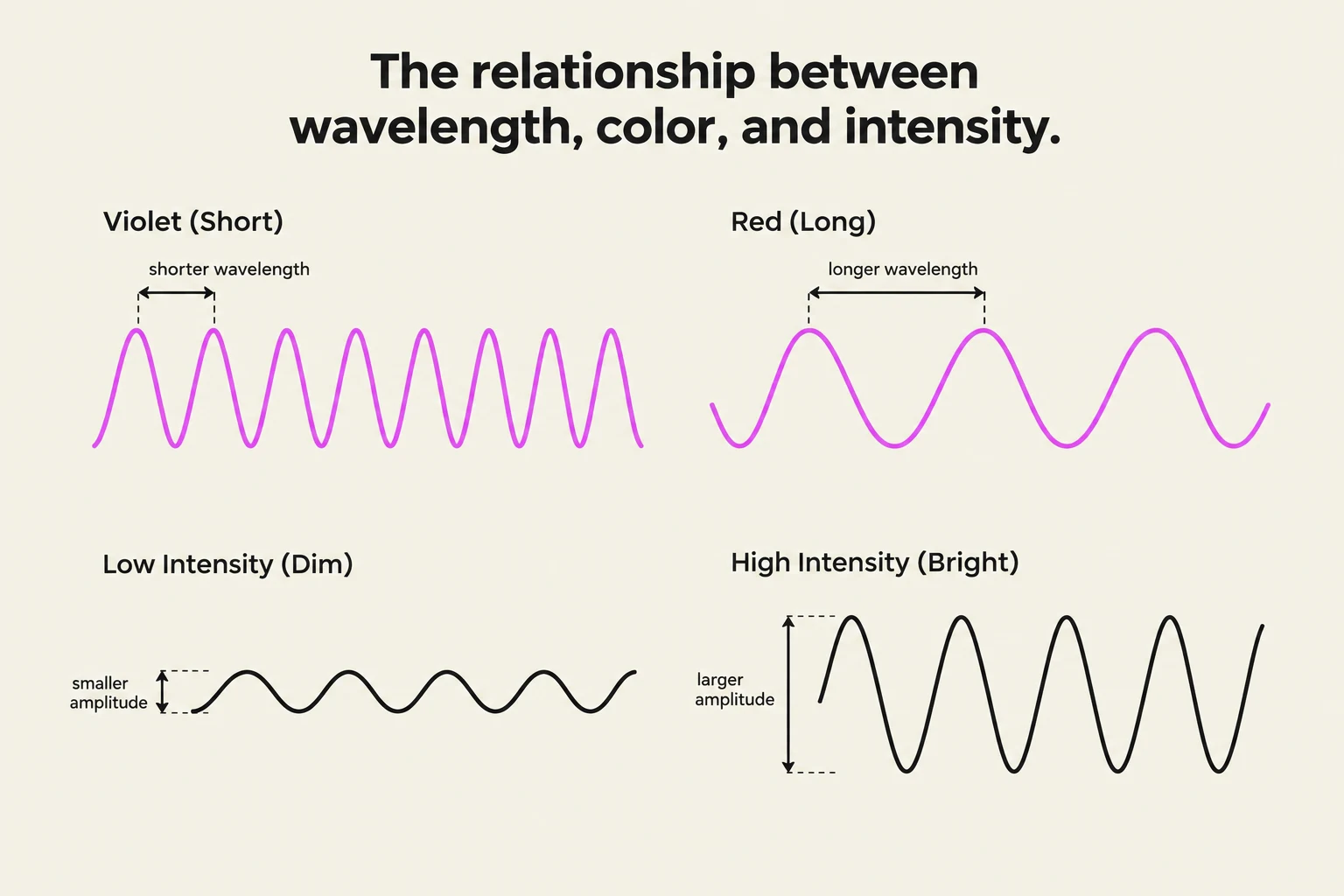
This diagram illustrates the relationship between wavelength, color, and intensity of light waves. Shorter wavelengths are associated with violet light, while longer wavelengths correspond to red light. Intensity is represented by the amplitude of the wave; a larger amplitude indicates higher intensity (brighter light), and a smaller amplitude indicates lower intensity (dim light).
Vision begins when light reflected from objects enters the eye. To understand how we see, we must first understand what light is.
The Electromagnetic Spectrum
Light is a form of electromagnetic radiation. The spectrum is vast, containing everything from long radio waves to incredibly short gamma rays. However, human eyes are only capable of detecting a very narrow band of this spectrum, known as the visible spectrum.
Wavelength and Color
Within the visible spectrum, the specific wavelength of light determines the color we perceive. Wavelength is measured in nanometers (nm), where one nanometer is one-billionth of a meter.
Shorter wavelengths are perceived as violet and blue light.
Longer wavelengths are perceived as orange and red light.
Color
Approximate Wavelength
Violet
400 nm
Blue
450 nm
Green
500–550 nm
Yellow
570–590 nm
Orange
590–620 nm
Red
620–700 nm
An object appears to have a specific color because of how it interacts with light: it absorbs certain wavelengths and reflects others. For instance, a rose appears red because it reflects relatively more red light toward your eyes.
Intensity and Brightness
It is vital not to confuse wavelength with intensity. While wavelength determines the hue (the color), intensity refers to the amount of energy carried by the wave. In visual terms, higher intensity results in greater perceived brightness, while lower intensity results in lower perceived brightness.
Color Vision: Photoreceptors and Species Differences
The human eye contains specialized cells in the retina called photoreceptors that allow us to see color.
Trichromatic Vision
Humans generally possess trichromatic vision, meaning we have three distinct types of cone photoreceptors in our retina. These cones are sensitive to different ranges of wavelengths:
S-cones: Most sensitive to short wavelengths (blue).
M-cones: Most sensitive to medium wavelengths (green).
L-cones: Most sensitive to long wavelengths (red).
The brain combines the responses from these three types of cones to distinguish a vast array of colors.
Animal Color Vision
Sensory abilities are shaped by evolution and survival needs, meaning different species experience the world very differently:
Dogs and Cats: Generally possess only two types of cones (dichromats), making it difficult for them to distinguish between red and green.
Birds: Many species have four types of cones, including sensitivity to ultraviolet (UV) light, which allows them to see patterns invisible to humans.
Insects (e.g., Bees): Can detect UV light to find patterns on flowers, though they may struggle to see red light like humans do.
Summary of Key Concepts
To master this topic, ensure you can distinguish between these fundamental pairs:
Sensation vs. Perception: Detection of stimuli vs. interpretation of stimuli.
Wavelength vs. Intensity: Perceived color (hue) vs. perceived brightness.
Rods vs. Cones: Dim-light/peripheral vision vs. color/detailed vision.
Transduction: The essential conversion of physical energy into neural signals.
Keep reading for free.
Create an account to finish this reading and make it part of your study routine.