An exploration of sensory perception, including its mechanisms, the categorization of stimuli, disturbances like sensory overload and deprivation, and age-related changes in vision and hearing.
Have you ever wondered how you know a fire alarm is ringing, or how you can tell the difference between a lemon and an orange without looking? It is not just about "feeling" or "seeing"; it is a complex neurological process. Sensory perception is the conscious process of selecting, organizing, and interpreting data from the senses into meaningful information. While our senses collect raw data, it is our brain that turns that data into a coherent reality. This process is essential for our growth, development, and survival.
The Mechanism of Perception
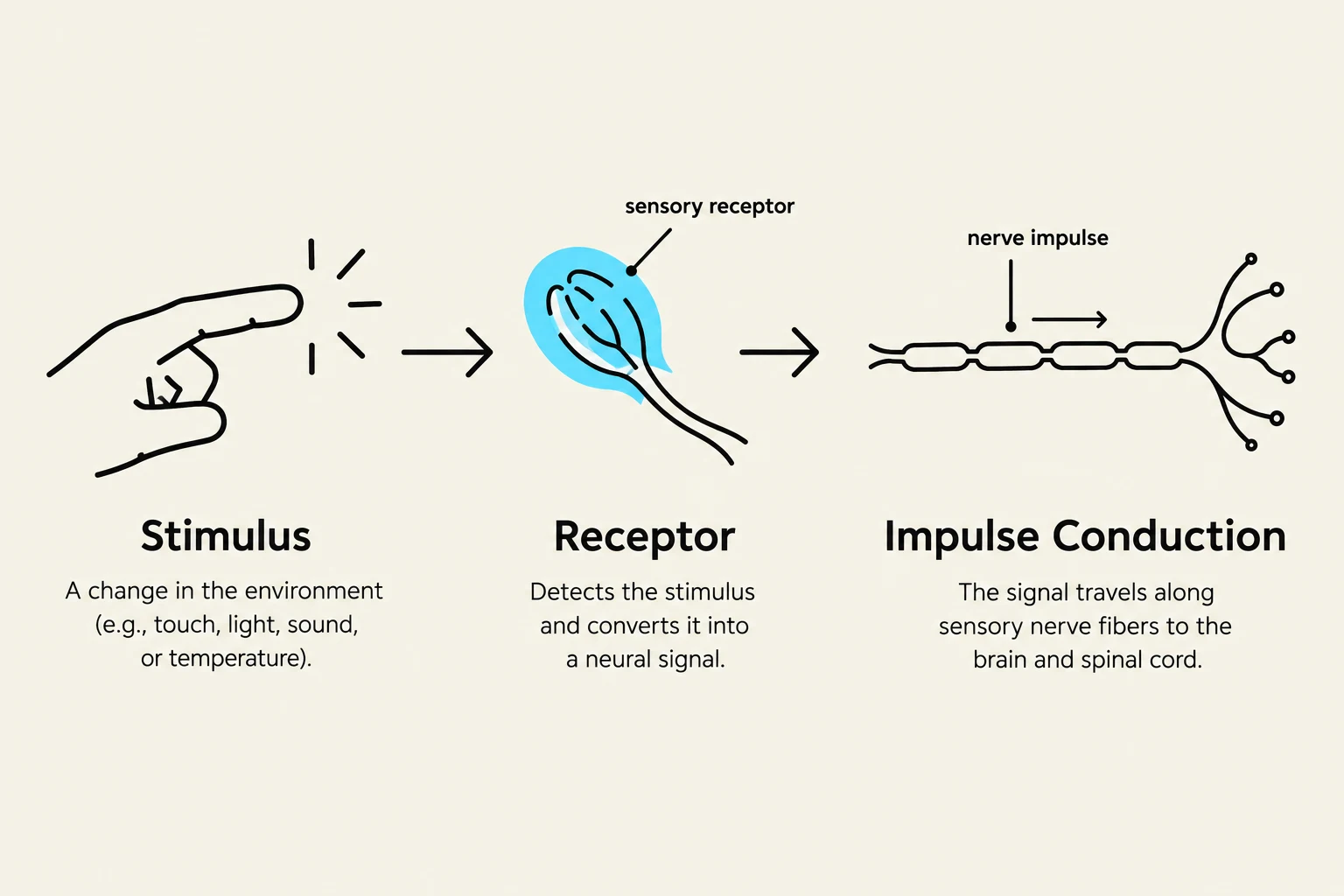
Perception is not a passive reception of data. It is an active interpretation influenced by the intensity, size, or change of a stimulus, as well as our own past experiences, knowledge, and attitudes. For a person to successfully perceive something, a specific sequence of events must occur: a stimulus must be present, a receptor must detect it, an impulse must be conducted through the nervous system, and finally, the brain must perceive it.
The brain's ability to manage this incoming stream of information is regulated by the Reticular Activating System (RAS). Extending from the hypothalamus to the medulla, the RAS monitors and regulates incoming stimuli to maintain an optimal state of arousal, known as sensoristasis.
This diagram illustrates the process of sensory reception and impulse conduction, starting with a stimulus, followed by a receptor detecting the stimulus and converting it into a neural signal, and finally, impulse conduction along nerve fibers to the brain and spinal cord.
Study Tip: Remember that "Arousal" is not a binary "on/off" switch. It exists on a spectrum ranging from unconscious states (like coma or sleep) to various levels of conscious states (like delirium, confusion, or normal consciousness).
Categorizing Sensory Stimuli
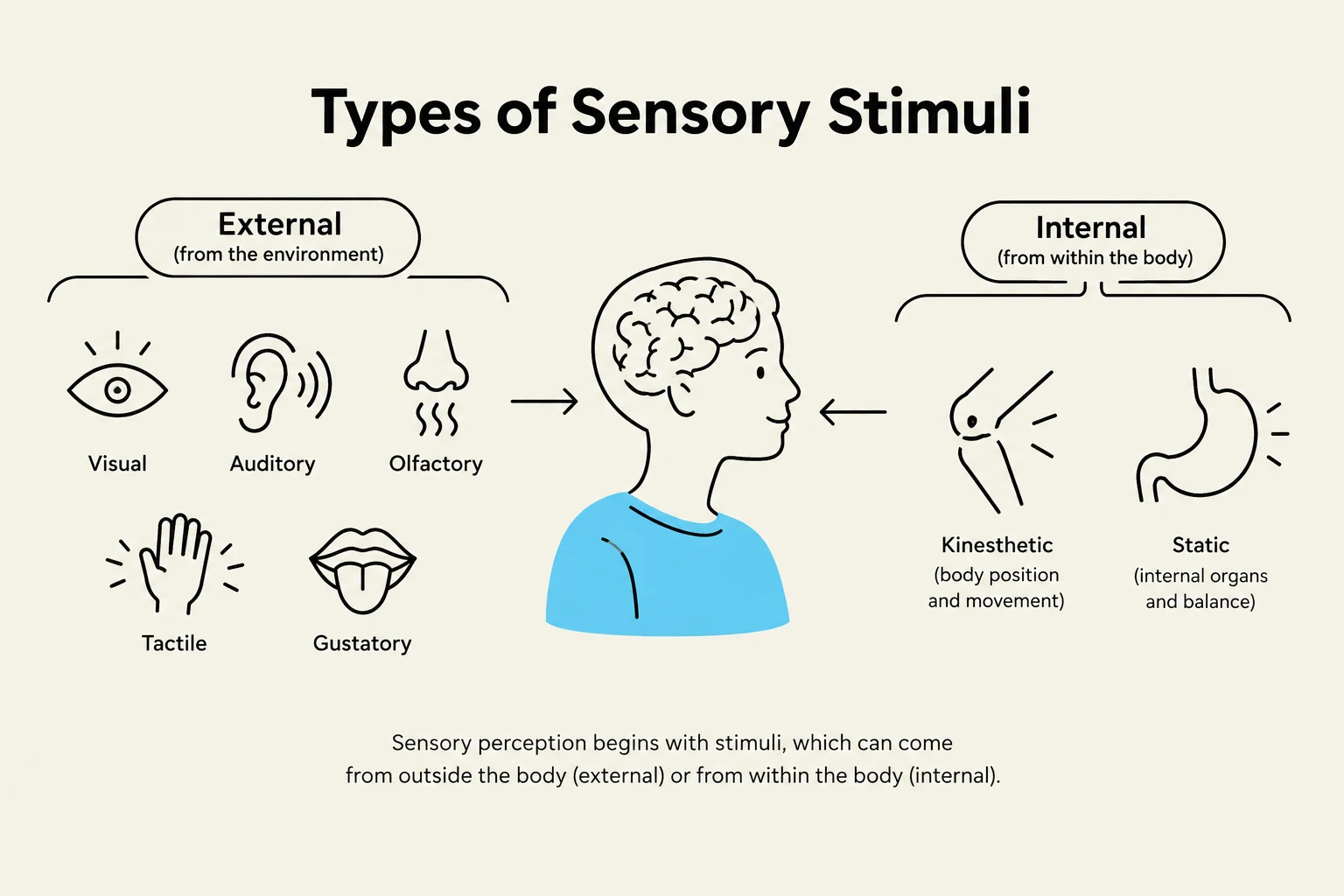
We can divide the stimuli that drive our perception into two primary categories: external and internal.
External Stimuli
External stimuli come from the environment around us and are processed through our primary five senses:
Visual: Sight and light perception.
Auditory: Hearing and sound perception.
Olfactory: The sense of smell.
Tactile: The sense of touch.
Gustatory: The sense of taste.
Internal Stimuli
Internal stimuli originate from within the body, providing critical feedback about our physical state:
Kinesthetic: The sense of movement.
Stereognosis: The ability to perceive the form and texture of an object through touch.
Visceral: Sensation from internal organs.
Proprioception: The sense of body position and spatial orientation.
This diagram illustrates the two main categories of sensory stimuli: external, originating from the environment, and internal, originating from within the body. External stimuli include visual, auditory, olfactory, tactile, and gustatory senses. Internal stimuli encompass kinesthetic senses related to body position and movement, and static senses related to internal organs and balance.
Disturbed Sensory Perception
When the balance of sensory input is disrupted, it can lead to significant clinical issues. These disruptions generally fall into three categories:
Sensory Deprivation: This occurs when a person experiences decreased or monotonous sensory input. This is common in environments with very little stimulation or in patients with an impaired ability to process information. It can manifest as physical behaviors, escape behaviors, or changes in cognitive and affective behavior.
Sensory Overload: This happens when the brain receives so much stimuli that it cannot respond meaningfully or selectively ignore irrelevant information. Patients often feel out of control and may exhibit behaviors similar to those in sensory deprivation.
Sensory Deficit: This refers to impaired or absent functioning in one or more senses. While the body can often adapt to gradual losses, sudden losses are highly disorienting.
Additionally, Sensory Processing Disorder involves difficulty in how the brain organizes and uses information, making everyday interactions difficult. We must also be wary of Sensory Poverty—a modern phenomenon where, despite high-tech devices, we lack rich, varied, and natural sensory experiences like smelling flowers or feeling the wind.
Clinical Considerations: Aging and Deficits
Several factors affect how we receive stimulation, including culture, personality, stress, and medications. However, aging is one of the most significant factors in sensory changes.
Visual Impairments
Common age-related changes include Presbyopia (loss of lens elasticity making near vision difficult) and Cataracts (clouding of the lens). More severe conditions include Glaucoma (increased intraocular pressure), Macular Degeneration (the leading cause of legal blindness in older adults), and Diabetic Retinopathy. A Detached Retina is a medical emergency that can lead to permanent vision loss if the blood supply is interrupted.
Auditory Impairments
Hearing loss is categorized into two types:
Conductive: Sound cannot travel effectively through the outer or middle ear (e.g., earwax impaction or a ruptured eardrum).
Sensorineural: Damage to the inner ear, cochlea, or the 8th cranial nerve (e.g., due to noise exposure, aging, or ototoxic drugs).
Common symptoms include Tinnitus (ringing or buzzing in the ears) and Meniere disease, which causes vertigo and fluctuating hearing loss.
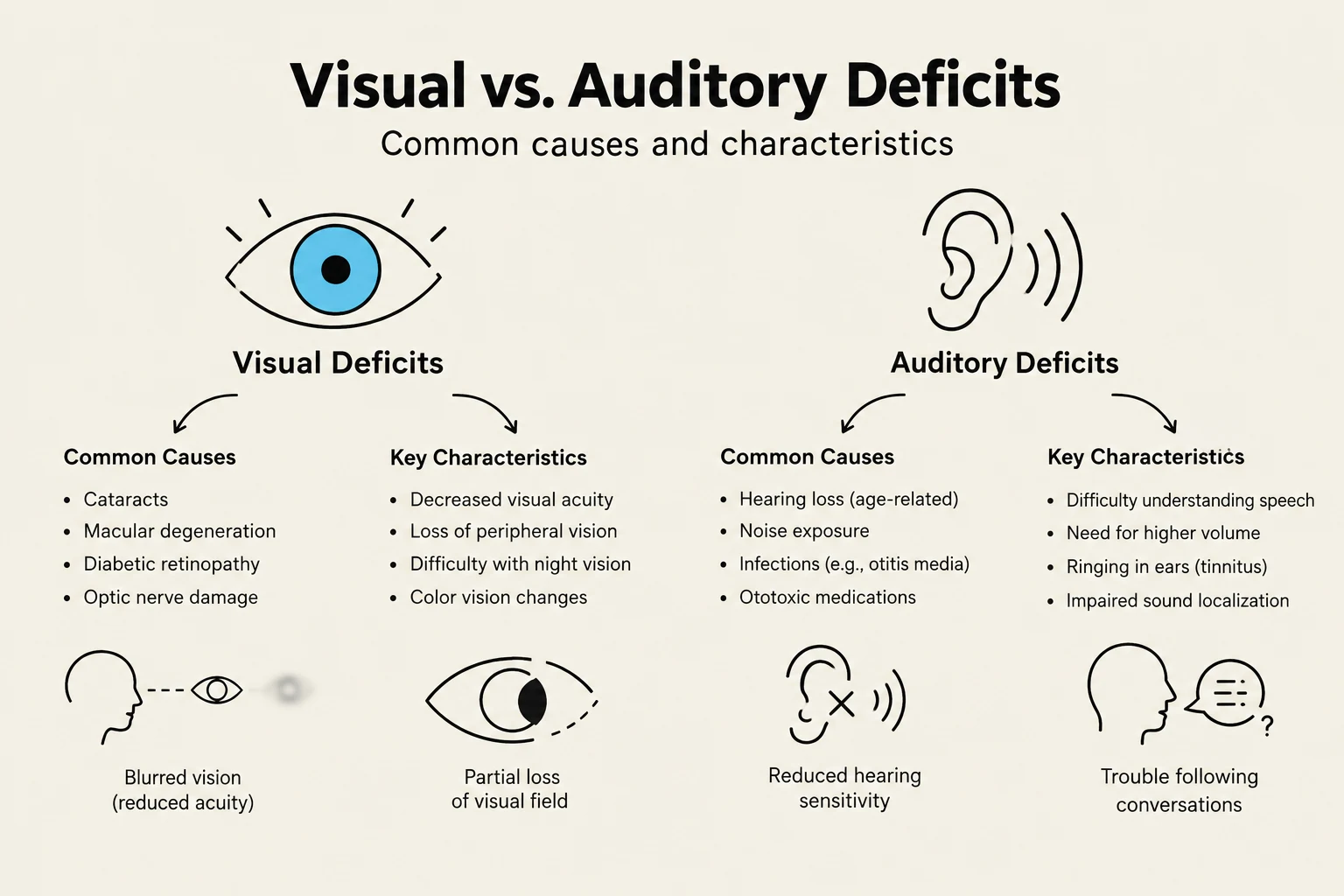
This diagram illustrates the common causes and characteristics of visual and auditory deficits, providing a comparative overview of conditions affecting sight and hearing.
Nursing Interventions and Communication
When caring for patients with sensory deficits, the goal is to maintain safety and promote meaningful interaction.
For Visually Impaired Patients:
Always acknowledge your presence when entering the room.
Explain before touching the patient.
Keep pathways clear and the call light within reach.
For Hearing Impaired Patients:
Face the patient directly so they can see your mouth.
Decrease background noise before speaking.
Do not cover your mouth or chew gum while talking.
For Confused or Unconscious Patients:
Confused: Use simple, direct language and orient them to time, place, and person.
Unconscious: Always assume the patient can hear you. Speak in a normal tone and explain what you are doing before touching them, as hearing is often the last sense lost.
Clinical Note: When communicating with a patient who is confused, focus on reinforcing reality and emphasizing their strengths rather than their weaknesses.
Keep reading for free.
Create an account to finish this reading and make it part of your study routine.