An introduction to the core concepts of sensation and perception, including the distinction between them, psychophysics, thresholds, Weber's Law, Signal Detection Theory, sensory adaptation, and subliminal perception.
Have you ever wondered why you can hear a whisper in a quiet room but struggle to hear a conversation in a loud restaurant? Or why a bright light seems to "disappear" after you've been staring at it for a few minutes? The answers lie in the complex relationship between how our bodies receive physical energy from the world and how our brains make sense of that energy. To understand human experience, we must first distinguish between the raw data of the senses and the meaningful stories our brains tell us about that data.
Sensation vs. Perception: The Input and the Interpretation
While often used interchangeably in casual conversation, sensation and perception represent two distinct stages of processing.
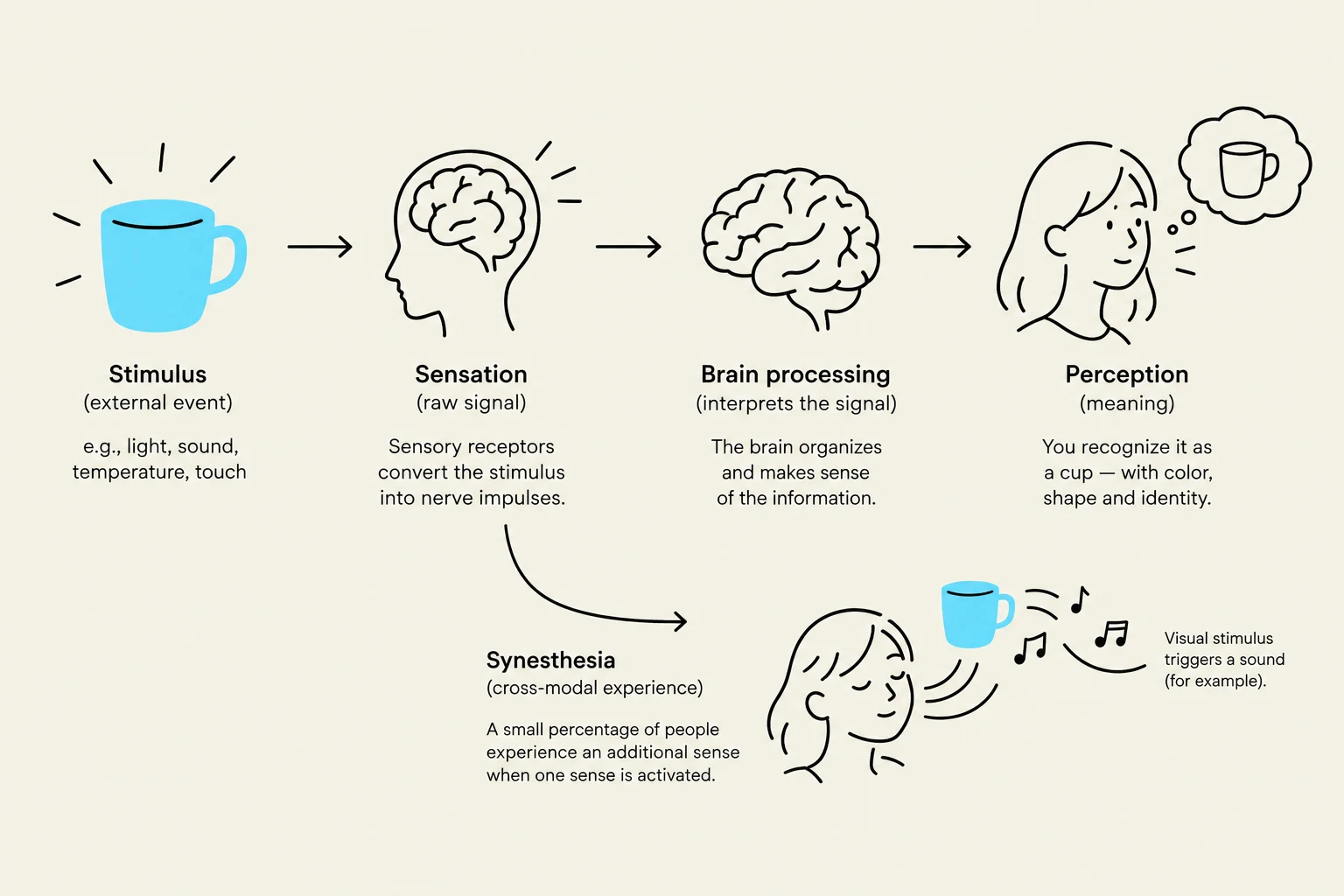
Sensation is the physiological process of stimulation. It occurs when our sense organs (like the eyes, ears, or skin) are triggered by external physical stimuli, such as light waves, sound vibrations, or chemical molecules. It is essentially the "raw data" collection phase.
Perception, on the other hand, is the psychological process. It involves the selection, organization, and interpretation of that sensory input to create a coherent mental representation of the world. If sensation is the act of a camera capturing light, perception is the brain's ability to recognize that the light forms the shape of a human face.
In most people, these processes are separate but sequential. However, in a unique neurological condition known as synesthesia, these processes overlap. Individuals with synesthesia experience "crossed" senses, where the stimulation of one sense triggers an automatic experience in another—for example, "seeing" colors when hearing specific musical notes or "tasting" words.
This diagram illustrates the process of stimulus, sensation, brain processing, and perception, including an example of synesthesia where a visual stimulus triggers a sound.
Psychophysics: Measuring the Mind
Psychophysics is the scientific study of the relationship between physical stimuli and our psychological experience of them. Because we cannot "see" a thought, psychophysicists use mathematical models to determine the limits of human detection.
Thresholds and Detection
Two fundamental concepts define the limits of our sensory capabilities:
Absolute Threshold: This is the minimum intensity of a stimulus required for a person to detect it at least 50% of the time. For instance, if you can detect a single candle flame from 30 miles away on a dark night half the time, that distance represents your absolute threshold for light.
Just Noticeable Difference (JND): Also known as the difference threshold, this is the smallest change in a stimulus that a person can detect. If you are holding a 10lb weight and someone adds a tiny pebble, you might not notice. If they add a 1lb weight, you will. The JND is the point at which you finally say, "Something changed."
Weber’s Law
A crucial discovery in psychophysics is Weber’s law, which states that the size of the JND is proportional to the magnitude of the initial stimulus.
This means that as a stimulus becomes more intense, you need a much larger change to notice a difference. For example, if you are in a dimly lit room, turning on a small lamp is highly noticeable. However, if you are in a brightly lit stadium, turning on that same small lamp will likely go unnoticed. The "difference" required to trigger perception scales with the starting point.
Exam Tip: Remember that Weber's Law is about proportionality, not absolute amounts. It's not that you always need "5 units" of change to notice a difference; it's that you might need a "10% change" regardless of the starting amount.
Signal Detection Theory: Beyond Intensity
Early models of sensation assumed that if a stimulus was strong enough, we would always detect it. However, Signal Detection Theory (SDT) provides a more realistic model by acknowledging that detection is not just about stimulus intensity, but also about the observer's internal state.
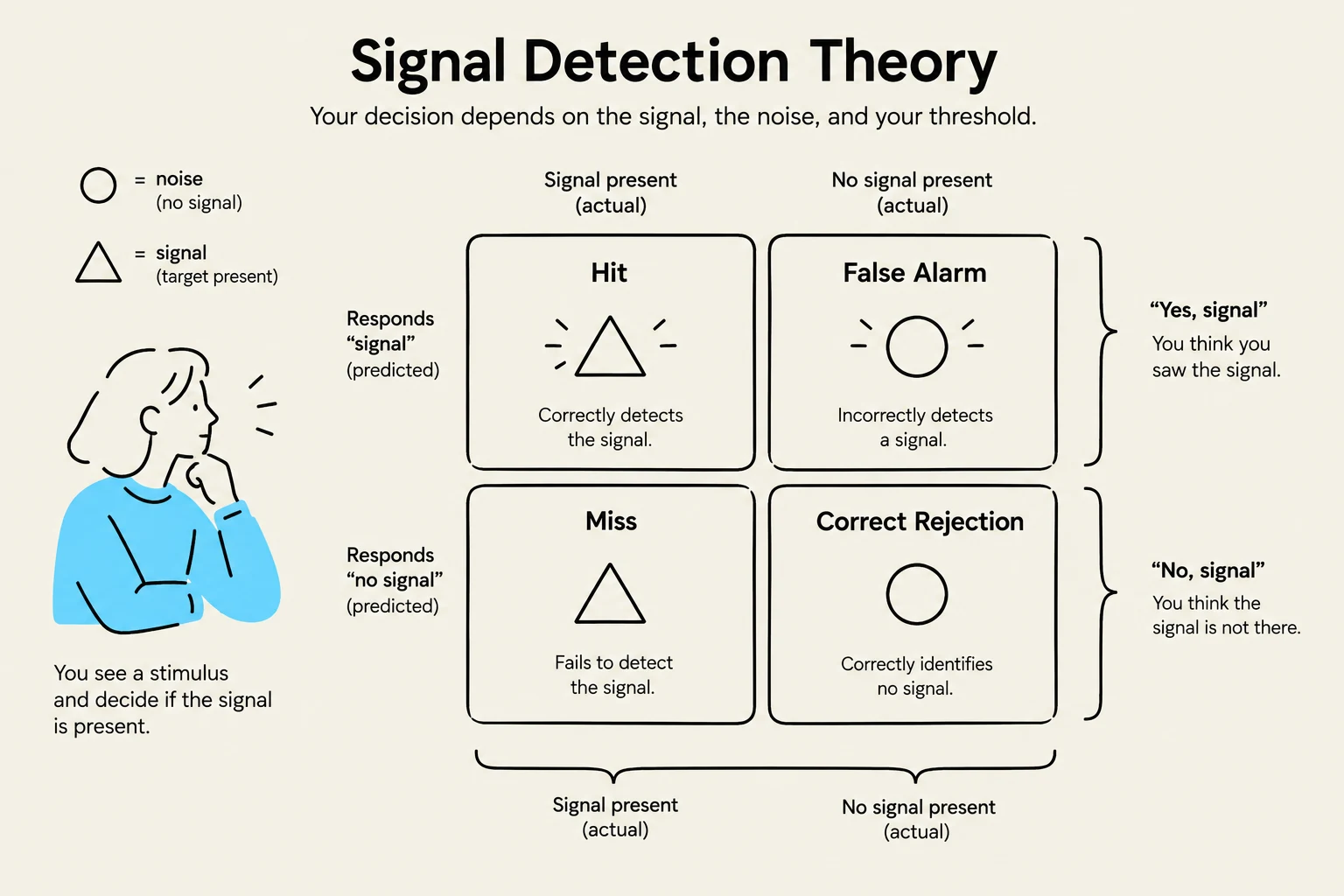
SDT posits that our ability to detect a "signal" (the stimulus) amidst "noise" (background interference) is influenced by factors like attention, motivation, and individual decision-making tendencies. Because of this, even with a clear signal, humans make errors.
The theory categorizes every detection attempt into one of four outcomes:
Outcome
Stimulus Present?
Decision
Description
Hit
Yes
"Yes"
Correct detection of the stimulus.
Miss
Yes
"No"
Failure to detect an existing stimulus.
False Alarm
No
"Yes"
Detecting a stimulus that isn't actually there.
Correct Rejection
No
"No"
Correctly identifying that no stimulus is present.
This diagram illustrates Signal Detection Theory, explaining how decisions are made based on the presence of a signal, noise, and an individual's threshold. It outlines four possible outcomes: Hit, Miss, False Alarm, and Correct Rejection, based on whether the signal was actually present and how the individual responded.
Sensory Adaptation and Subliminal Perception
Our sensory systems are not constant; they are dynamic and constantly adjusting to our environment.
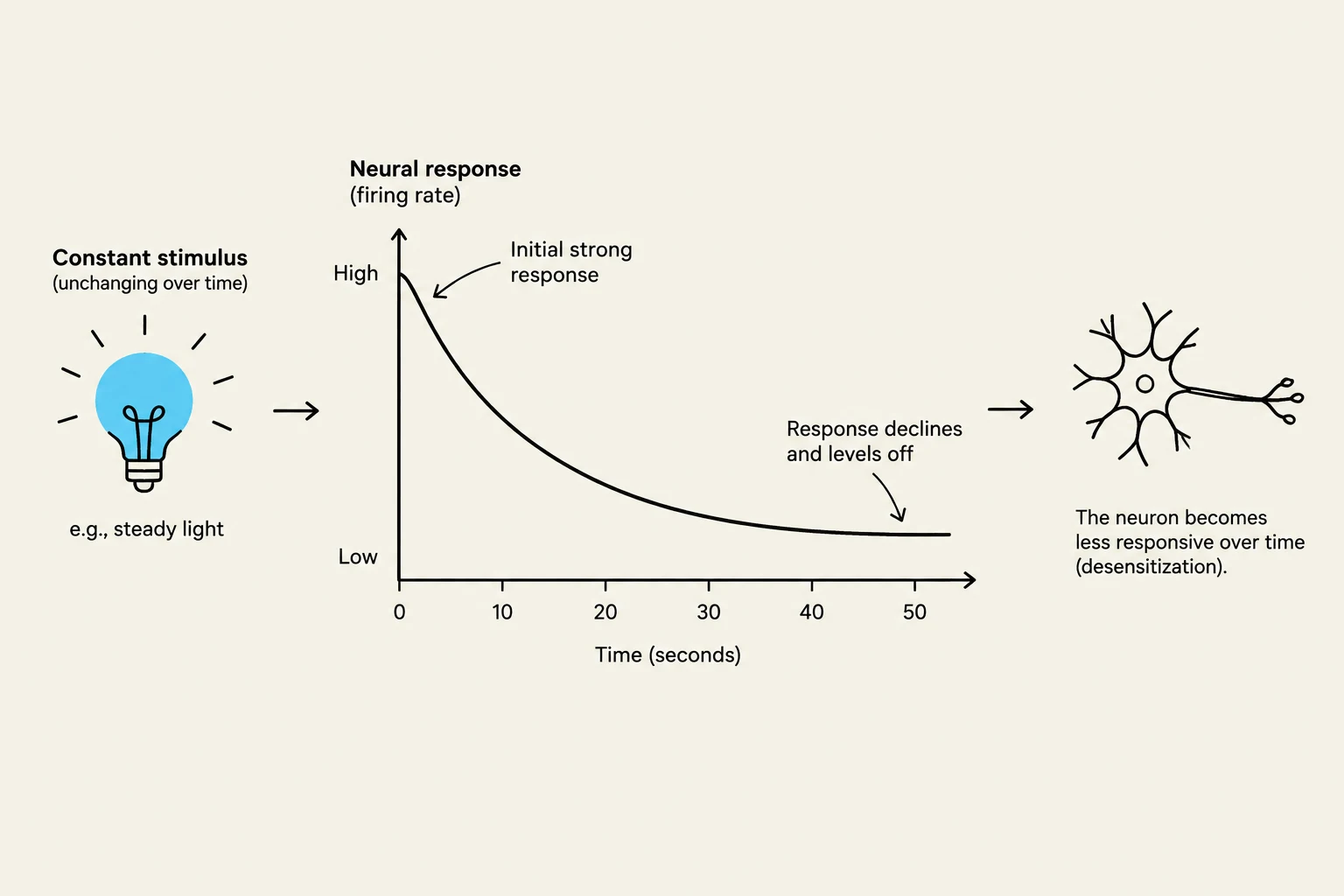
Sensory Adaptation is the gradual decline in sensitivity that occurs following prolonged exposure to a constant, unchanging stimulus. A classic example is walking into a room that smells strongly of perfume; after ten minutes, you likely won't notice the scent anymore. Your sensory receptors have "adapted" to the constant input, allowing your brain to prioritize new, changing information instead.
Subliminal Perception refers to the phenomenon where perception occurs without conscious awareness. This involves stimuli that are below the absolute threshold—too weak or too brief to be "seen" or "heard" intentionally, yet potentially still processed by the brain in ways that can influence behavior or affect.
This diagram illustrates neural desensitization, where a neuron's response to a constant stimulus decreases and levels off over time.
By understanding these fundamentals, we gain insight into the delicate balance between the physical world and the mental world we inhabit. From the mathematical precision of Weber's Law to the unpredictable nature of Signal Detection, our journey from sensation to perception is a complex dance of biology and psychology.
Keep reading for free.
Create an account to finish this reading and make it part of your study routine.