Explore the foundational concepts of sensation and perception, including the distinction between input and interpretation, psychophysics, thresholds, Weber's Law, signal detection theory, and adaptation.
Have you ever wondered why a room that felt stuffy when you first entered suddenly feels comfortable after ten minutes? Or why you can hear a whisper in a quiet library but struggle to hear a conversation in a crowded stadium? The answers lie in the complex interplay between how our bodies receive information from the environment and how our brains interpret that information. Understanding this distinction—between the raw data of the world and the mental story our brain tells us—is the foundation of sensory psychology.
Sensation vs. Perception: The Input and the Interpretation
To understand how we experience the world, we must first distinguish between two distinct stages of processing: sensation and perception.
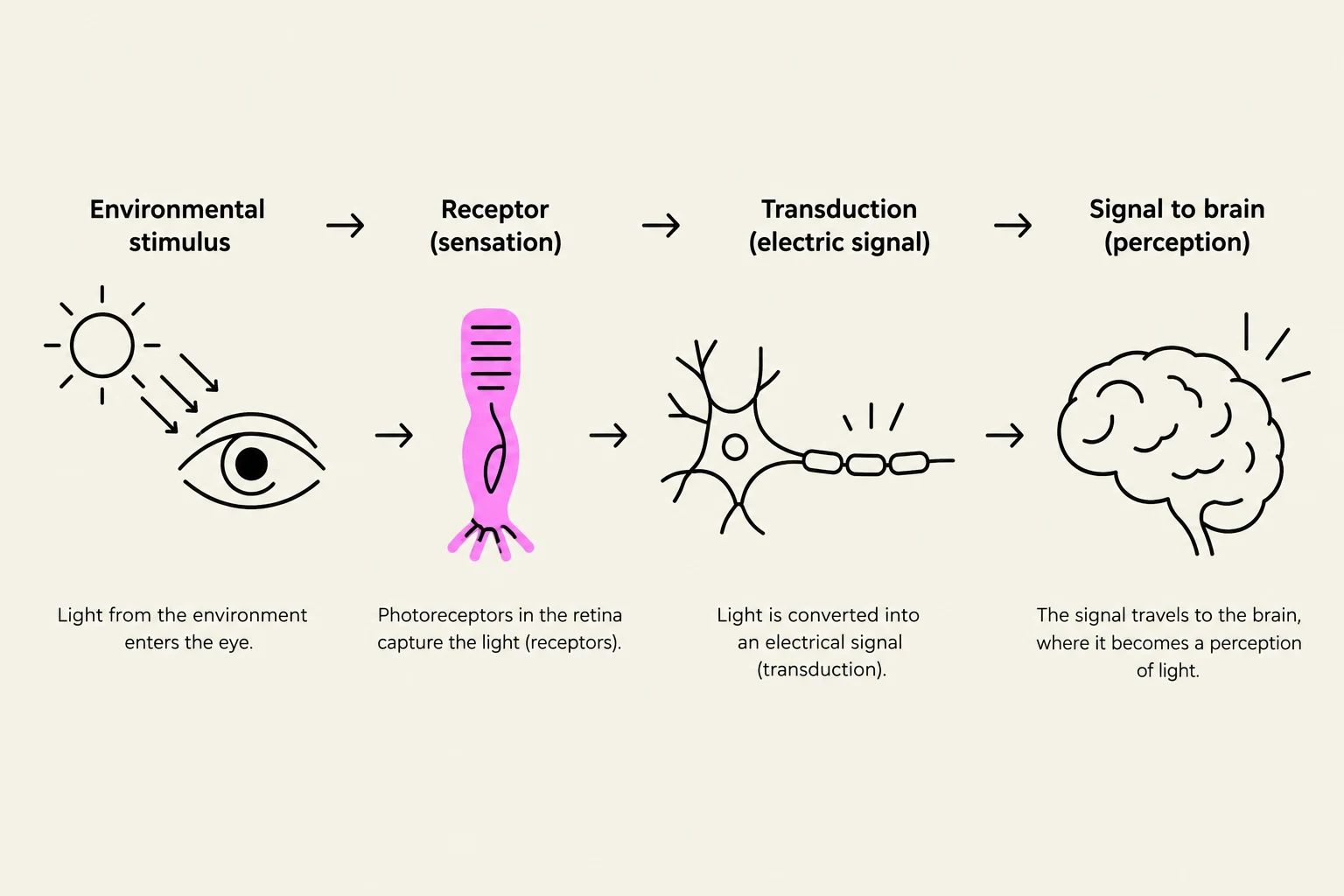
Sensation is the initial stage of the process. It occurs when our sensory organs (such as the eyes, ears, or skin) receive stimulus energies from the environment. However, these physical energies—like light waves or sound vibrations—cannot be understood by the brain in their raw form. This leads to the second critical step: transduction.
Transduction is the biological process of transforming stimulus energy from the environment into neural impulses, which are electrical signals that the nervous system can understand. While every sense uses this same "language" of electrical signals, the brain knows which sense is which based on where those signals connect within its neural architecture.
Perception is the final stage. It is the neural processing of those electrical signals to create an internal mental representation of the external world. As a helpful way to remember: sensation is the "input," while perception is the "interpretation".
This diagram illustrates the process of visual perception, starting from an environmental stimulus (light) entering the eye, being captured by photoreceptors in the retina, converted into an electrical signal through transduction, and finally transmitted to the brain for perception.
Psychophysics: Measuring the Invisible
How do scientists measure something as subjective as "feeling" or "hearing"? They use psychophysics, the study of the relationship between the physical characteristics of environmental stimuli and our mental experience of them.
Absolute and Difference Thresholds
One of the primary goals of psychophysics is to determine our thresholds of awareness.
Absolute Threshold: This is the minimum amount of stimulation necessary for a person to detect a stimulus at least 50% of the time. For example, if you are in a pitch-black room, the absolute threshold for light is the point at which you can just barely perceive a single candle being lit.
Difference Threshold (Just-Noticeable Difference/JND): This refers to the minimum amount of change required between two stimuli for an observer to detect a difference 50% of the time.
Weber’s Law and Relative Change
A key finding in psychophysics is that our ability to notice a change is not based on a fixed amount, but on a ratio. This is known as Weber’s Law. It states that the likelihood of perceiving a stimulus change is proportional to the magnitude of the original stimulus.
To express this mathematically, we use the Weber fraction, which is the ratio of the minimum detectable change (ΔI) to the overall stimulus magnitude (I):
Weber Fraction=IΔI
Study Tip: The "Quarter" Example
If you are holding one quarter, adding a second quarter is a 100% increase, making it very easy to notice. However, if you are holding a 10-pound dumbbell, adding a single quarter is such a tiny fraction of the total weight that you won't notice it at all. This is Weber's Law in action: the larger the starting stimulus, the larger the change must be to be "just noticeable".
Signal Detection Theory: Beyond the Threshold
While thresholds provide a baseline, they don't tell the whole story. Signal Detection Theory suggests that detecting a stimulus isn't just about how strong the signal is; it also depends on our psychological state and biases.
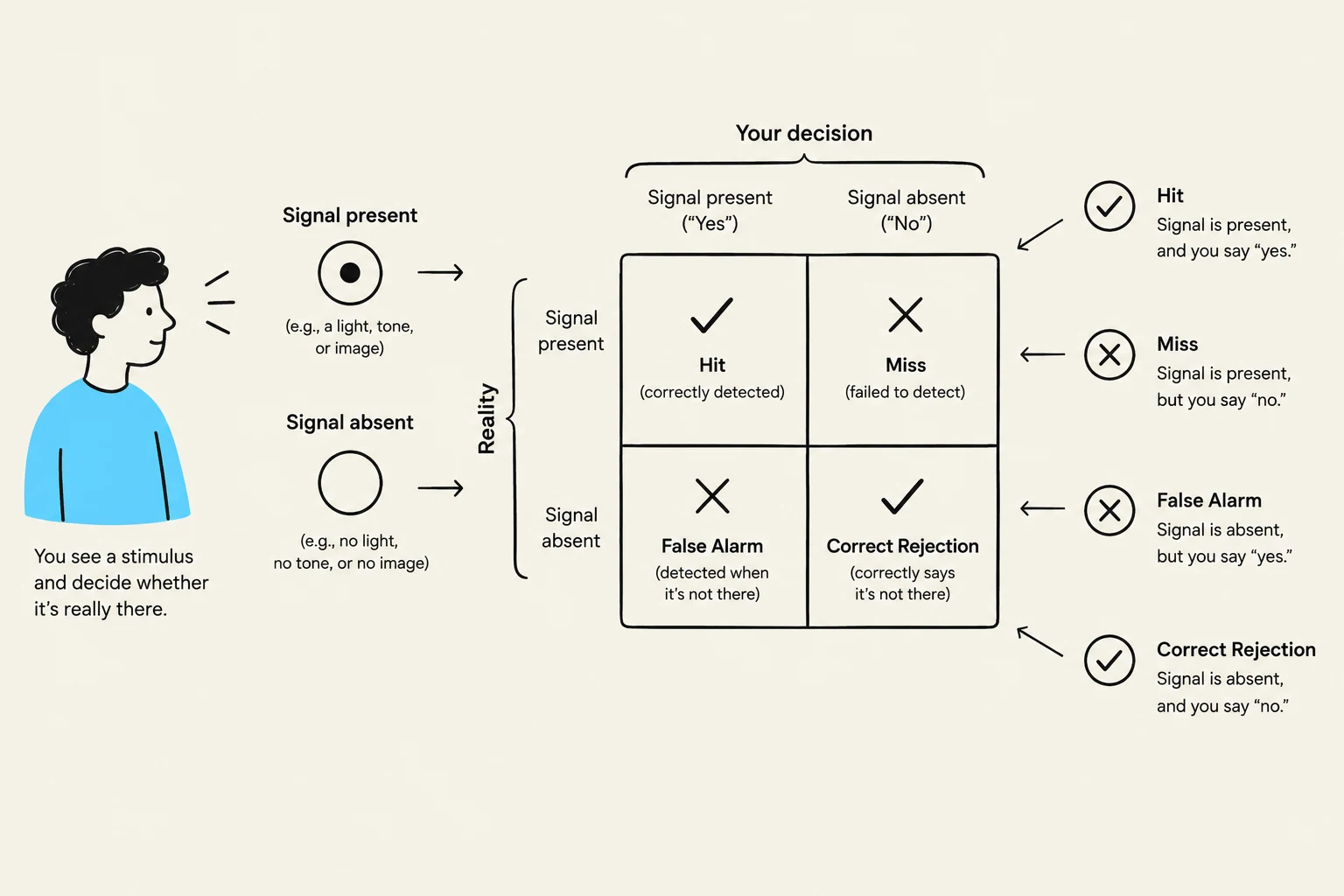
When we try to detect a signal (like a doctor looking for a tumor on an X-ray), our responses fall into four categories:
Hit: The stimulus is present, and we say "Yes."
Miss: The stimulus is present, but we say "No."
False Alarm: The stimulus is absent, but we say "Yes."
Correct Rejection: The stimulus is absent, and we say "No."
Because of our internal tendencies, we may exhibit different biases:
Liberal Bias: An individual is more likely to report perceiving a stimulus. This results in more "hits" but also more "false alarms". (Example: A radiologist who flags every scan as a "possible tumor" to ensure they don't miss anything).
Conservative Bias: An individual is more hesitant to report perception. This results in fewer false alarms but more "misses".
This diagram illustrates the four possible outcomes when a person perceives a stimulus: Hit, Miss, False Alarm, and Correct Rejection, based on whether the signal is present or absent in reality and the person's decision.
Adaptation: Why We Stop Noticing
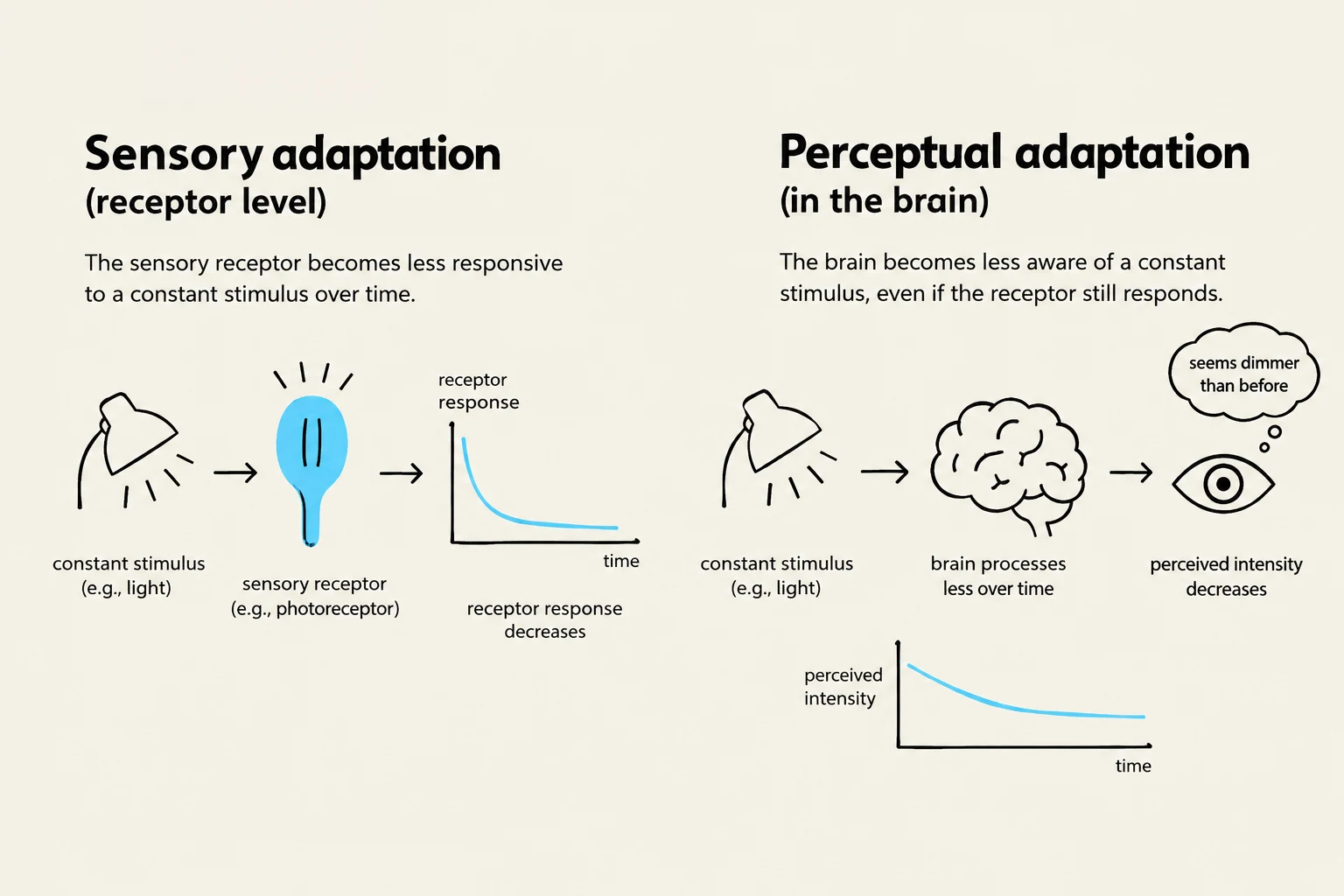
Our sensory systems are designed to detect change rather than constant states. This is achieved through adaptation, a phenomenon where we stop noticing a stimulus that remains constant over time. This allows us to remain sensitive to new, potentially important changes in our environment.
There are two distinct levels of adaptation:
Sensory Adaptation: This occurs at the level of the sensory receptors themselves. For instance, your eyes adjust to a dark room, or your skin stops "feeling" the clothes you are wearing.
Perceptual Adaptation: This occurs within the perceptual centers of the brain.
When adaptation is prolonged or intense, it can lead to aftereffects. These are opposing sensory or perceptual distortions that occur after the stimulus is removed. A classic example is the "motion aftereffect": if you stare at a spinning spiral for 30 seconds and then look at a stationary object, the object may appear to move in the opposite direction.
This illustration depicts sensory and perceptual adaptation. Sensory adaptation occurs at the receptor level, where the receptor becomes less responsive to a constant stimulus over time. Perceptual adaptation occurs in the brain, where awareness of a constant stimulus decreases even if the receptor is still responding.
Keep reading for free.
Create an account to finish this reading and make it part of your study routine.