Fundamentals of Public Relations in Construction Management
This document explains the core principles of Public Relations (PR) within the context of construction management. It defines PR as a strategic effort to build mutual understanding between an organization and its publics, distinguishing it from publicity, propaganda, and advertising. The text covers universal PR object
In the field of construction management, technical expertise and project execution are only half of the equation for success. The other half lies in how an organization communicates its value, its progress, and its integrity to the world. Communication is the very essence of human civilization, serving as the resource used to influence other minds. In a professional context, this becomes Public Relations (PR)—a strategic discipline designed to bridge the gap between complex organizations and the diverse groups of people they impact.
Defining Public Relations
Public Relations is defined as the deliberate, planned, and sustained effort to establish and maintain mutual understanding between an organization and its public. Unlike spontaneous communication, PR is a structured process aimed at bringing people together in understanding—whether that involves a government and its citizens, a producer and their consumers, or a professional and their clients.
It is important to note that every individual and organization possesses a "public relations" profile, whether it is intentionally managed or not. In modern society, as companies and government bodies grow in complexity, the lack of personal contact between leaders and the public often leads to misunderstanding and mistrust. The role of the Public Relations Officer (PRO) is to mitigate this through effective channels of communication.
Core Principle: A public relations program can never be better than the actual policies, practices, and products of the organization it represents. If the underlying business practices are poor, no amount of PR can mask them effectively.
This diagram illustrates the role of a Public Relations Officer in managing communication between an organization's policies and the public, fostering trust and supporting organizational goals.
The South African Context
Practicing public relations in South Africa presents unique challenges. The nation is characterized by eleven official languages and a diverse population of varying racial and cultural origins. This diversity requires a highly nuanced approach to communication to ensure that messages are not only heard but understood across different cultural landscapes.
Distinguishing PR from Related Interventions
To the uninitiated, several terms are often used interchangeably with Public Relations, but they represent distinct tools and approaches:
Publicity: A tool of PR that focuses on telling a story through the press, stunts, or media coverage.
Propaganda: The organized and systematic spreading of a doctrine or idea, where the "ends often justify the means".
Advertising: A paid medium used by publicists and PR practitioners to ensure a specific story is delivered to a target audience.
While these are different, they are often used in combination. For instance, a successful construction firm might use advertising to build brand awareness while simultaneously using PR to manage community relations during a large-scale development project.
Universal Objectives and Functions
While specific goals vary based on an organization's size and location, there are universal objectives that any PR program should strive to achieve:
Reputation Management: Establishing and maintaining a positive reputation and goodwill.
Internal Alignment: Keeping employees informed and helping to guide management.
Economic Role: Explaining the organization's role in the economy and promoting economic education.
Market Support: Assisting in the development of new markets and attracting high-caliber employees.
To achieve these, a practitioner must follow a systematic function: defining the desired image, identifying the "publics," assessing the current image, deciding on improvements, selecting tactics, and budgeting.
This diagram illustrates a cyclical process for defining objectives and identifying target audiences, emphasizing planning, learning, and adaptation.
Understanding "Publics": Internal vs. External
In PR, a "public" is not just a single mass of people; it is a collection of specific groups that have an interest in or are affected by the organization. These are divided into two categories:
Internal Publics
Public relations begins at home. Employees are an organization’s most important public. If staff members do not speak well of the firm, the organization's external efforts will likely fail. Internal PR encompasses:
Organizational Policies: The direction set by the board and management.
Physical Identity: The appearance of buildings, vehicles, and letterheads.
Personal Behavior: The conduct of every employee, from the receptionist to the CEO.
External Publics
These are the groups upon whose support and goodwill the organization depends. In construction management, these typically include:
Shareholders and customers.
Suppliers, dealers, and banks.
Government and local authorities.
The local community.
Exam Tip: To understand what external publics truly think, a PRO should not rely on assumptions. Instead, they should conduct a formal opinion or attitude survey to provide an unbiased baseline for their strategy.
Tactics, Techniques, and Media
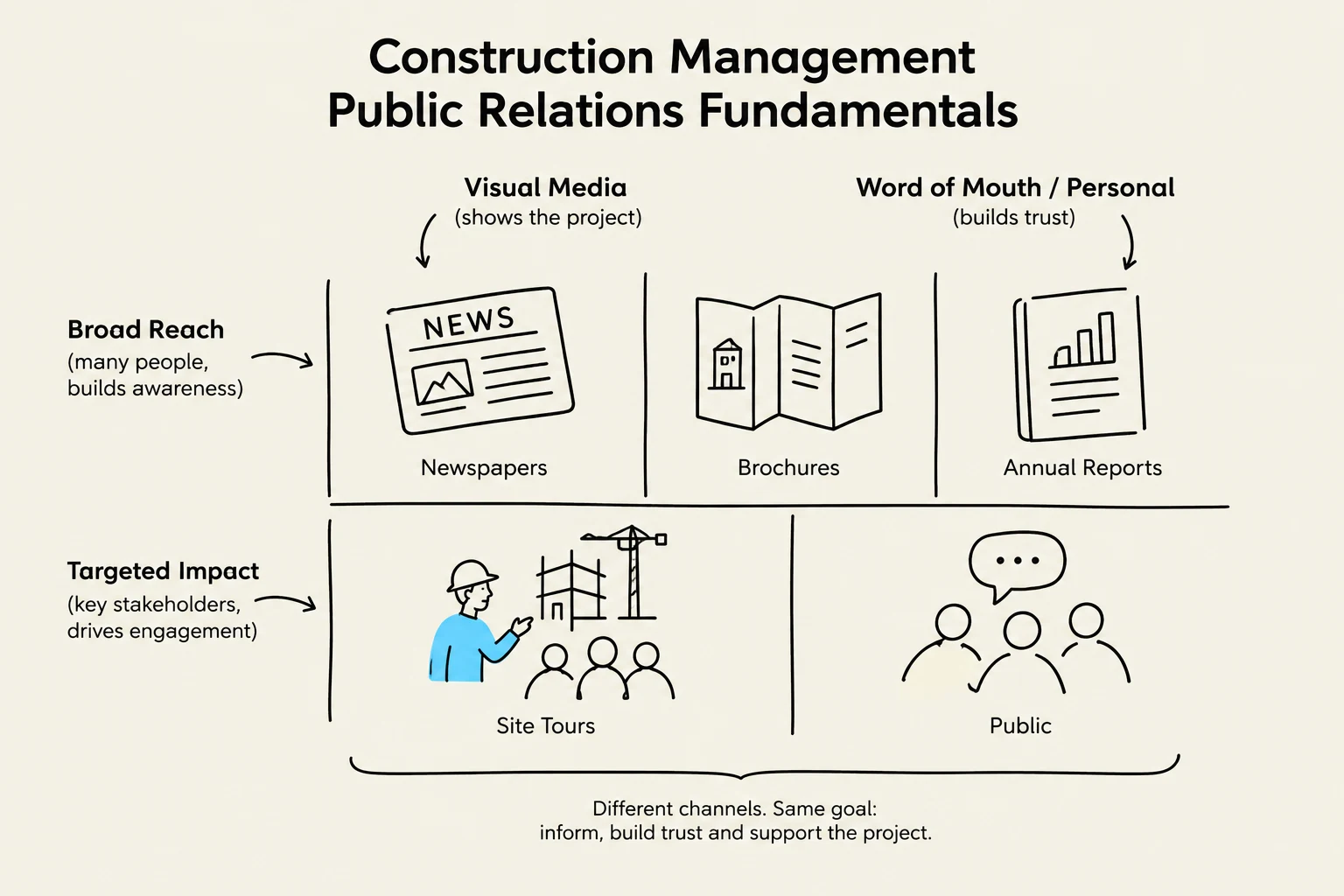
Once a strategy is set, the practitioner must choose the right media to deliver the message. These are generally categorized into visual and verbal/word-of-mouth channels.
Visual and Written Media
Press Releases and Conferences: Used for strategic projects or accidents. A successful press release must be factual, brief, and have a striking headline.
Brochures and Annual Reports: Essential for showcasing company history, completed projects, and corporate identity.
In-house Journals: These serve to bridge the gap between management and workers, helping to dispel rumors and share company news.
Digital Media: The use of DVDs for training or promotional purposes.
Word of Mouth and Personal Contact
Site Visits and Tours: Allowing the public to see progress firsthand.
Receptions and Presentations: Celebrating milestones, such as a 5-star health and safety grading.
Sponsorships and Community Service: Supporting local causes to build rapport.
This diagram illustrates fundamental public relations strategies in construction management, categorizing them by reach (broad vs. targeted) and communication type (visual media vs. word of mouth/personal).
Budgeting for Public Relations
Budgeting for PR is unique because it is difficult to evaluate the results in purely tangible, monetary terms. However, a budget should be prepared with the same rigor as a construction contract.
A critical component of a PR budget is the contingency fund. Because an organization's reputation can change overnight due to unforeseen events like strikes or accidents, the PRO must have access to funds to act immediately without waiting for emergency approvals. While the first budget may be an estimate, subsequent budgets will become increasingly accurate as the practitioner learns the organization's needs.
Keep reading for free.
Create an account to finish this reading and make it part of your study routine.