Fundamentals of Photosynthesis and the Carbon Cycle
Explore the interconnected processes of photosynthesis and cellular respiration, which drive the carbon cycle. Learn about autotrophs, heterotrophs, chloroplast structure, and the two stages of photosynthesis: the light reactions and the Calvin cycle.
Life on Earth is a complex dance of energy and matter. While energy constantly flows through ecosystems and is eventually dissipated, the chemical elements that make up living things are continuously recycled. At the heart of this recycling process are two interconnected biological phenomena: photosynthesis and cellular respiration. Together, they form the basis of the carbon cycle, ensuring that the building blocks of life are available to all organisms.
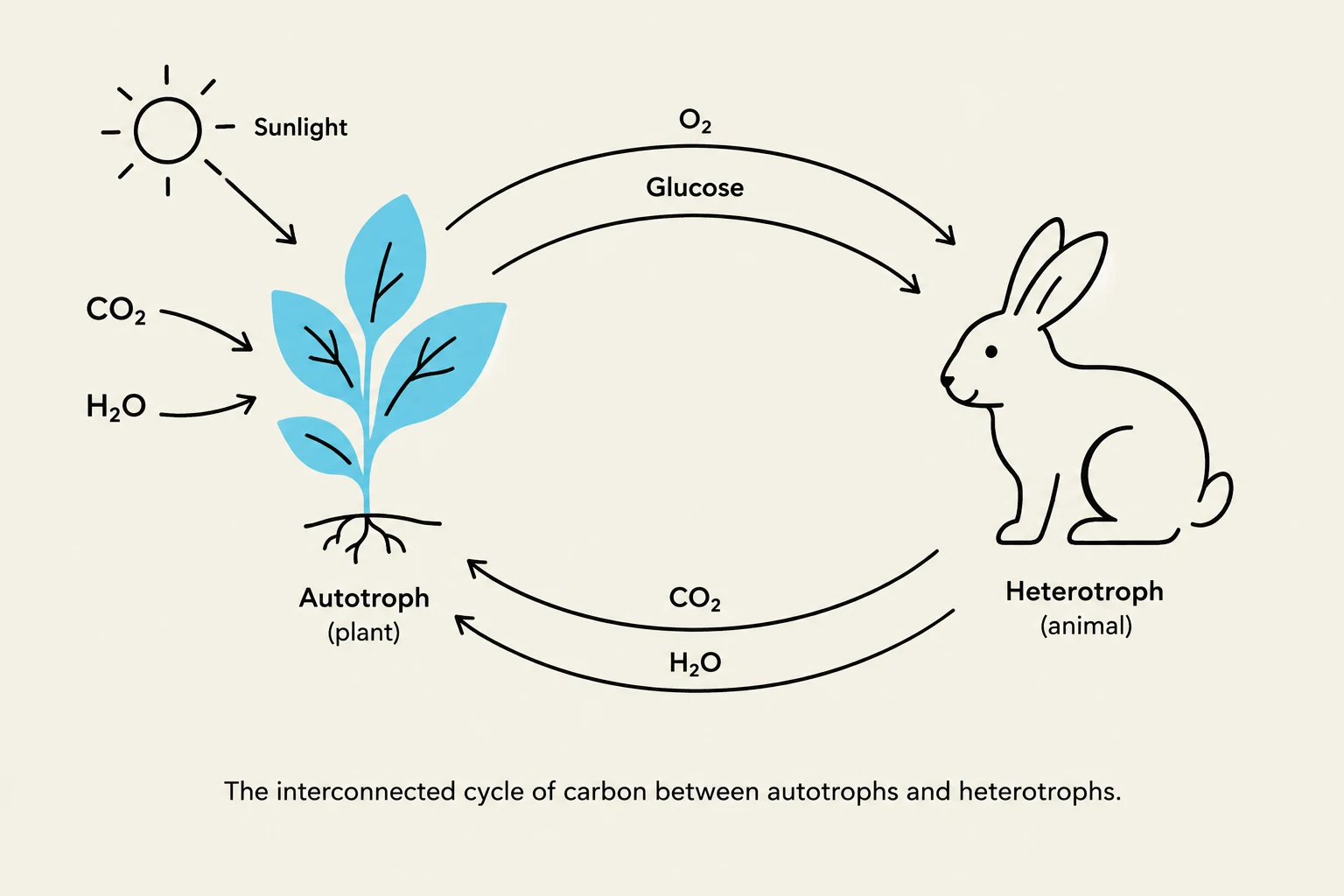
The interconnected cycle of carbon between autotrophs and heterotrophs.
The Biological Players: Autotrophs and Heterotrophs
To understand how energy enters the biosphere, we must distinguish between the different ways organisms obtain food.
Autotrophs ("Self-feeders"): These are the producers of the biological world. They generate food from non-living sources, such as carbon dioxide (CO2).
Photoautotrophs: A specific type of autotroph that uses light energy to synthesize organic compounds.
Heterotrophs ("Other-feeders"): These are the consumers. They cannot produce their own food and must rely on the organic compounds produced by other organisms.
Most life on Earth is essentially solar-powered, driven by the ability of photoautotrophs to convert sunlight into chemical energy.
The Carbon Cycle: Energy Flow vs. Element Recycling
The relationship between photosynthesis and cellular respiration is the engine of the carbon cycle. While energy flows in one direction (from the sun, through organisms, and eventually being used up), carbon is recycled between the atmosphere and living things.
Photosynthesis: Storing Energy
Photosynthesis captures light energy and stores it in stable, long-term forms like carbohydrates. The general equation for this process is:
CO2+H2O→[CH2O]n+O2
In this reaction, smaller, low-energy molecules are combined using solar energy to create larger, high-energy organic molecules.
Cellular Respiration: Releasing Energy
Cellular respiration performs the inverse task. It converts those stable carbohydrates back into versatile, usable energy forms, specifically ATP. The equation is:
[CH2O]n+O2+ADP+P→CO2+H2O+ATP
By breaking down the larger molecules, organisms release the energy that was previously stored.
Exam Tip: Remember that photosynthesis builds complex molecules to store energy, while respiration breaks them down to release energy for cellular work.
The Chloroplast and the Theory of Endosymbiosis
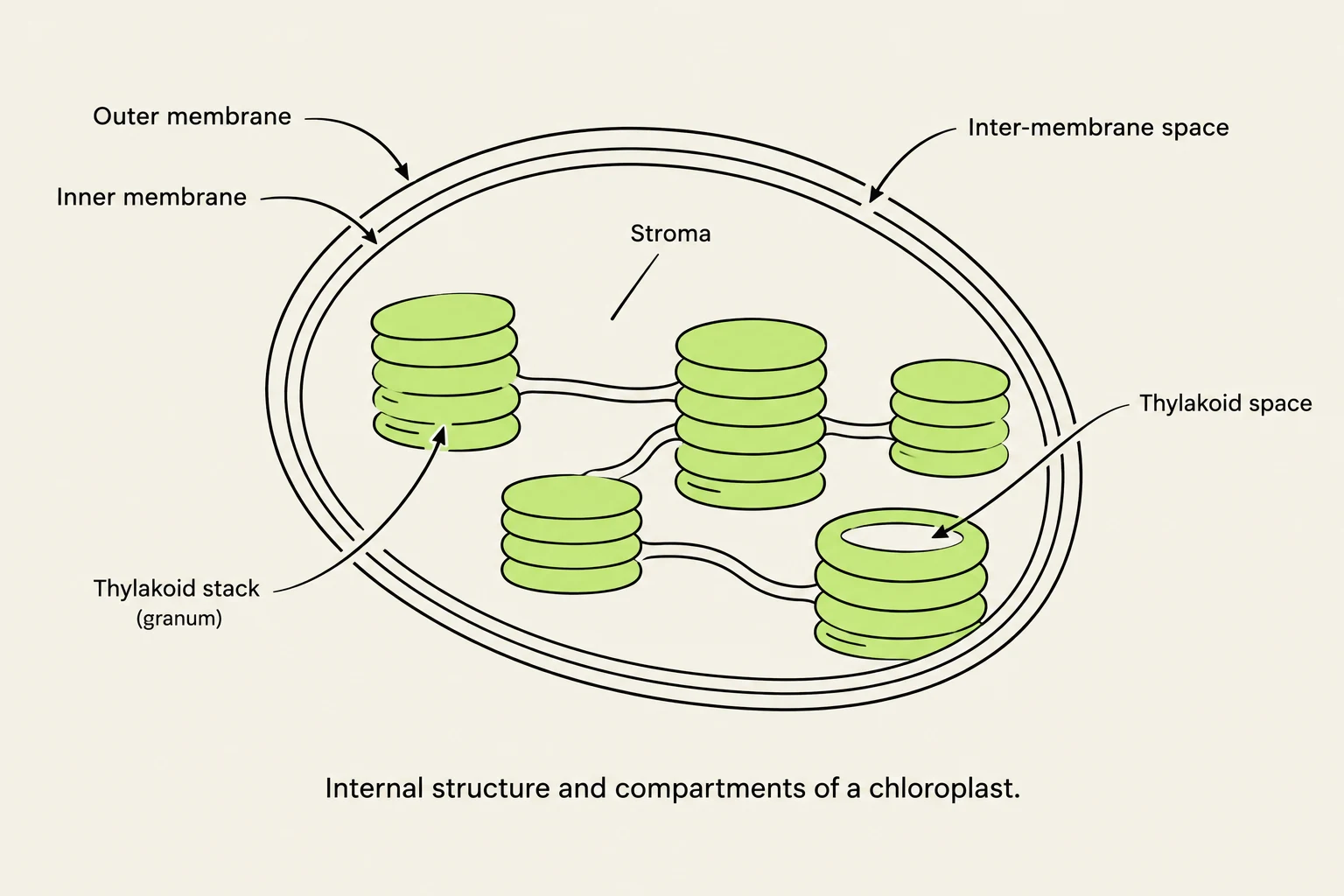
Internal structure and compartments of a chloroplast.
Photosynthesis takes place within a specialized organelle called the chloroplast. The existence of chloroplasts is explained by the theory of endosymbiosis. This theory suggests that a eukaryotic ancestor engulfed a photosynthetic prokaryote, which eventually became the chloroplast.
Evidence for endosymbiosis includes:
The presence of a double membrane.
The chloroplast's own DNA, ribosomes, and proteins, which are similar to those found in prokaryotes.
The ability of chloroplasts to undergo autonomous growth and replication.
Chloroplast Structure
The chloroplast is organized into three distinct, membrane-bound compartments:
Inter-membrane space: The area between the two outer membranes.
Stroma: The fluid-filled space surrounding the internal structures.
Thylakoid space: The interior of the thylakoids, which are often arranged in stacks.
The Two Stages of Photosynthesis
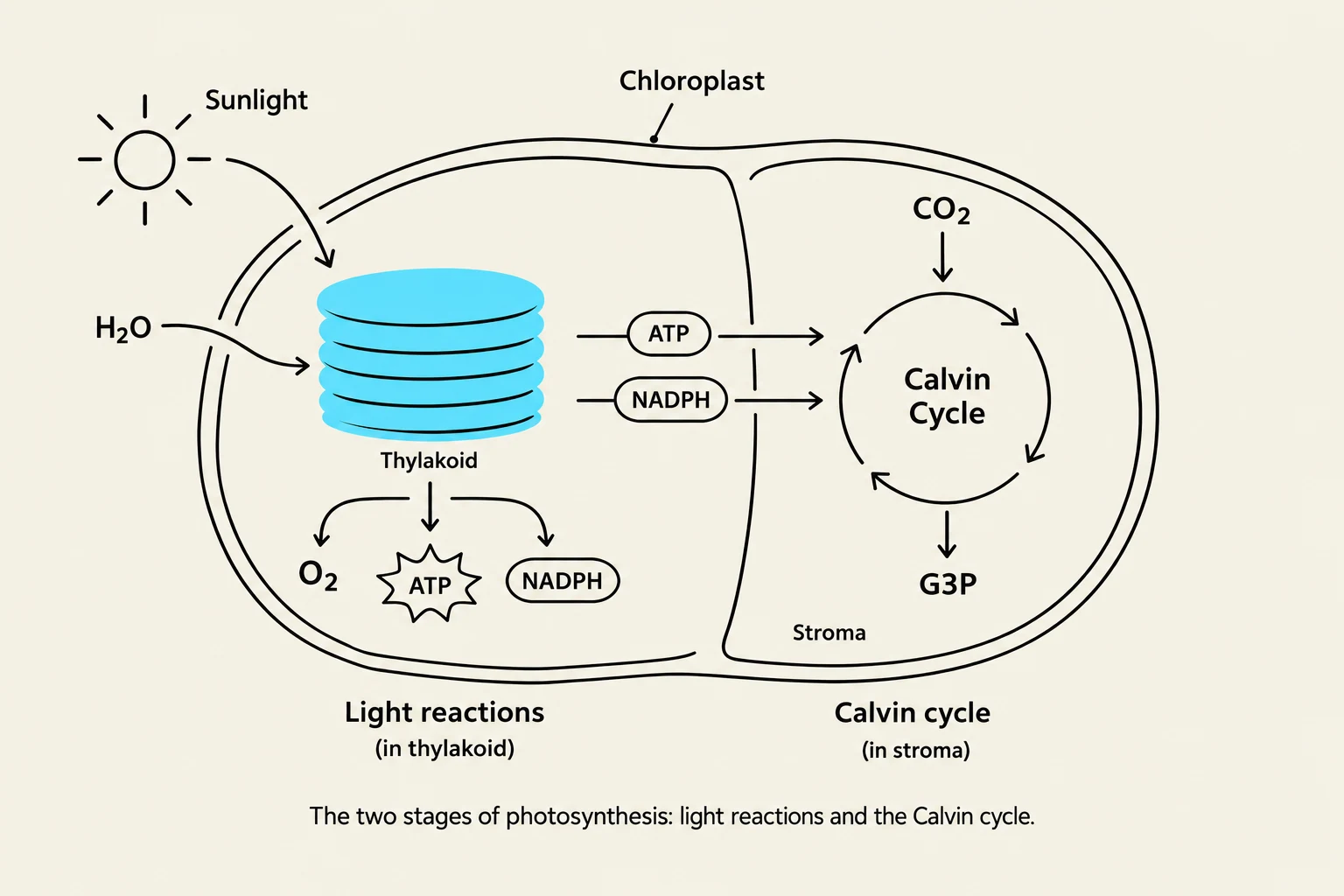
Diagram illustrating the two stages of photosynthesis: the light reactions occurring in the thylakoid and the Calvin cycle taking place in the stroma of the chloroplast.
Photosynthesis is not a single step but a two-part process involving different locations and different chemical goals.
1. The Light Reactions (The "Photo" Stage)
Location: Thylakoid
Goal: Convert solar energy into chemical energy.
The light reactions begin when pigments (such as chlorophyll) absorb photons from sunlight. This absorption excites electrons to a higher energy level. To replace these lost electrons, water (H2O) is split, releasing oxygen (O2) as a byproduct.
The process follows a linear electron flow:
Water→Photosystem II→Electron Transport Chain→Photosystem I→NADPH
As electrons move through the transport chain, they release energy used to pump hydrogen ions into the thylakoid space, creating a concentration gradient. This gradient powers ATP Synthase, a molecular "turbine" that produces ATP.
Inputs:H2O, light, ADP, P, NADP+
Outputs:O2, ATP, NADPH
2. The Calvin Cycle (The "Synthesis" Stage)
Location: Stroma
Goal: Transform chemical energy into storable organic forms (carbohydrates).
The Calvin Cycle does not require light directly, but it relies on the ATP and NADPH produced by the light reactions. It proceeds through three main steps:
Carbon Fixation:CO2 is incorporated into organic molecules via the enzyme Rubisco.
Reduction: The energy from ATP and NADPH is used to produce G3P (glyceraldehyde-3-phosphate), the primary output of photosynthesis.
Regeneration: The remaining molecules are used to regenerate the CO2 acceptor (RuBP) to keep the cycle running.
Inputs:CO2, ATP, NADPH
Outputs:[CH2O]n (G3P), ADP, P, NADP+
A Common Theme: Electron Energy Levels
A fundamental concept linking photosynthesis and respiration is the movement of electrons between energy levels.
In Photosynthesis: Electrons move from low-energy molecules (like water) to high-energy molecules (like carbohydrates). This process requires an input of energy.
In Respiration: Electrons move from high-energy carriers (like NADH or NADPH) back toward lower energy states. This process releases energy, which is captured to form ATP.
Molecule Type
Energy Level
Role in Photosynthesis
Role in Respiration
Water (H2O)
Low
Electron Source
Product
Carbohydrates ([CH2O]n)
High
Product
Electron Source
Summary Table for Study
Process
Location
Main Input
Main Output
Light Reactions
Thylakoid
Light, H2O
O2, ATP, NADPH
Calvin Cycle
Stroma
CO2, ATP, NADPH
G3P (Carbohydrate)
Keep reading for free.
Create an account to finish this reading and make it part of your study routine.