Fundamentals of Pharmacology and Pharmaceutical Water Types
This review covers the core principles of pharmacology, including local vs. systemic effects, pharmacokinetics (ADME), drug dynamics, and the distinctions between various grades of water used in pharmacy compounding and dispensing.
Preparing for a pharmacy theory midterm requires a dual focus: understanding the scientific principles of how drugs interact with the human body and mastering the technical details of pharmaceutical ingredients and administration. This review covers the core pillars of pharmacology, the movement of drugs through the body, and the critical distinctions between various non-medicinal ingredients used in compounding and dispensing.
Comparison of local versus systemic drug effects.
Fundamentals of Pharmacology
At its core, pharmacology is the science concerning the properties, characteristics, and actions of drugs. When studying for the exam, it is essential to distinguish between how a drug affects a specific site versus how it affects the whole body:
Local Effect: The drug is applied directly to the site of action, such as applying a cream to a skin rash or instilling eye drops for an infection.
Systemic Effect: The drug enters the circulatory system and is transported to its cellular site of action. This can happen via direct injection (I.V.) or through absorption into the bloodstream from another route, such as a transdermal patch used for chest pain.
Understanding these effects helps determine the appropriate route of administration and the expected therapeutic outcome.
Pharmacokinetics: The ADME Process
Pharmacokinetics is the study of how a drug moves through the body. This process is often summarized by the acronym ADME: Absorption, Distribution, Metabolism, and Elimination.
1. Absorption
Absorption is the process where a drug enters the bloodstream from the site of administration. The rate and extent of this process depend heavily on the dosage form, the route used, and specific patient conditions.
2. Distribution
Once in the bloodstream, distribution describes how the drug spreads throughout the body to various tissues and organs. This is influenced by blood flow, tissue permeability, and the drug's affinity for specific tissues.
3. Metabolism and the First Pass Effect
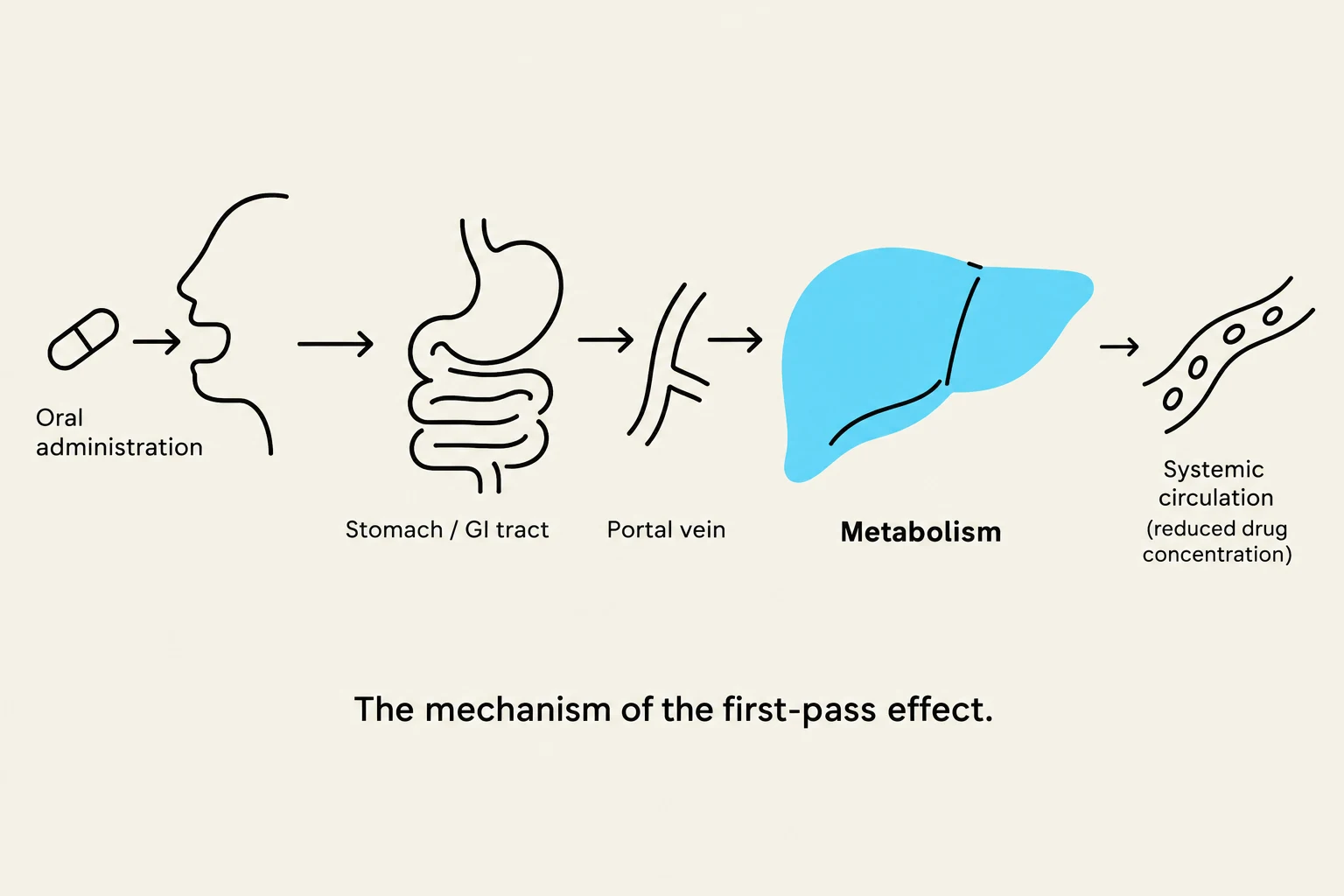
The mechanism of the first-pass effect, illustrating how orally administered substances are metabolized by the liver before reaching systemic circulation.
Metabolism involves the chemical alteration of drugs into active or inactive polar compounds. This occurs primarily in the liver, but also in the kidneys, lungs, and GI tract.
A critical concept for the midterm is the First Pass Effect (or First Pass Metabolism). When a drug is administered orally, it travels through the GI tract and enters the portal circulation to the liver. The liver enzymes may rapidly metabolize the drug before it ever reaches the systemic circulation, significantly reducing the concentration of the active drug available to target tissues.
Exam Tip: If a drug is subject to a heavy first-pass effect, an alternative route (such as sublingual or intravenous) may be chosen to ensure therapeutic levels are reached.
4. Elimination
Elimination is the process of removing the drug and its metabolites from the body, typically via the kidneys (urine) or the liver (bile). The rate of elimination directly influences the duration of action (how long the drug is effective).
Drug Dynamics and Safety
When evaluating a medication, pharmacists must consider several temporal and safety-related factors:
Onset of Action: The time required for a drug to produce a response.
Duration of Action: The length of time a drug remains effective.
Adverse Effects: Undesirable or harmful effects that occur after administration. These can range from mild (nausea, drowsiness) to severe and life-threatening (anaphylaxis, organ damage).
Drug Interactions: When two or more drugs, or a drug and another substance (like food or alcohol), interact to alter how a drug is metabolized or its effects in the body.
Non-Medicinal Ingredients: Water Types
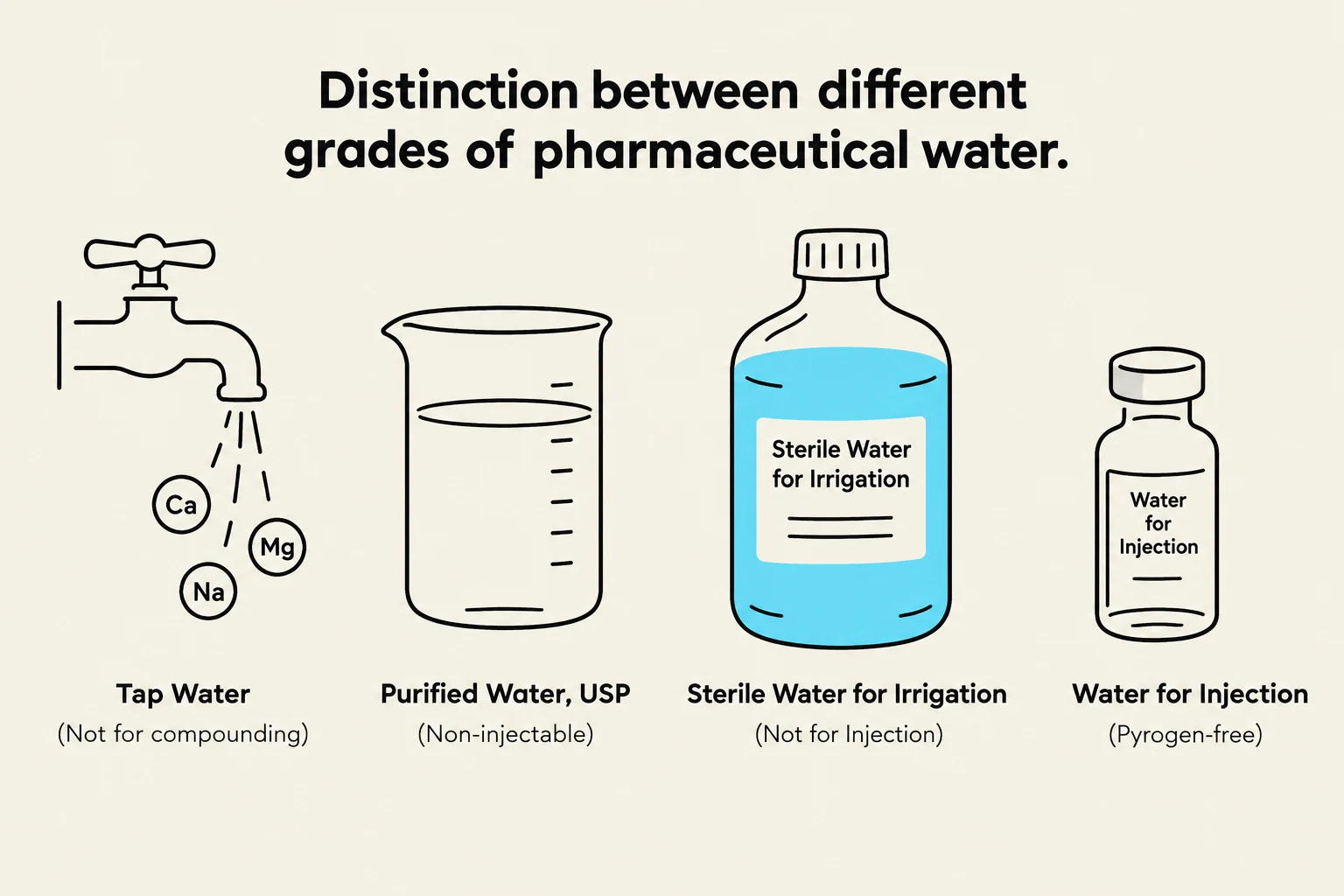
This illustration distinguishes between different grades of pharmaceutical water, including tap water, purified water (USP), sterile water for irrigation, and water for injection, highlighting their respective uses and properties.
In pharmacy, "water" is not a single substance; different grades of water are required depending on the intended use. You must memorize these distinctions for the midterm:
Water Type
Characteristics & Use
Tap Water
From municipal supply; contains minerals and microorganisms; not used for manufacturing or compounding.
Purified Water, USP
Purified via distillation or reverse osmosis; used for non-injectable aqueous forms and cleaning; must yield ≤0.0001% residue.
Sterile Water for Irrigation
Sterile and non-pyrogenic; used for cleansing or flushing tissues; labeled "For Irrigation Only, Not for Injection".
Water for Injection
Highly purified; used as a solvent for drugs that will be sterilized after preparation; must be pyrogen-free.
Sterile Water for Injection
Already sterilized; supplied in single-dose containers; used as a vehicle for injectables (but not for IV because it lacks tonicity).
Bacteriostatic Water for Injection
Contains an antimicrobial agent (typically benzyl alcohol) to inhibit bacterial growth; suitable for multi-dose vials.
Warning: Bacteriostatic water containing benzyl alcohol should not be used in neonates, infants, or during pregnancy due to potential adverse effects.
Summary of Routes of Administration
The route of administration dictates whether an effect is local or systemic and how the drug bypasses or encounters the first-pass effect:
Oral (P.O.): Most common; systemic effect; subject to first-pass effect.
Sublingual (SL) / Buccal: Under the tongue or between cheek and gum; avoids first-pass effect; rapid onset.
Topical vs. Transdermal: Topical is applied to the skin for local effect (e.g., a rash); Transdermal uses a patch to deliver the drug into the circulation for a systemic effect (e.g., nitroglycerin patch).
Parenteral: Includes Intravenous (IV), Intramuscular (IM), and Subcutaneous (SC). These routes provide rapid systemic effects and are often used when the oral route is not viable.
Keep reading for free.
Create an account to finish this reading and make it part of your study routine.