Fundamentals of Pharmacokinetics and Pharmacodynamics
An overview of pharmacokinetics including drug distribution, metabolism, excretion, and half-life, alongside pharmacodynamics involving mechanisms of action through receptor, enzyme, and non-selective interactions.
To understand how medications work in a clinical setting, one must distinguish between what the body does to a drug and what the drug does to the body. This distinction is the foundation of pharmacology, divided into two primary disciplines: pharmacokinetics, which tracks the movement of a drug through the body, and pharmacodynamics, which explores the biochemical and physiological interactions that produce a therapeutic effect.
Pharmacokinetics: The ADME Model
Pharmacokinetics is often summarized by the "ADME" model: Absorption, Distribution, Metabolism, and Excretion. Understanding these processes allows clinicians to predict the time to onset of action, the time to peak effect, and the overall duration of a drug's action.
Absorption and Distribution
Absorption is the movement of a drug from its site of administration into the bloodstream. The route of administration—whether enteral (oral, sublingual), parenteral (IV, IM, SubQ), or topical—significantly impacts the rate and extent of this process. For example, drugs taken orally must often pass through the liver via the hepatic portal system before reaching systemic circulation, a phenomenon known as the "first-pass effect".
Once in the bloodstream, distribution occurs, which is the transport of the drug to its intended site of action. Drugs are typically distributed first to highly vascularized tissues, such as the heart, liver, and kidneys, while areas like fat or skin are served more slowly.
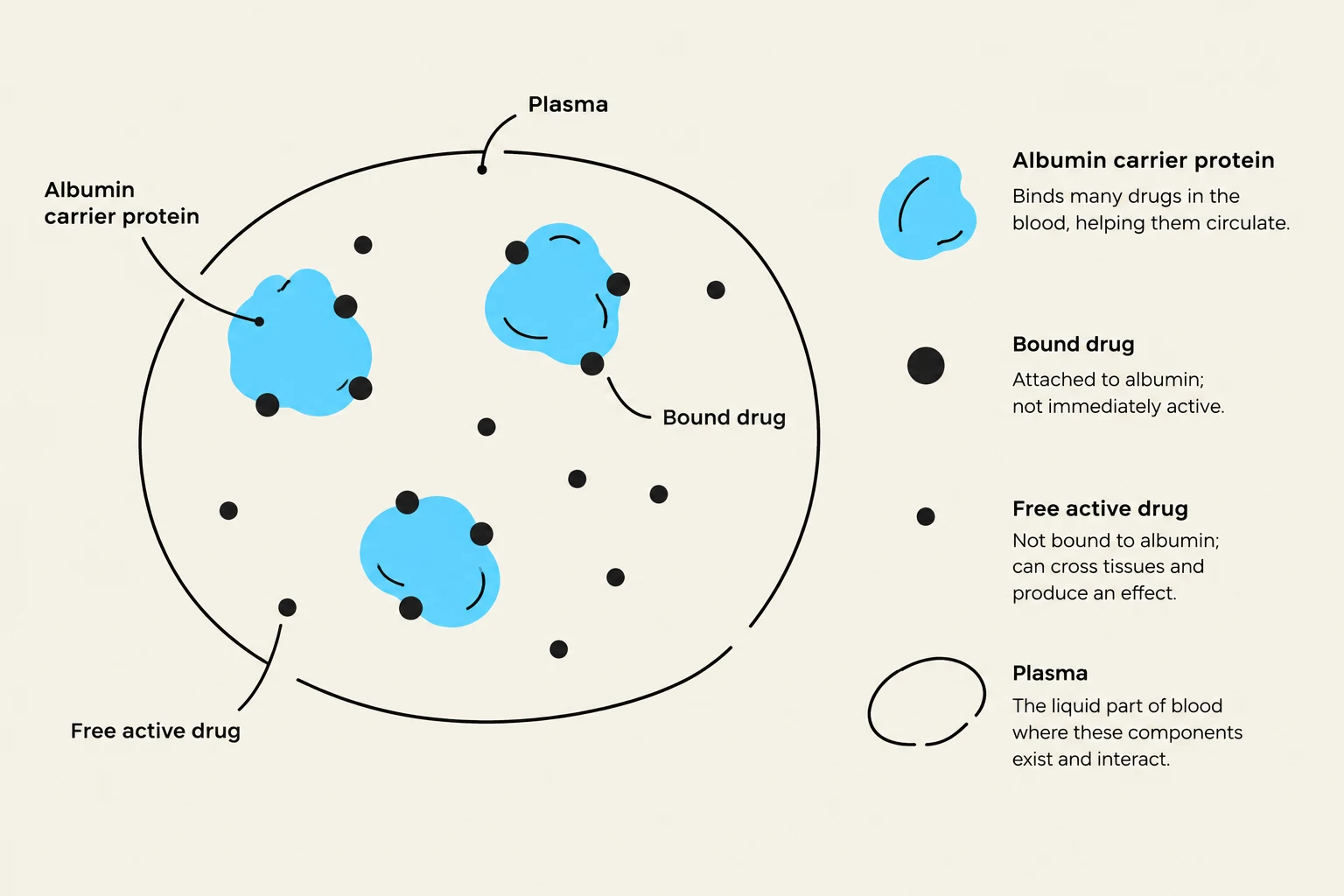
A critical factor in distribution is the role of carrier proteins. Many drugs travel through the blood bound to proteins, most notably albumin. It is vital to remember that only "free" (unbound) drugs are pharmacologically active.
Diagram illustrating how albumin carrier proteins in plasma bind drugs, affecting their circulation and activity. Free active drugs are unbound and can interact with tissues.
Clinical Alert: If a patient has low albumin levels, or if two different drugs compete for the same albumin binding sites, the concentration of "free" active drug can increase, potentially leading to toxicity.
Metabolism and Excretion
Metabolism (or biotransformation) is the biochemical alteration of a drug, primarily occurring in the liver. The goal is often to convert the drug into a more water-soluble form to facilitate removal. This process is largely facilitated by a group of enzymes known as the cytochrome P450 enzymes. Efficiency in metabolism can be altered by age, liver disease, or the presence of enzyme inducers and inhibitors.
Excretion is the final removal of drugs and their metabolites from the body. The kidneys serve as the primary mechanism for excretion, though the liver, lungs, and bowel also contribute.
The Concept of Half-Life
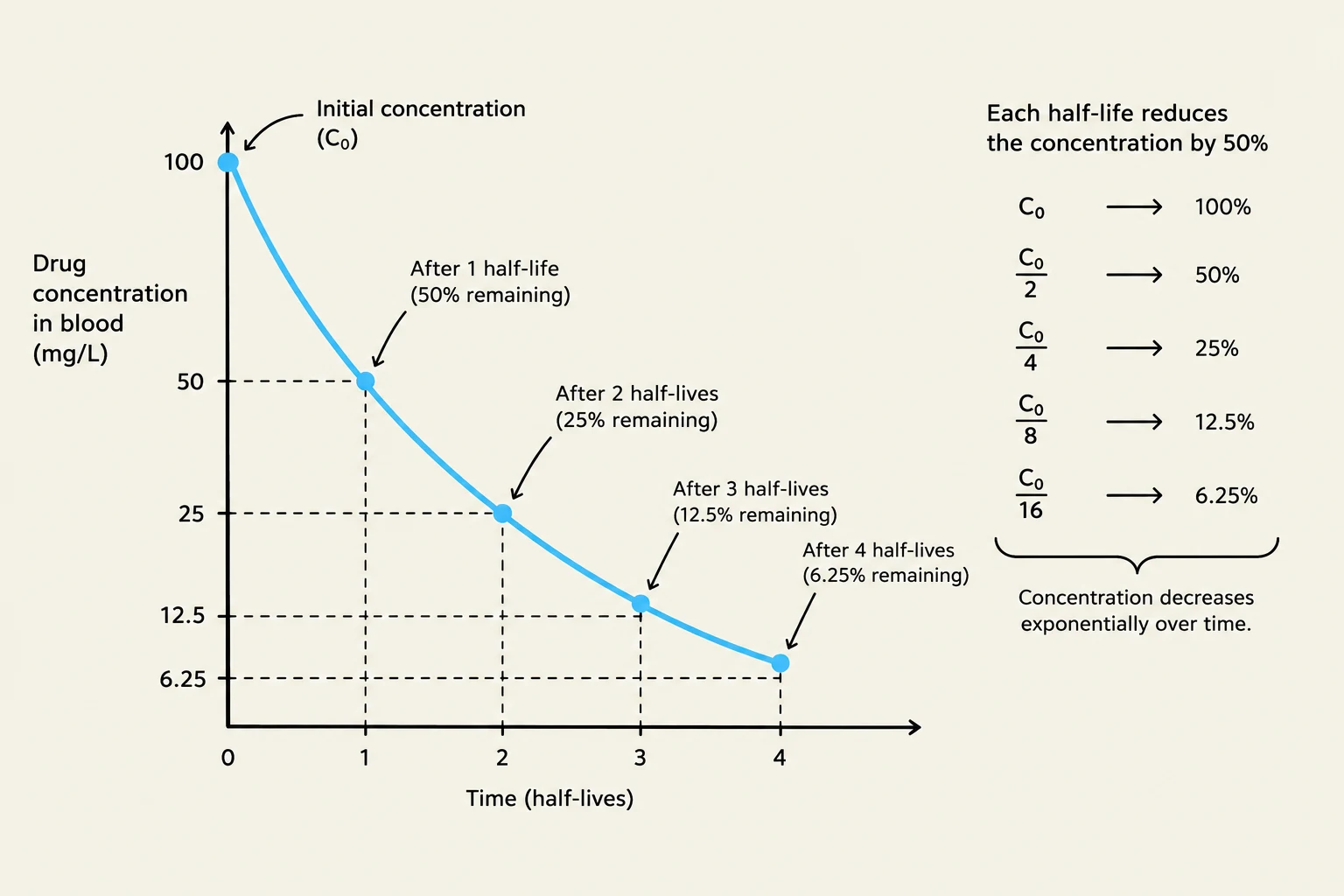
To manage dosing intervals, clinicians rely on the drug's half-life—the time required for the serum concentration of a drug to be reduced by 50% during the elimination phase.
Worked Example: Calculating Concentration
If a drug has a peak serum level of 160 mg/L and a half-life of 4 hours, how long until the concentration reaches 20 mg/L?
After 1 half-life (4 hrs): 160→80 mg/L
After 2 half-lives (8 hrs): 80→40 mg/L
After 3 half-lives (12 hrs): 40→20 mg/L
Answer: It would take 12 hours.
This graph illustrates the exponential decrease in drug concentration in the blood over time, demonstrating the concept of half-life where each half-life reduces the concentration by 50%.
Pharmacodynamics: Mechanisms of Action
While pharmacokinetics is about movement, pharmacodynamics is about the "mechanisms of action"—the specific biochemical interactions through which a drug produces its therapeutic effect (the desired, beneficial result).
Mechanisms of Action
Drugs modify cellular activity through three primary pathways:
Receptor Interactions: Receptors are reactive sites (usually proteins) on or inside a cell. Drugs can mimic or block natural substances at these sites.
Agonists: Drugs that mimic natural substances to produce a response.
Antagonists: Drugs that block the receptor to prevent a response.
Enzyme Interactions: Enzymes catalyze biochemical reactions. Drugs can act as selective interactions by either inhibiting or activating these enzyme systems.
Non-selective Interactions: Some drugs do not target specific receptors or enzymes. Instead, they may have non-specific effects, such as altering cell membranes or creating osmotic effects (e.g., antacids).
Clinical Application: Safety and Monitoring
In nursing practice, understanding these principles is essential for safe medication administration. The goal is to achieve a therapeutic outcome while avoiding adverse drug events (ADEs), which include medication errors (preventable) and adverse drug reactions (unexpected/undesirable).
Clinicians must monitor the therapeutic index (TI), which is the ratio between the toxic dose and the dose that provides a therapeutic effect:
TI=ED50TD50
A drug with a high therapeutic index is generally safer, whereas a drug with a narrow therapeutic index requires much more rigorous monitoring to prevent toxicity.
Exam Tip: Always distinguish between "Pharmacokinetics" (what the body does to the drug: ADME) and "Pharmacodynamics" (what the drug does to the body: Mechanisms of Action).
Keep reading for free.
Create an account to finish this reading and make it part of your study routine.