An overview of nutrition, including macronutrients, micronutrients, water, measuring nutritional adequacy, and factors affecting nutritional needs. Covers clinical assessment metrics and guidance from MyPlate.
Nutrition is the scientific study of how the body handles nutrients and how human behavior and the environment impact the process of nourishment. At its core, nutrition involves understanding how we obtain the chemical substances necessary to sustain life, promote growth, and maintain bodily functions.
Nutrients are categorized into two primary types:
Essential Nutrients: These must be obtained through the diet because the body cannot produce them in sufficient quantities.
Non-essential Nutrients: These are not strictly required from the diet because the body can synthesize them in sufficient amounts.
To understand how to fuel the body, we must look at the six classes of nutrients, which are divided into macronutrients and micronutrients.
Macronutrients: The Body's Fuel
Macronutrients are required in large amounts to provide energy, which is measured in kilocalories (kcal).
Carbohydrates
The metabolic pathway of excess carbohydrates, showing their conversion from a carbohydrate source like bread to glucose in the bloodstream, and finally to triglycerides stored in adipose tissue.
Commonly known as starches and sugars, carbohydrates are classified as either simple or complex. Their primary function is to supply energy to the body. Once consumed, they are converted into glucose, which is the primary form used for transport through the blood or for immediate cellular use. It is important to note that if carbohydrates are consumed in excess, they are stored as triglycerides in adipose (fat) tissue.
Proteins
Proteins are classified as either complete or incomplete. They are vital for the formation of all body structures, playing a key role in tissue repair and growth. Like carbohydrates, if protein intake exceeds the body's needs, the excess is stored as fat.
Fats (Triglycerides and Lipids)
Fats are classified as saturated or unsaturated. They serve several critical roles: providing insulation for the body, providing protection for organs, and cushioning them. Furthermore, fats are required for the absorption of fat-soluble vitamins.
Exam Tip: Energy Values
When calculating energy intake, remember the specific caloric density per gram for each macronutrient:
Carbohydrates: 4 kcal/g
Protein: 4 kcal/g
Fat: 9 kcal/g
Micronutrients: Regulators of Body Processes
Micronutrients are required in much smaller amounts than macronutrients, but they act as essential catalysts for metabolic processes.
Vitamins
Comparison of water-soluble and fat-soluble vitamin absorption and storage in the human body.
Vitamins are categorized based on how they are absorbed and stored:
Water-soluble vitamins: This group includes the B vitamins and Vitamin C. They are absorbed through the intestinal wall directly into the bloodstream. Because they are not stored in the body, they require daily intake.
Fat-soluble vitamins: This group includes Vitamins A, D, E, and K. They are absorbed via lymphatic circulation. Unlike water-soluble vitamins, excess amounts can be stored in the liver and adipose tissue.
Minerals
Minerals are inorganic elements found in body fluids and tissues. They provide structural support (such as in bones) or help regulate various physiological processes. Minerals are further classified into:
Macro-minerals
Micro-minerals
Water: The Vital Nutrient
While often overlooked in discussions of "food," water is the most vital nutrient for human life. It accounts for a significant portion of total body weight and serves three primary functions: acting as a solvent, a lubricant, and a transport medium. It is important to remember that water does not only come from drinking; it is also obtained through food.
Measuring Nutritional Adequacy
To ensure that individuals are meeting their nutritional needs, health professionals use the Dietary Reference Intakes (DRIs). The DRIs consist of several key metrics:
Estimated Average Requirement (EAR): The intake level estimated to meet the requirements of half the healthy individuals in a specific group.
Recommended Daily Allowance (RDA): The average daily level of intake sufficient to meet the requirements of nearly all (97-98%) healthy individuals.
Adequate Intake (AI): A value used when an RDA cannot be determined.
Tolerable Upper Intake Level (UL): The maximum daily amount of a nutrient that is unlikely to cause adverse health effects.
Clinical Assessment Metrics
Two common metrics used to assess an individual's nutritional and metabolic status are:
Basal Metabolism (BMR): The amount of energy required to maintain vital functions at rest.
Body Mass Index (BMI): A measure used to assess body fat based on height and weight.
The US formula for calculating BMI is:
BMI=height (in)2weight (lbs)×703
Reading Food Labels and MyPlate
Understanding how to apply these fundamentals in daily life involves interpreting food labels and following dietary guides like MyPlate.
MyPlate Guidelines
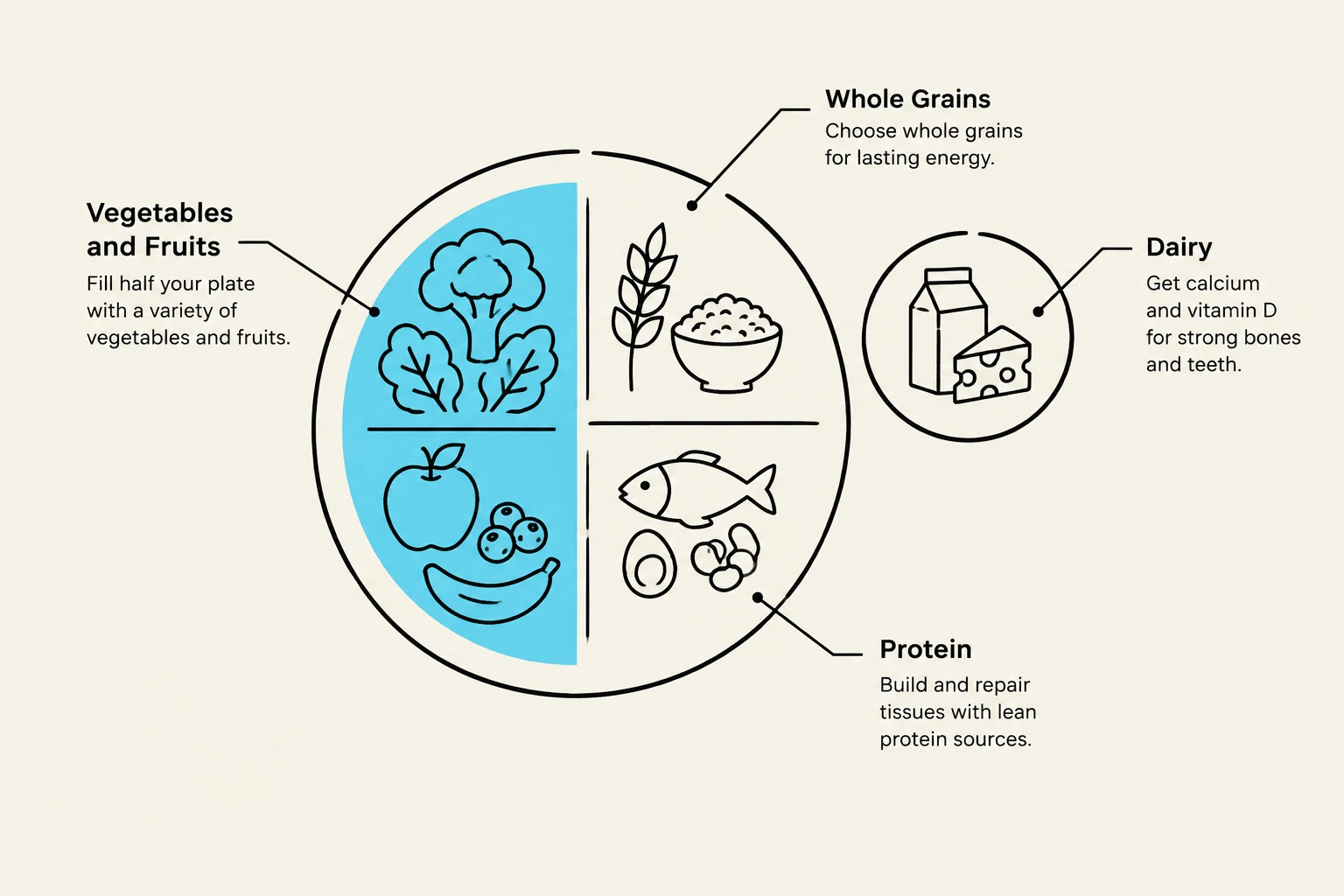
A diagram illustrating a balanced diet, divided into sections for vegetables and fruits, whole grains, protein, and dairy, with brief descriptions of their nutritional benefits.
The MyPlate guide suggests a balanced approach to eating:
Fruits and Vegetables: Make half your plate fruits and vegetables. Aim for variety and prioritize non-starchy vegetables.
Grains: Choose mostly whole grains (like brown rice or whole wheat) because they contain more fiber, iron, and B vitamins than refined grains.
Protein: Aim for a palm-sized portion, choosing lean options like beans, nuts, fish, or chicken.
Dairy: Aim for approximately 3 servings per day, preferably low-fat, to ensure adequate calcium intake.
Interpreting Nutrition Facts
When reading an FDA food label, pay close attention to the following:
Serving Size: This is the basis for all nutrient information on the label.
Calories: The label shows total calories and how many come specifically from fat.
% Daily Value (%DV): This tells you how much a nutrient in one serving contributes to a total daily diet based on a 2,000-calorie standard.
Limits: To reduce the risk of chronic diseases like heart disease or high blood pressure, aim to limit the intake of total fat, saturated fat, cholesterol, and sodium.
Factors Affecting Nutrition
Nutritional needs are not static; they change based on various developmental and physiological factors.
Developmental Considerations
Adults: Nutritional needs may change based on activity levels. While adults may become more aware of the role of exercise, work and family pressures can lead to a decline in physical activity. If caloric intake is not adjusted to match activity levels, progressive weight gain may occur.
Older Adults: Due to a slower metabolic rate, older adults generally have decreased energy requirements. However, their need for specific nutrients—such as fiber, water, and foods rich in vitamins and minerals—actually increases to maintain GI function and prevent constipation.
Clinical Assessment of Nutritional Status
In a clinical or nursing setting, a nutritional assessment involves several components:
Dietary Intake: Reviewing what the patient eats.
Anthropometric Data: Measuring height, weight, and BMI.
Biochemical Data: Analyzing blood work. For example, decreased Albumin or Prealbumin can indicate malnutrition, while abnormal Blood Urea Nitrogen (BUN) levels can indicate dehydration or starvation.
Clinical Observations: Looking for physical signs.
Good status: Alert, energetic, shiny hair, and firm nails.
Poor status: Listless, easily fatigued, dry/brittle hair, or pale skin.
Keep reading for free.
Create an account to finish this reading and make it part of your study routine.