Fundamentals of Nursing Data Collection and Communication
This guide explains the core principles of nursing data collection, differentiating between subjective and objective data, and detailing the focused health history using the OLDCARTSS framework. It also covers therapeutic communication techniques and the importance of privacy and confidentiality in patient care.
In the nursing profession, gathering accurate information is the foundation of safe and effective patient care. While a physician might focus on a diagnosis, the nurse’s role in data collection is uniquely centered on the client's lived experience, their functional status, and how their health impacts their daily life. This process requires a blend of technical skill, therapeutic communication, and a keen understanding of the distinction between what a patient feels and what a nurse observes.
The Fundamentals of Data: Subjective vs. Objective
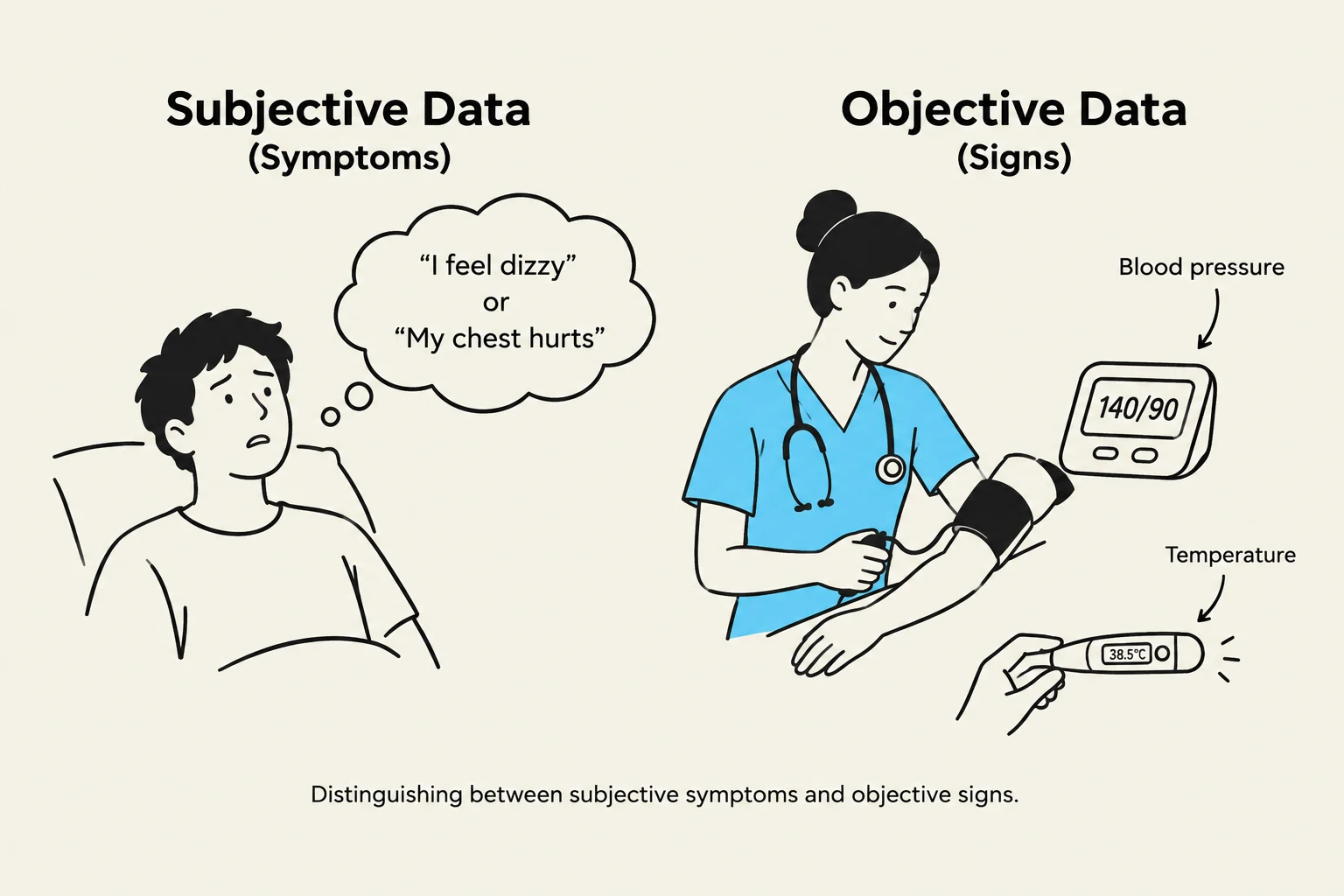
This illustration distinguishes between subjective data (symptoms reported by a patient) and objective data (signs measured by a healthcare professional), such as blood pressure and temperature.
To build a complete clinical picture, nurses must distinguish between two types of data: subjective and objective.
Subjective Data (Symptoms): This is information collected directly from the client. It includes their personal experiences, feelings, perceptions, and reasons for seeking care. Because these are internal experiences, they cannot be independently verified by the nurse. For example, if a patient says, "I feel nauseous," that is subjective data.
Objective Data (Signs): These are observable and measurable facts. Objective data includes findings from physical assessments—things the nurse can see, hear, smell, or feel. For example, a blood pressure reading of 120/80 mmHg or a visible skin rash are objective data.
Exam Tip: Remember the mnemonic: Symptoms are Subjective (what the patient says), and Signs are Seen/Sensed (what the nurse observes).
The Focused Health History
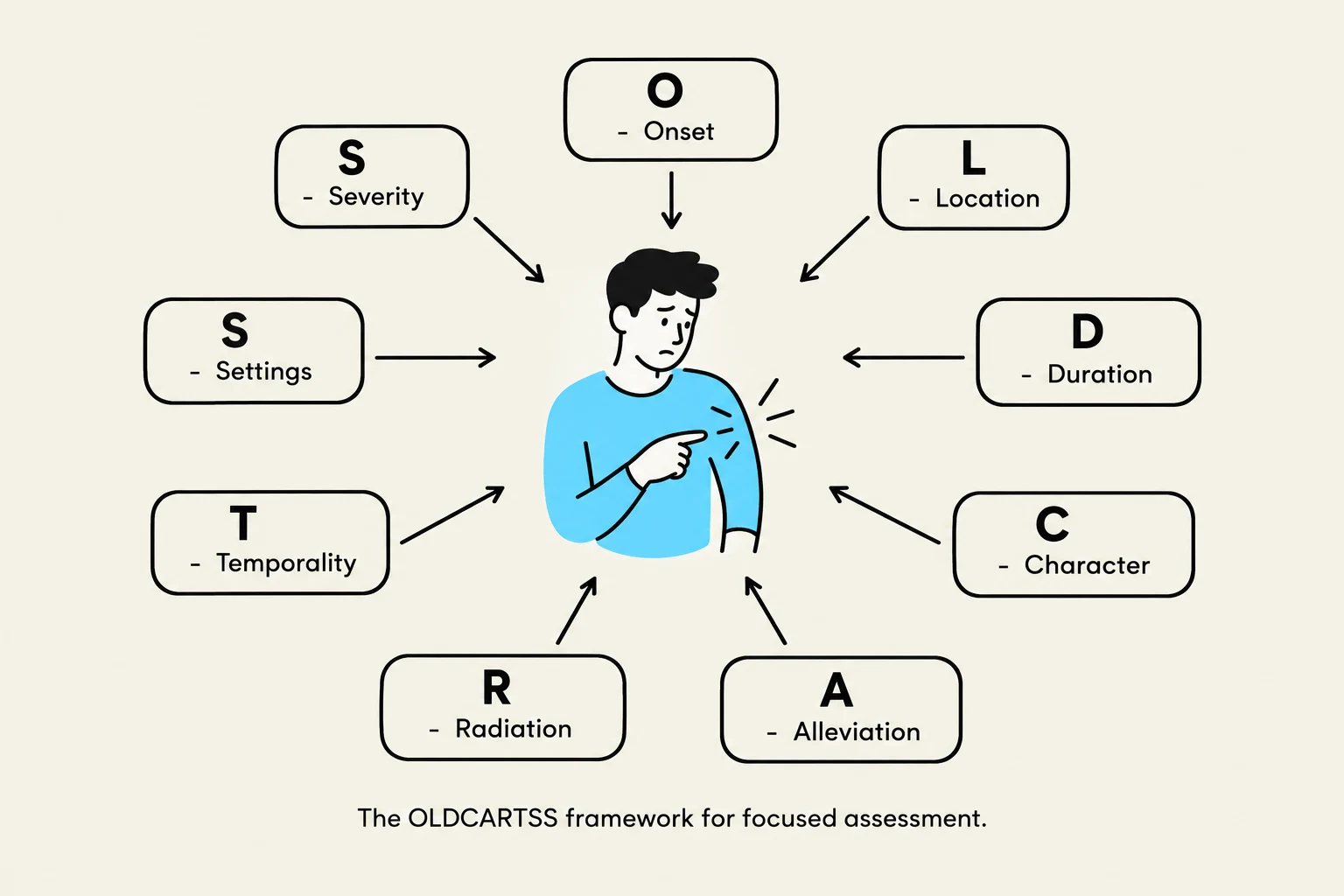
The OLDCARTSS framework is a mnemonic used for focused assessment of symptoms, covering Onset, Location, Duration, Character, Alleviation, Radiation, and Severity, and Settings.
While a comprehensive history looks at every body system, nurses most frequently perform a focused health history. This is a targeted assessment used when a client reports a specific symptom, a new problem arises, or a change in status is noted.
When conducting a focused history, nurses often utilize the OLDCARTSS framework to ensure they have captured all necessary details regarding a specific complaint (such as pain):
Letter
Component
Guiding Question Example
O
Onset
"When did you first notice this?"
L
Location
"Can you point to exactly where it hurts?"
D
Duration
"How long does the pain last when it happens?"
C
Characteristics
"Can you describe how it feels (sharp, dull, etc.)?"
A
Aggravating Factors
"Does anything make it worse?"
R
Relieving Factors
"Have you tried anything to make it better?"
T
Timing
"Is there a specific time of day this occurs?"
S
Severity
"On a scale of 0–10, how would you rate it?"
S
Self-Perception
"What are your thoughts on why this is happening?"
Note: OLDCARTSS is a memory aid for the nurse; you do not document the acronym itself, and you should only use the components relevant to the specific symptom being assessed.
Interview Phases and Therapeutic Communication
A successful interview is not just a checklist; it is a structured interaction that relies on therapeutic communication (TC)—a client-focused, empathetic approach designed to understand the client's unique context.
The Three Phases of the Interview
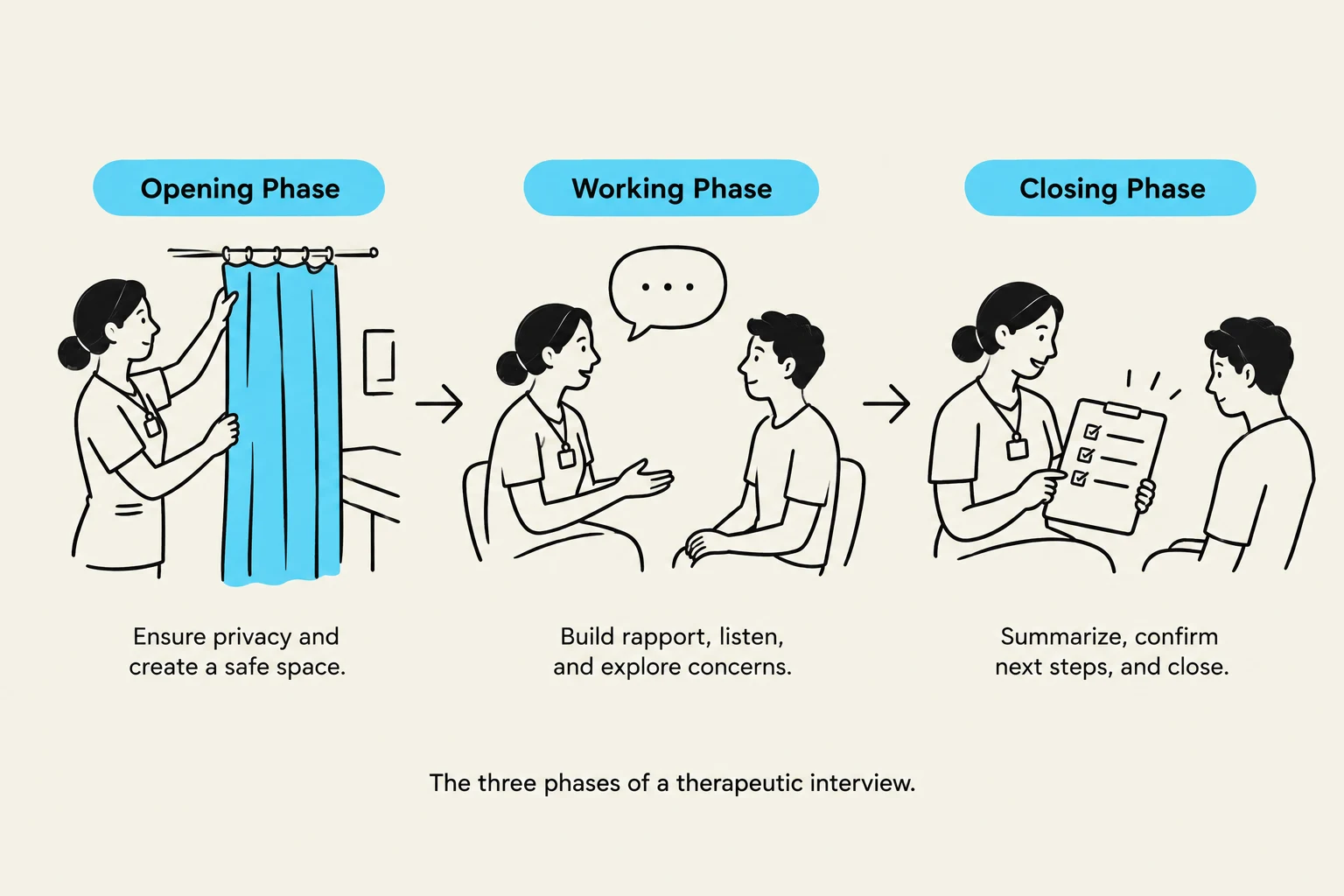
The three phases of a therapeutic interview: Opening, Working, and Closing.
Opening Phase: This begins with preparation. The nurse ensures privacy, checks if the client has sensory aids (like glasses or hearing aids), and establishes rapport by introducing themselves.
Working Phase: This is the "bulk" of the interaction where the nurse listens to the client's story, asks clarifying questions, and collects data.
Closing Phase: The nurse summarizes the information gathered, allows the client to make corrections, and explains the next steps in their care.
Essential Communication Skills
To navigate the working phase effectively, nurses use several key techniques:
Active Listening: Decoding the meaning behind words and observing non-verbal cues.
Reflection: Mirroring the feeling behind a statement (e.g., "It sounds like you are worried about this test").
Clarification: Asking for more detail when a term is vague (e.g., "What do you mean by a 'spell'?").
Silence: Giving the client space to think and process intense emotions.
Warning: Non-Therapeutic Behaviors
Avoid "False Reassurance" (e.g., "Don't worry, you'll be fine"). This dismisses the client's feelings. Instead, address the emotion: "I can see you are anxious; I will stay here with you while we do this assessment".
Sources of Data: Primary vs. Secondary
Nurses must evaluate the reliability of their information sources:
Primary Sources: The most desirable source is the client themselves. However, if a client is a non-communicative infant, the mother becomes the primary source. A translator (who provides a verbatim, word-for-word translation) is also considered a primary source.
Secondary Sources: These include family members, witnesses, medical charts, and interpreters. Unlike translators, interpreters translate the meaning and intent into the target language to make sense, making them secondary sources.
When collecting a history, nurses also review existing documentation regarding:
Past Medical/Family History: Often found in the patient's chart.
Medications: Including regular home medications and how they are taken.
Allergies: Crucial for safety; nurses must distinguish between true allergies and mere intolerances.
Privacy and Confidentiality
Confidentiality is the legal and ethical obligation to protect information entrusted to the healthcare team. While privacy refers to the protection of the person (e.g., closing curtains during a bath), confidentiality refers to the protection of the information.
Professional Boundaries
Access: You may only access the charts of clients to whom you are currently assigned. Accessing others' charts is professional misconduct.
Social Media: Follow the "6 Ps": Be Professional, Positive, Person/Patient-free, Protect yourself, respect Privacy, and always Pause before posting.
Breaching Confidentiality: The only time confidentiality should be breached is when there is a serious threat to safety, such as a client expressing intent for suicide or homicide.
Keep reading for free.
Create an account to finish this reading and make it part of your study routine.