In the world of data management, there is a common misconception that "metadata" is simply a fancy term for "data about data". While technically true, this definition is misleadingly simple. In a modern enterprise, metadata is the connective tissue that describes technical and business processes, data rules, constraints, and the complex relationships between data elements and the concepts they represent.
Metadata acts as the organizational catalog for data assets, contrasting unmanaged data with organized and easily findable information.
Without effective metadata management, an organization is like a massive library without a card catalog: you might own thousands of books, but finding a specific topic or author becomes an impossible task. Metadata management is the essential process of capturing, documenting, and managing the organizational knowledge required to locate, understand, and utilize data assets.
The Dual Nature of Metadata Management
Metadata management serves two critical functions: it is a knowledge management tool and a risk management necessity.
1. Knowledge Management
As organizations grow, data knowledge becomes fragmented. No single individual knows everything about the data landscape. Metadata captures this distributed knowledge, documenting the history, origin, and meaning of data so that it remains an enterprise asset even when staff turnover occurs.
2. Risk Management
From a risk perspective, metadata is vital for identifying sensitive or private data (such as Personally Identifiable Information). It allows organizations to manage the data lifecycle—from creation to archiving or deletion—ensuring they meet regulatory compliance requirements and minimize legal exposure.
Exam Tip: If asked to distinguish between the roles of metadata, remember that it functions as a "guide" for data consumers (Knowledge Management) and a "shield" for the organization (Risk Management).
Core Types of Metadata
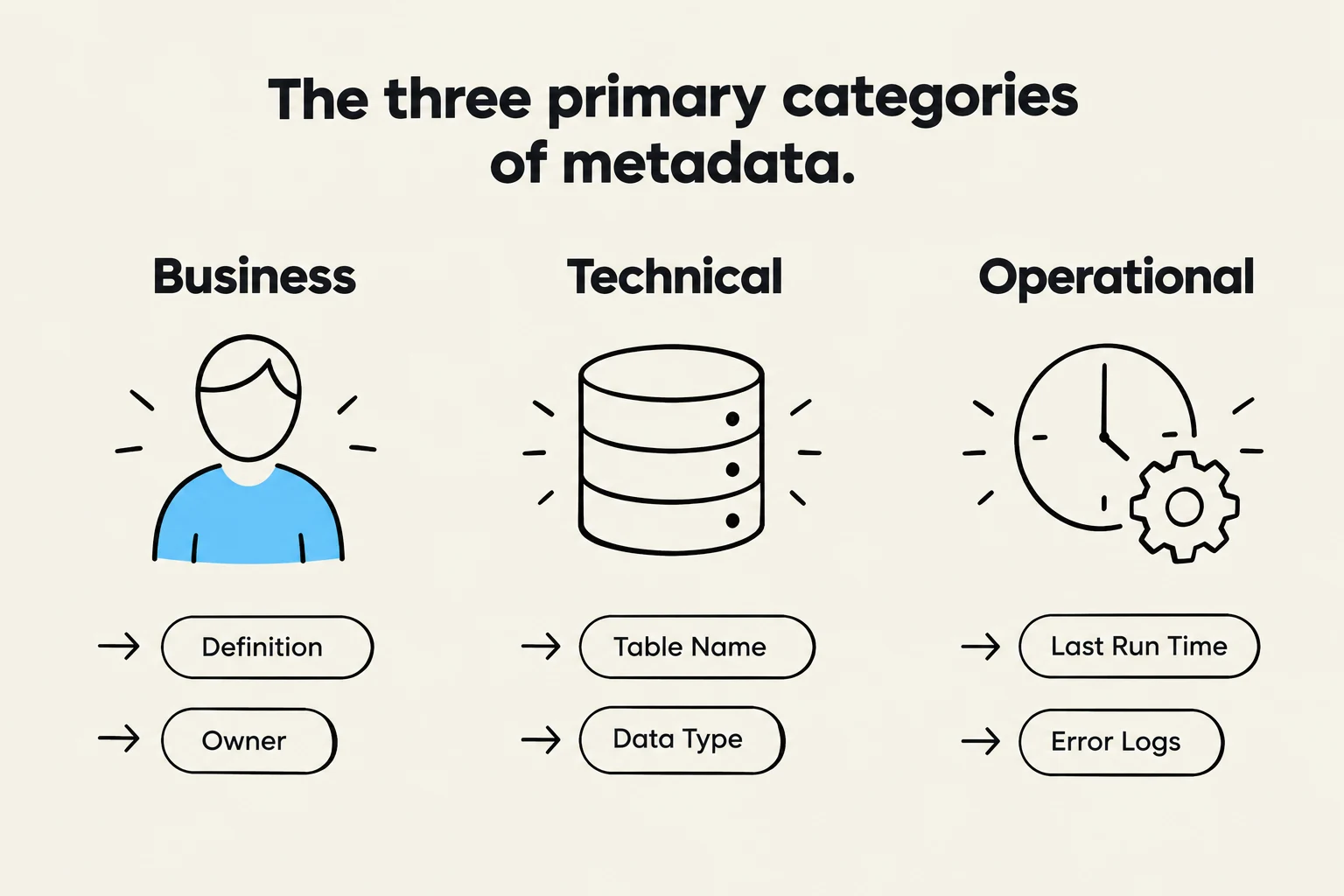
The three primary categories of metadata are Business, Technical, and Operational, with examples for each.
To manage metadata effectively, it is helpful to categorize it based on its origin. While these categories often overlap in practice, they provide a framework for defining requirements.
Business Metadata: Focuses on the content and condition of data from a non-technical perspective. It includes business definitions, rules, calculations, data ownership (stewards), and data quality scores.
Technical Metadata: Provides the "under the hood" details required by IT professionals. This includes physical database table names, column properties, access permissions, ETL (Extract, Transform, Load) job details, and file format schemas.
Operational Metadata: Describes the "how" and "when" of data processing. Examples include execution logs, error reports, backup/retention rules, and audit results.
Driving Value through Data Governance
Metadata management does not exist in a vacuum; it is a core component of Data Governance. Effective governance ensures that metadata is not just collected, but is accurate, consistent, and secure.
Business Drivers
Well-managed metadata provides several tangible benefits to an organization:
Increased Data Confidence: By providing context, metadata enables the measurement of Data Quality.
Operational Efficiency: It identifies redundant data and processes, reducing research time and speeding up the system development lifecycle.
Improved Communication: It bridges the gap between business users (who need definitions) and IT professionals (who need technical specs).
Accurate Impact Analysis: It allows teams to see how a change in one system will ripple through others, preventing project failures.
The Cost of Poor Management
Conversely, failing to manage metadata leads to "data silos," redundant repositories, and conflicting versions of the truth. This ultimately erodes consumer confidence, as users can no longer trust that the data they are seeing is the correct or most recent version.
Strategy and Implementation
Successful implementation requires moving from a reactive state to a proactive metadata strategy.
Guiding Principles
Organizational Commitment: Metadata must be treated as an enterprise asset, requiring senior management support and dedicated funding.
Strategy-Driven: Requirements (both business and technical) must be defined before purchasing tools.
Enterprise Perspective: While the implementation should be iterative and incremental to provide immediate value, the architecture must be designed for future extensibility.
Architectural Approaches
Organizations typically adopt one of several architectural patterns to house their metadata:
Architecture Type
Description
Key Advantage
Key Limitation
Centralized
A single repository stores copies of metadata from all sources.
High availability and quick retrieval.
High maintenance and complex synchronization.
Distributed
Metadata is retrieved from source systems in real-time.
Metadata is always current.
No support for user-added/manual metadata.
Hybrid
Combines a central repository for manual/standardized metadata with real-time retrieval for others.
Balances consistency with currency.
Increased overhead to link results.
Advanced Techniques: Lineage and Big Data
Data Lineage and Impact Analysis
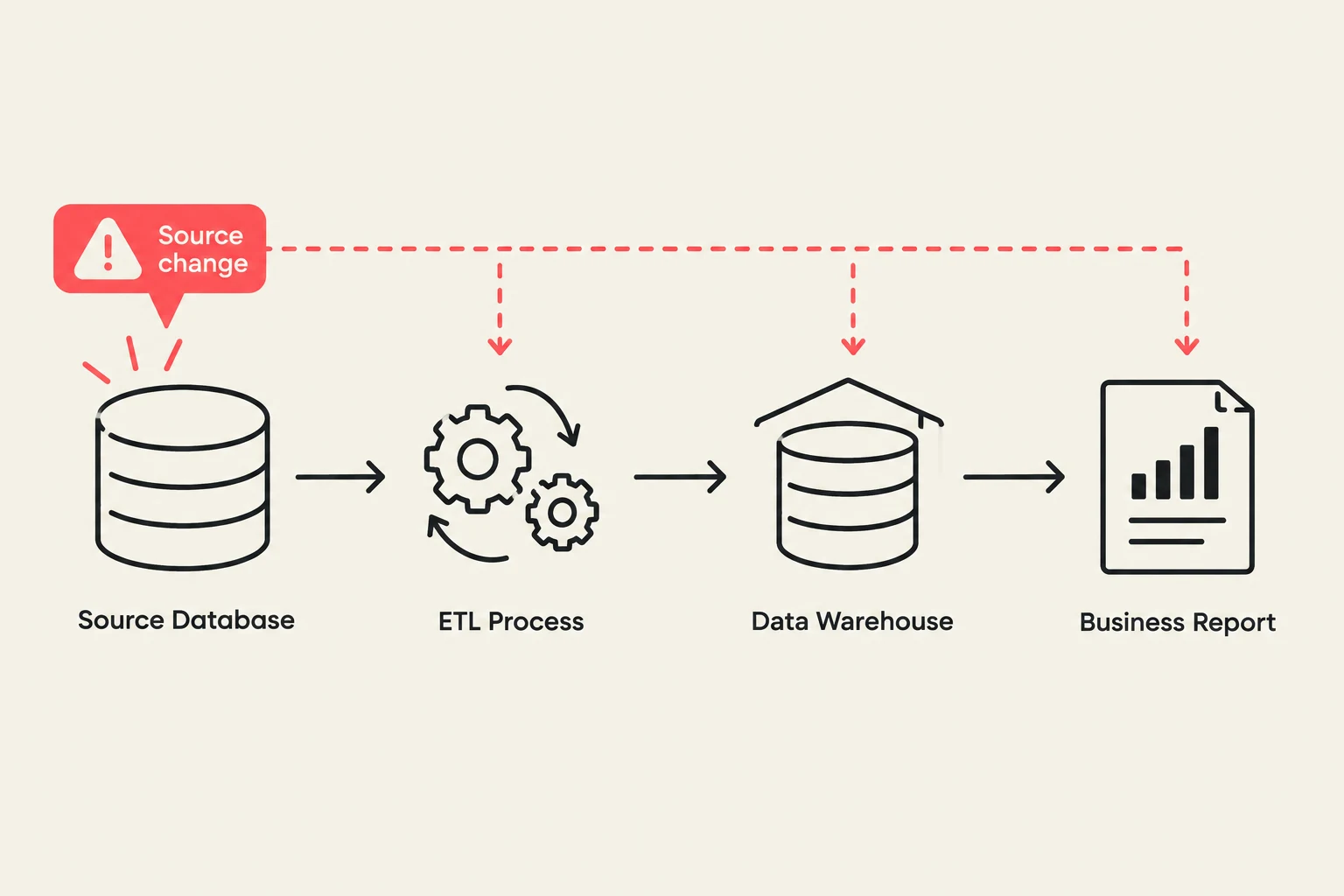
This diagram illustrates the ETL (Extract, Transform, Load) process, showing data flowing from a source database through an ETL process to a data warehouse, culminating in a business report. A "Source change" alert is also indicated.
One of the most powerful uses of metadata is Data Lineage—the ability to trace the movement and transformation of data from its origin to its final destination.
As Designed Lineage: Based on mapping specifications and documentation.
As Implemented Lineage: Derived from actual programming code and system execution.
By "stitching" these pieces together, organizations can perform Impact Analysis, answering critical questions like: "If we change the length of this column in the source system, which downstream reports will break?".
Metadata in the Age of Big Data
In modern data lakes, where data is often unstructured, metadata management is even more critical. Because data is often ingested in massive volumes, organizations must apply metadata tags during the ingestion process. This includes profiling the data to identify domains, relationships, and sensitive information (like PII) immediately upon entry.
Keep reading for free.
Create an account to finish this reading and make it part of your study routine.