An overview of metadata management, its importance in data governance, and the different types of metadata including business, technical, and operational.
In the world of data management, there is a common saying that metadata is simply "data about data." While this is a helpful shorthand, it is misleadingly simple. In reality, metadata is the essential "card catalog" of an organization. Just as a library without a catalog would make finding a specific book nearly impossible, an organization without effective metadata management cannot truly understand, secure, or govern its data assets.
Metadata management involves the planning, implementation, and control activities that enable an organization to process, maintain, integrate, secure, audit, and govern its data. It describes not just the data itself, but the business processes, technical rules, and logical structures that give that data meaning.
The Three Pillars of Metadata Types
This diagram illustrates the three distinct categories of metadata: Business Metadata, Technical Metadata, and Operational Metadata, along with their definitions and examples.
To manage metadata effectively, organizations must first categorize it. While these categories often overlap in practice, they are best understood by where the information originates:
Business Metadata: This focuses on the meaning and context of data. It includes business terms, definitions, calculations, business rules, and data ownership information (such as Data Stewards).
Technical Metadata: This provides the "under the hood" details required by IT. It includes physical database table and column names, data types, access permissions, ETL (Extract, Transform, Load) job details, and physical data models.
Operational Metadata: This describes the history and status of data processing. Examples include execution logs for batch programs, error logs, backup/retention rules, and data usage patterns.
Study Tip: When distinguishing between these types, ask: "Who needs this to understand the meaning (Business), the structure (Technical), or the history (Operational)?"
The Metadata Management Framework
A robust metadata program operates through a structured lifecycle of activities, often categorized into four functional areas: Planning (P), Development (D), Control (C), and Operations (O).
1. Planning and Strategy
The foundation of any program is the Metadata Strategy. This document outlines how the organization will move from its current state to a future state where metadata is managed as an enterprise asset. This phase involves defining requirements for both business and technical users and aligning the strategy with business priorities.
2. Architecture and the Metamodel
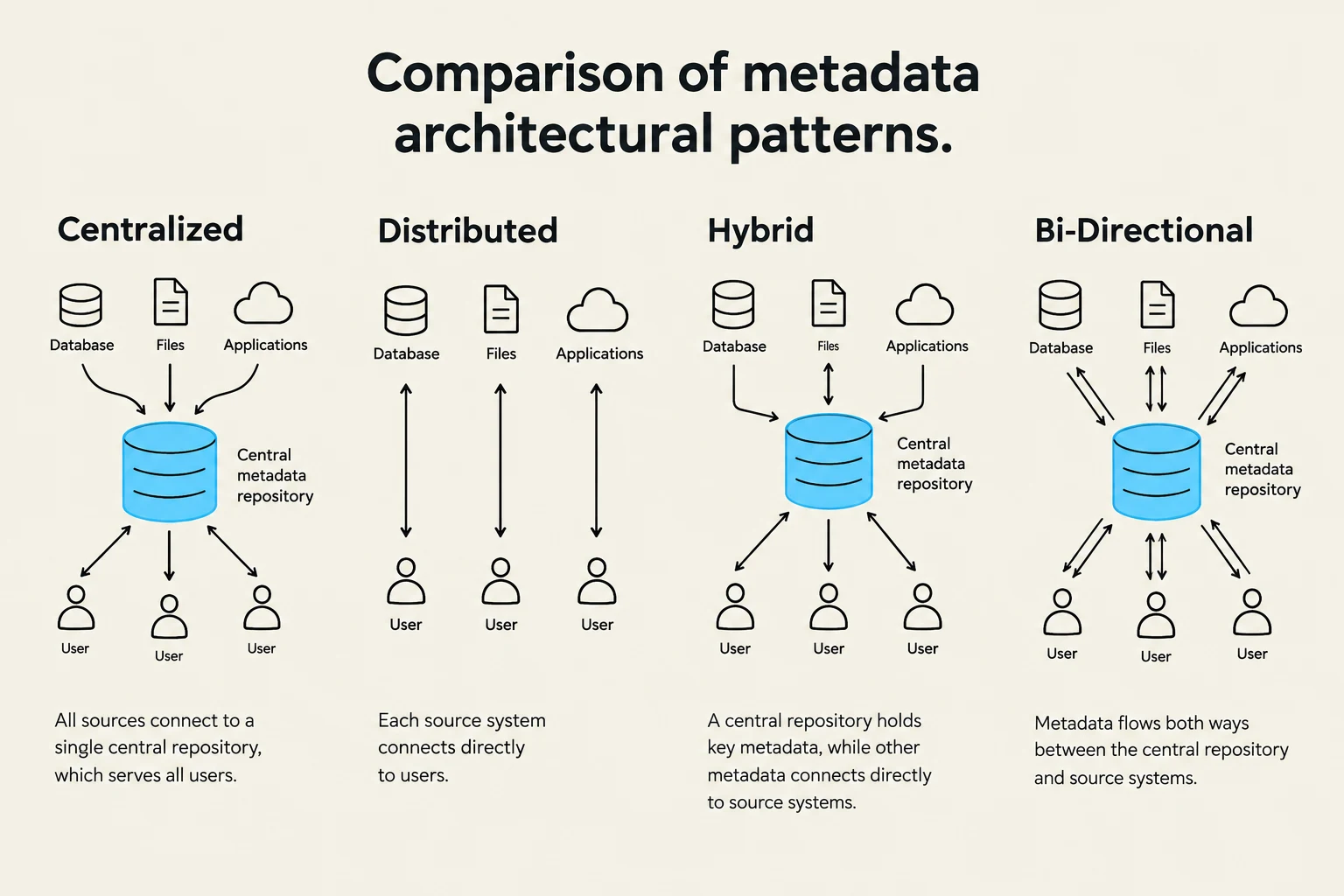
This diagram compares four metadata architectural patterns: Centralized, Distributed, Hybrid, and Bi-Directional. Each pattern illustrates how databases, files, and applications interact with a central metadata repository and users.
Before building a repository, an organization must design its Metadata Architecture. This involves creating a Metamodel—a model that defines the types of metadata to be collected and the relationships between them.
Depending on the organization's needs, they may choose one of several architectural patterns:
Centralized: A single repository contains copies of metadata from all sources. This offers high availability and easy global searching but can be costly to maintain.
Distributed: Metadata is retrieved from source systems in real-time without a persistent central store. This ensures data is always current but makes global searching difficult.
Hybrid: A combination where critical, standardized metadata is stored centrally, while other metadata is retrieved from sources as needed.
Bi-Directional: An advanced approach where changes made in the repository can be coordinated back to the original source systems.
3. Implementation: Stores and Repositories
Metadata must be housed in Metadata Stores. Common tools include:
Business Glossaries: To document business terminology and definitions.
Data Dictionaries: To define the structure and contents of specific datasets.
Metadata Repositories: Physical tables that store integrated metadata from various tools like BI, modeling, and ETL tools.
Key Techniques: Lineage and Impact Analysis
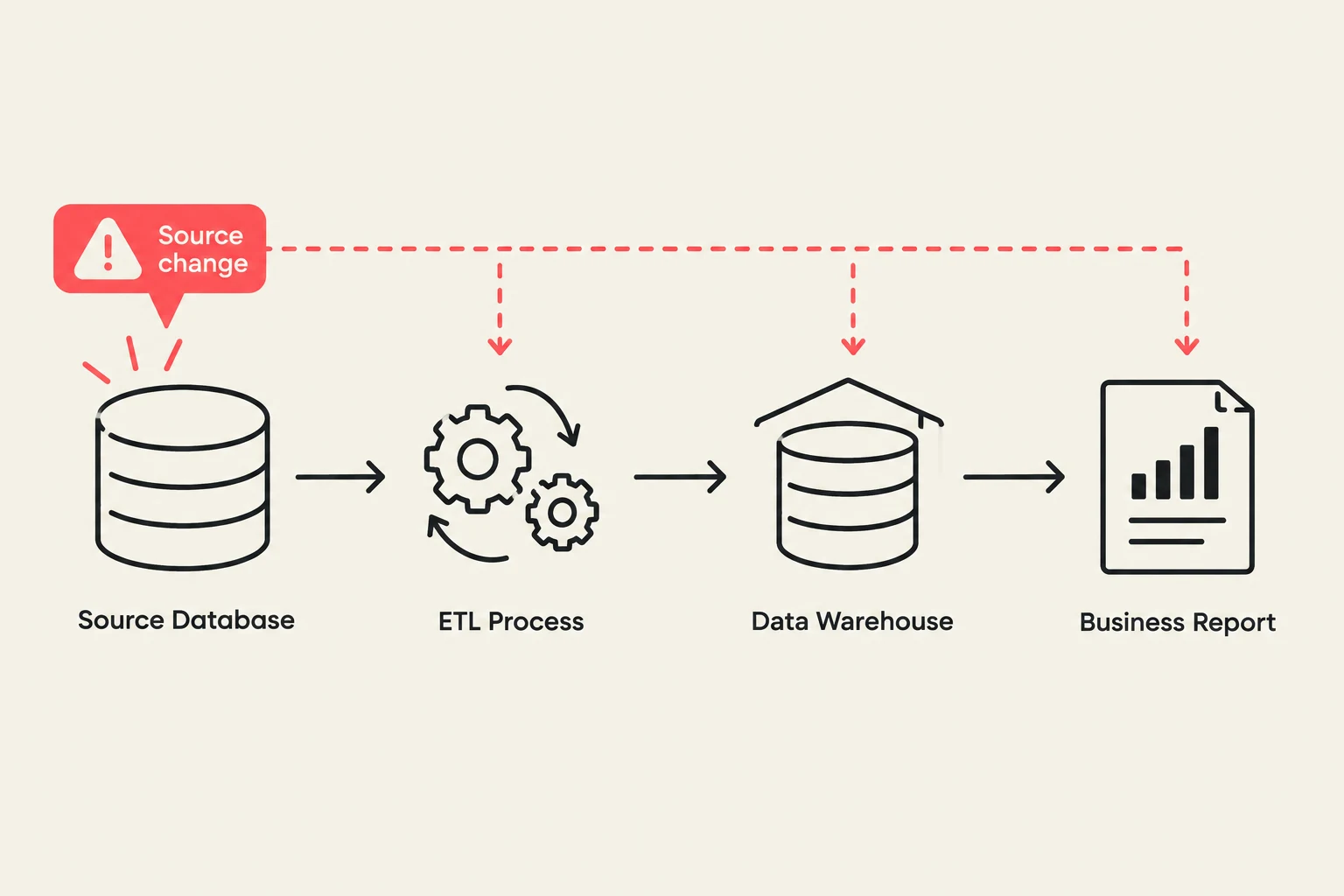
This diagram illustrates the ETL (Extract, Transform, Load) process, showing data flowing from a source database through an ETL process to a data warehouse, culminating in a business report. A "Source change" alert is also indicated.
Two of the most critical deliverables of a metadata management program are Data Lineage and Impact Analysis.
Data Lineage provides a visual map of the data's journey from its origin (the system of record) to its final destination (such as a report). There are two ways to view lineage:
As Designed Lineage: Based on mapping specifications and documentation.
As Implemented Lineage: Based on actual programming code and system execution.
By "stitching" these pieces together, organizations achieve a holistic view of data movement. This enables Impact Analysis, which allows users to predict how a change in one area (e.g., changing a column width in a database) will affect downstream systems and reports.
Measuring Success
To ensure the metadata program is providing value, organizations use specific Metrics:
Metric
Description
Metadata Coverage Scorecard
Compares the actual metadata available against the total scope defined in the strategy.
Metadata Quality Scorecard
Assesses the completeness, reliability, and currency of the metadata.
Metadata Usage
Tracks user uptake, such as repository login counts or glossary activity.
Exam Note: If asked how to prove the value of metadata to management, suggest measuring the reduction in time data consumers spend searching for information or the reduction in errors caused by incorrect data assumptions.
In conclusion, metadata management is not a standalone task but a vital component of the broader Data Management Framework. It supports Data Governance, Data Quality, and Data Architecture, turning raw data into a manageable, trusted, and valuable enterprise asset.
Keep reading for free.
Create an account to finish this reading and make it part of your study routine.