This content explains the nature of ionic bonding, including the transfer of electrons between metals and non-metals to form cations and anions. It covers the use of Lewis symbols, predicting compound formation, and the physical properties and conductivity of ionic compounds, contrasting them with molecular compounds.
In the study of chemistry, understanding how atoms combine to form stable structures is essential. When we look at the vast array of substances that make up our world, we find that they are primarily classified into two main categories: ionic and molecular compounds. While molecular compounds involve the sharing of electrons, ionic compounds are defined by a more dramatic process: the complete transfer of electrons from one atom to another.
The Nature of Ionic Bonding
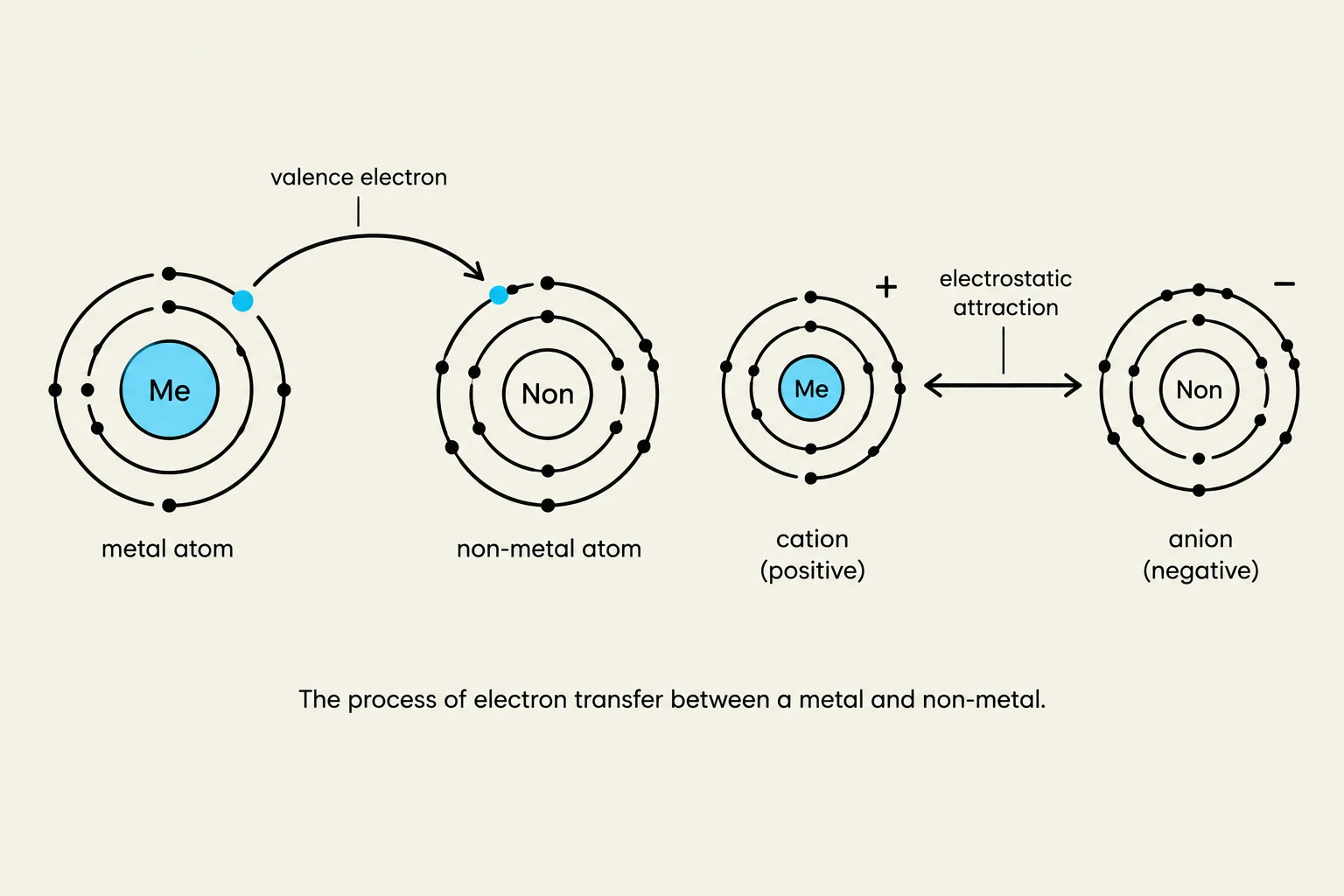
Diagram illustrating the process of electron transfer between a metal atom and a non-metal atom, resulting in the formation of a cation and an anion due to electrostatic attraction.
At the heart of an ionic compound is the ionic bond. This bond is not a physical "link" like a string, but rather a powerful electrostatic attraction between oppositely charged particles.
To understand how these bonds form, we must look at the types of atoms involved:
Metals: These elements typically have few valence electrons (the electrons in the outermost shell) and tend to lose them during chemical reactions.
Non-metals: These elements typically have many valence electrons and tend to gain electrons to achieve a stable configuration.
When a metal reacts with a non-metal, a transfer of electrons occurs. The metal "donates" its valence electrons to the non-metal. This movement of charge transforms the neutral atoms into charged particles known as ions:
Cations: These are positively charged ions formed when an atom loses electrons.
Anions: These are negatively charged ions formed when an atom gains electrons.
Because one particle is positive and the other is negative, they are drawn to each other like magnets, creating the stable ionic bond that holds the compound together.
Visualizing Electron Transfer with Lewis Symbols
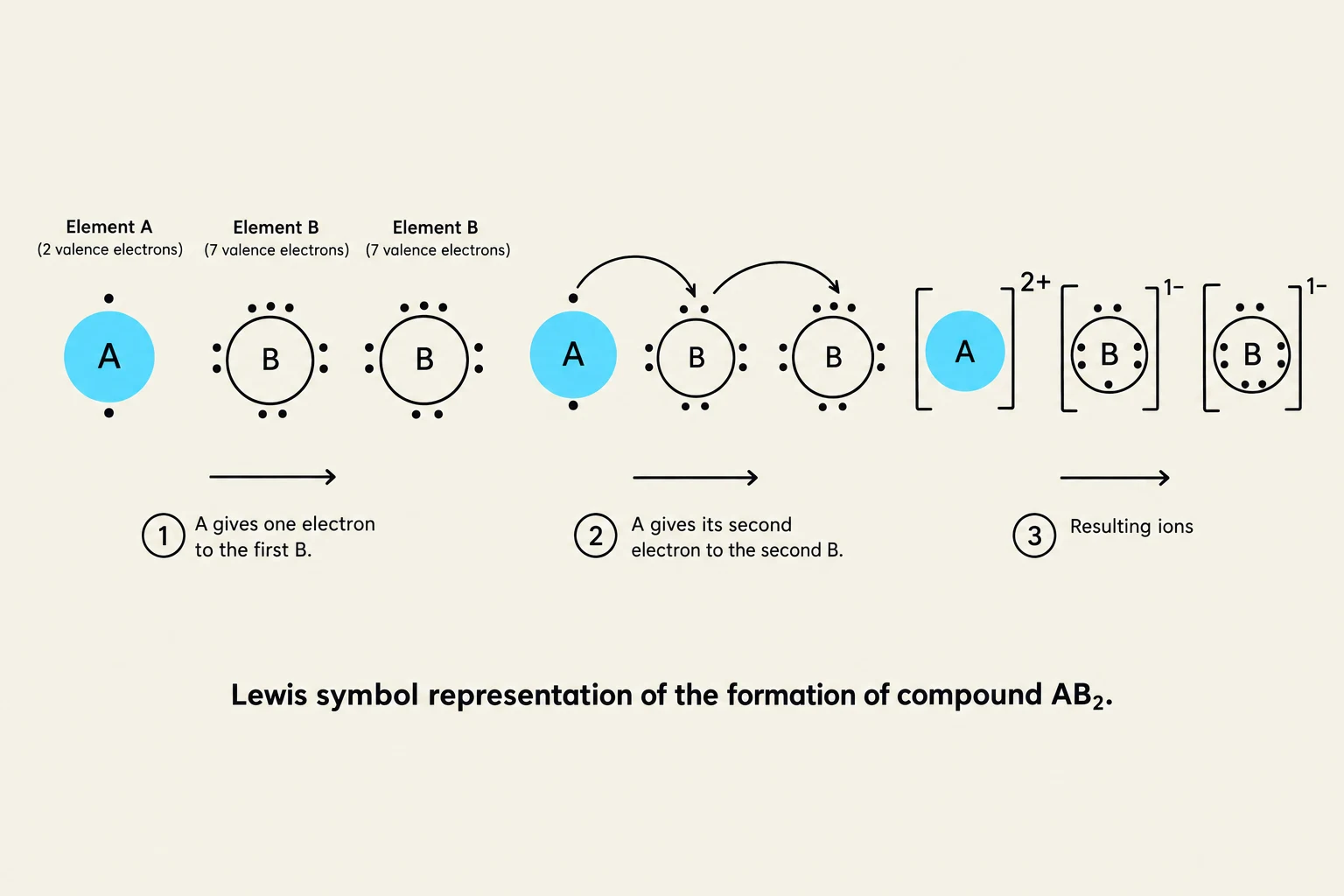
Lewis symbol representation of the formation of compound AB2, illustrating the transfer of electrons from element A to two atoms of element B to form ions.
Chemists use a shorthand tool called Lewis symbols to represent valence electrons and illustrate how they are transferred during bond formation. In a Lewis symbol, the element's symbol is surrounded by dots representing its valence electrons.
LEARNING TIP
As you progress through your chemistry studies, you will find that your definitions of concepts like "ionic compounds" may evolve. As you learn more about the underlying physics and mathematics, your understanding—and your definitions—will become more precise.
Worked Example: Predicting Compound Formation
Let's apply this logic to a hypothetical scenario to see how we can predict a compound's identity.
Problem:
Element A has 2 valence electrons. Element B has 7 valence electrons.
(a) Classify A and B as a metal or non-metal.
(b) Use Lewis symbols to show the formation.
(c) Write the chemical formula.
Solution:
Classification: Elements with very few valence electrons (like 1, 2, or 3) are typically metals. Elements with many valence electrons (like 6 or 7) are typically non-metals. Therefore, A is a metal and B is a non-metal.
Electron Transfer: To reach a stable state, Element A will donate its 2 electrons to Element B. However, since Element B only needs 1 electron to fill its shell, one atom of A will actually provide electrons to two atoms of B.
Ion Formation:
Atom A becomes A2+ (a cation).
Atom B becomes B1− (an anion).
Chemical Formula: To achieve electrical neutrality, the total positive charge must equal the total negative charge. We need one A2+ to balance two B1− ions.
The resulting chemical formula is AB2.
Physical Properties and Conductivity
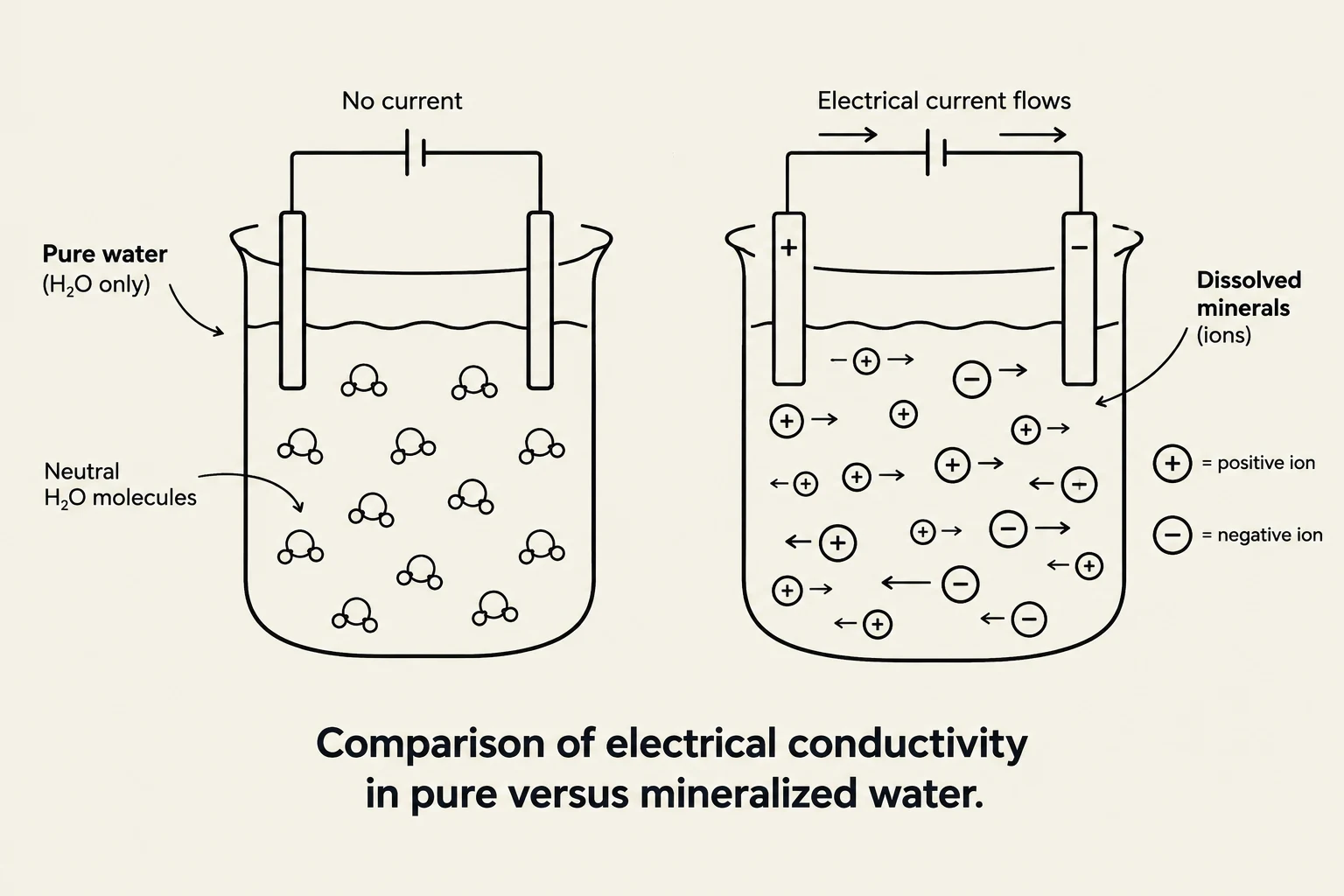
Comparison of electrical conductivity in pure versus mineralized water.
The strength of the electrostatic attraction in ionic bonds gives these compounds unique physical characteristics. While specific properties vary, they are all a direct result of the strong, multi-directional attraction between the cations and anions in a crystal lattice.
One of the most important distinctions in chemistry is how these substances conduct electricity.
IMPORTANT DISTINCTION
It is a common misconception that water is an ionic substance. Water (H2O) is actually a molecular compound. However, the presence of ions in water changes its behavior significantly.
Pure Water: In its pure form, water is a poor conductor of electricity because it lacks mobile charged particles.
Water with Dissolved Minerals: Tap water, lake water, and seawater are good conductors of electricity. This is because they contain dissolved minerals that break apart into mobile ions, which can carry an electrical current through the liquid.
Summary Table: Ionic vs. Molecular
Feature
Ionic Compounds
Molecular Compounds
Primary Mechanism
Transfer of electrons
Sharing of electrons
Constituent Particles
Cations and Anions
Molecules
Bond Type
Electrostatic attraction
Covalent bonds
Typical Elements
Metal + Non-metal
Non-metal + Non-metal
In conclusion, the identity of an ionic compound is determined by the specific ratio of cations to anions required to achieve electrical neutrality. By analyzing the valence electrons of the constituent elements, we can predict the chemical formula and understand the fundamental nature of the substance.
Keep reading for free.
Create an account to finish this reading and make it part of your study routine.